An early riser solves the problem of clattering dropboards
Issue 74 : Sept/Oct 2010
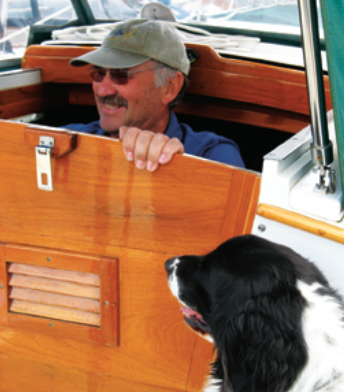
Gary Stoop built new teak companionway dropboards to replace the damaged ones that came with his well-used Ericson Cruising 31, Imagine. The replacements were simple and sturdy with good-looking louvers in the middle board to help ventilate the saloon, but they were heavy, cumbersome, and awkward to store when not in use. They also interfered with movement between cockpit and cabin. Their greatest drawback, though, was that, when lifting out the heavy boards first thing in the morning to row their faithful dog, Pepper, ashore, Gary often awoke his slumbering first mate, Brenda.
All this led to thoughts of hinged doors. Custom doors were beyond the Stoop budget so, if they were to have them, Gary would have to design and build them himself.
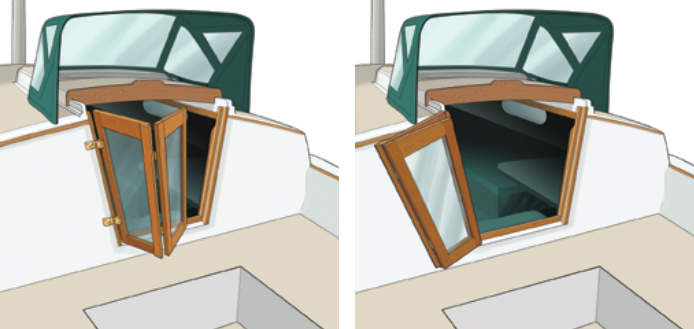
Since the companionway is offset to starboard, Gary decided on a bi-fold arrangement that would allow both doors, when open, to fold flat against the main bulkhead to port of the entrance, where they wouldn’t obstruct the seats on either side of the companionway. He could see it would take much trial and error to ensure the geometry of the finished doors would allow easy opening and closing while also giving the entrance the best possible appearance.
Gary started by making a 1/4-inch plywood pattern to match the shape of the dropboards and fit into the existing guides. He cut the plywood down the middle and used duct tape as temporary hinges. He then tackled each problem as it arose.
Angles and curves
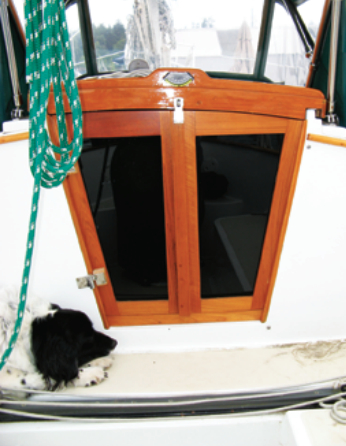
Because of the angle of the companionway opening, the plywood doors swung down and hit the bridge deck. Gary solved that problem by making a 3-inch high sill that fit into the bottom of the dropboard slot. Once he’d cut 3 inches off the bottoms of the doors, they cleared the bridge deck and folded flat against the bulkhead.
The framework of the doors would be built from a half dozen 1 x 2s left over from a teak anchor sprit he’d built previously (see “A custom anchor sprit” in the May 2010 issue). Because of the curve at the top of the sliding hatch, the top frame would have to be cut from a couple of short pieces of leftover 5-inch-wide teak.
Gary was concerned that he might not have the necessary skill or the proper tools to join the framing members, so he considered several ways of doing it. In the end, he joined the boards by a method suggested by a West System representative who described a corner detail that involved no dadoing, overlaps, or dowels such as might be used in more professional work. The boards meet each other on the flat.
First, Gary drilled holes in both pieces of teak slightly larger than the diameter of the screws he would use in assembly. He filled these holes with thickened epoxy resin.
When the epoxy had set, he re-drilled the holes to the appropriate size for 3-inch #10 flathead wood screws. He glued the contact faces with epoxy, set the screws, and plugged the holes over the countersunk screw heads. (Note: We’re not familiar with this technique but it seems the screws might be more secure in the epoxy-fi lled holes than they would be if driven directly into the end grain of the wood. –Eds.)
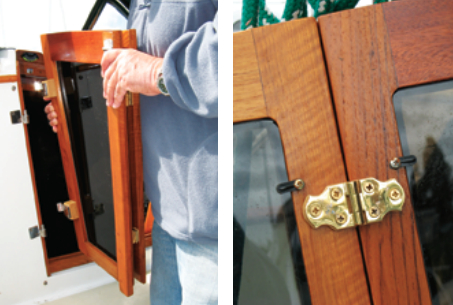
Next, Gary routered the 3/4 -inch doorframes to take inserts — one set is 1/4 -inch tinted Plexiglas and another is insect screen — that are held in place with vinyl turn buttons. A routered radiused corner added a touch of refinement. The doors fold on brass hinges that are offset on 1/4 -inch teak spacers to allow the doors to lie flat against each other. They swing on gudgeons and pintles. The gudgeons are mounted on teak spacing blocks to allow the doors to meet the frames properly. Gary worked out all these details on the plywood mockup.
Gary coated the teak frames with eight coats of Epifanes high-gloss varnish to match other teak work on the boat. The whole assembly is easily removed and can be replaced by those previously mentioned sturdy dropboards.
Imagine’s doors are so quiet in use that Brenda can enjoy a little more time asleep each morning as Gary and Pepper head for shore.
Richard Smith is a contributing editor with Good Old Boat. As well as sailing and writing about boats, he’s an architect, and he designs and builds very small houses. He and his wife, Beth, live in a house with a 16-foot beam and an LOA just a few feet shorter than their Ericson Cruising 31, Kuma, which they sail on the reaches of Puget Sound.
Thank you to Sailrite Enterprises, Inc., for providing free access to back issues of Good Old Boat through intellectual property rights. Sailrite.com