A stylish and well-built cruiser/racer
Issue 78 : May/Jun 2011
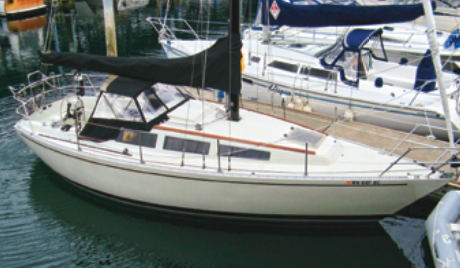
I stood at the top of the marine ramp in Edmonds, Washington, looking down at Greg Pearson’s S2 9.2A, Blast. My first impression was of a particularly well-kept 1970s cruiser/ racer with basically clean lines.
The “9.2” stands for 9.2 meters, which equals 29 feet 11 inches, just under the 30-foot length limit set by the Midget Ocean Racing Conference (MORC), a popular rating system in the 1970s. The 9.2 name lasted for many years until the builder changed it to S2 30, but by then it was too late: the 9.2 name stuck.
History
Leon Slikkers, who made his name building powerboats, founded S2 Yachts in 1974 to build sailboats in Holland, Michigan. He commissioned Arthur Edmunds to design the S2 9.2 and several other boats in the S2 line. (For a general background of the company, see the S2 8.6 review in July 2008.)
Arthur Edmunds’ best-known production sailboats are probably the Allied Princess 36 and Allied Mistress 39. His S2 9.2A (for “aft cockpit”) and the S2 9.2C (for “center cockpit”) have identical rigs and hulls. More than 700 S2s of both types were sold and they acquired a reputation for being well built.
Design
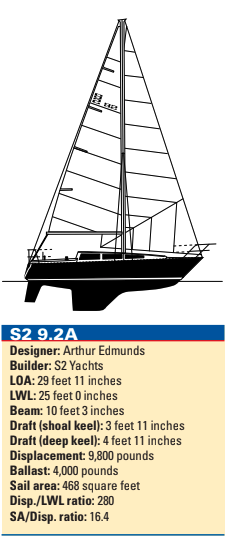
While Arthur’s Allied designs were full-keel cruisers, the S2 9.2 has a cruising fin keel, a spade rudder with a partial skeg, a moderately deep forefoot to reduce pounding, and a very fl at sheer that gradually rises forward. A shoal-draft option reduced draft from 4 feet 11 inches to 3 feet 11 inches.
With a moderate displacement/length ratio of 280 and sail area/displacement ratio of 16.4, the S2 9.2 is a capable coastal cruiser.
The design’s sloping deckhouse and swoopy inset Lexan portlights foreshadowed Euro-style design features that were to become established over the next decade or two. When it was introduced 30 years ago, the 9.2 had a distinctly modern appearance.
Construction
The hull is solid, hand-laid fiberglass with an inward flange at the sheer on which the balsa-cored deck is attached. Through-bolts and a fl exible adhesive bedding compound secure the extruded aluminum toerail, hull, and deck together. Any fender washers used in the mounting of deck hardware should be replaced with proper metal backing plates (see “Better Backing Blocks,” March 2010).
S2 Yachts resisted the industry trend toward molded interior liners, so the 9.2’s bulkheads and furniture are tabbed to the hull, usually on both sides of each surface, and contribute to the hull’s structural stiffness. Two tons of lead ballast is encapsulated in a well-sealed keel cavity.
For the most part, production boats of the 1970s used similar technologies and have generally held up well. But, as with any well-used boat of the era, the normal precautions apply: inspect the balsa-cored deck for softness, especially near chainplates, stanchions, and other deck fittings. Also check that the keel with its encapsulated ballast has remained watertight.
Hull blisters have been a problem with some 9.2s. Greg reports that the previous owner of Blast found blisters. In 1989, he had the hull dried out and blasted before applying an epoxy barrier coat. Blast has been kept in the water during the last six years and has been blister-free.
On deck
As Greg and I walked down to the dock, I had a closer look at Blast. She appeared to have nothing tacked on — the scourge of many less-than-good old boats is the assortment of unmatched and conspicuous bits and pieces of gear and fittings they acquire over the years. In fact, it was hard to believe this boat was launched 34 years ago.
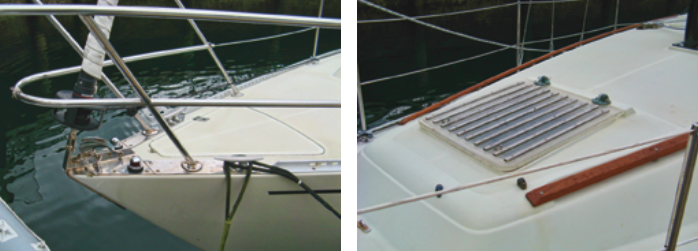
The quality of Blast’s gelcoat surfaces is immediately apparent. They are generally free of stress cracks even where they are tightly curved, and her non-skid surfaces seem on par with other boats of the era. Her substantial hardware is of a size and quality that is unlikely to necessitate an upgrade. She has 8-inch bow cleats bolted through stainless-steel deck-mounted chafing plates. These fittings incorporate the navigation lights and chocks as well. A hinged and flush-mounted anchor-locker lid and an acrylic forward hatch with teak non-skid strips are neatly and unobtrusively integrated into the deck molding. There’s nothing here to trip the foredeck crew or snag lines.
Well-detailed “no-trip” teak handrails extending from the cockpit to the bow are mounted on fiberglass spacers.
Blast’s black cove stripe accents the black canvas in her largely transparent dodger and well-tailored sailcover. The overall effect is a well-coordinated and good-looking boat.
The cockpit
The T-shaped 8-foot cockpit works well, with the mainsail sheeted abaft the 28-inch destroyer-type steering wheel, where it is out of the way and easily handled by the helmsman, along with the traveler lines and backstay adjustment wheel. The 8-inch stern cleats are mounted on stainless-steel chafing pads, an arrangement similar to that at the bow. The helmsman’s seat on an S2 9.2 is separated from crew working at the winches, and Greg reports that this makes tending to headsail sheets and roller reefing a bit of a tussle when he’s singlehanding.
The winches are by Lewmar. Two #40 two-speed sheet winches and two #10 single-speed winches are mounted on the coamings. Other running rigging is led aft to the cockpit. The main halyard is handled by a #10 winch on the starboard side of the companionway, while jib and spinnaker halyards are taken care of by a #10 to port.
The starboard seat locker opens to reveal general stowage and access to the stuffing box and engine controls. Two lockers under the helmsman’s seat provide additional stowage.
The rig
The S2 9.2 is a masthead sloop with a high-aspect-ratio sailplan. Blast’s 208-square-foot full-battened Lidgard mainsail sets very well. A 150 percent genoa adds about 352 square feet for a total of 560 square feet.
The mast, a black-painted aluminum extrusion, has a single pair of airfoil spreaders. It is stepped on deck and a strong post integrated within the main bulkhead carries the compression load to the keel. There is a mechanical adjuster for the backstay. Mast height above the water is 43 feet 6 inches.
In addition to main and headsail sheets, running rigging includes an outhaul, downhaul, halyards, reefing lines, and a Cunningham. Headsail sheets are led through snatch blocks that can be easily moved about on the slotted aluminum toerail.
Belowdecks
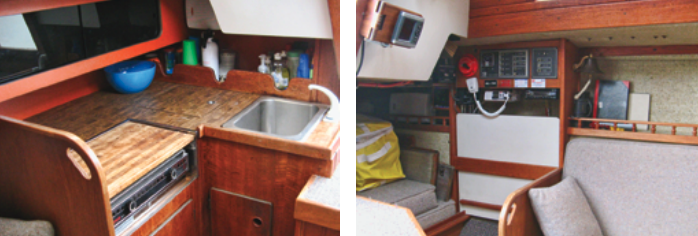
The S2 9.2 has a translucent acrylic sliding companionway hatch with teak handholds inside to either side. The engine enclosure provides a wide, deep, and carpeted first step down to the roomy and well-appointed cabin. Teak-veneer plywood and solid teak trim are used to a considerable extent throughout the boat.
Immediately to port, the entry to a quarter berth doubles as a navigation space. When used for navigation, a table pivots down and a seat folds up from the side of the engine box. When not in use, the table is stowed against the hull side and a cushion takes its place. The electrical panel, with circuit breakers and a battery-condition meter, is located above the nav table. A lockable master battery switch is next to the panel and a VHF radio is below it. Greg has a Garmin 300C fish finder/depth sounder mounted on hinges so he can view it from the cockpit.
Opposite the nav station, a small L-shaped galley contains a small sink with pressure cold water, an icebox,
and an Origo alcohol stove. Headroom is 6 feet 3 inches in this area, gradually dropping to about 5 feet 10 inches at the entry to the forward cabin.
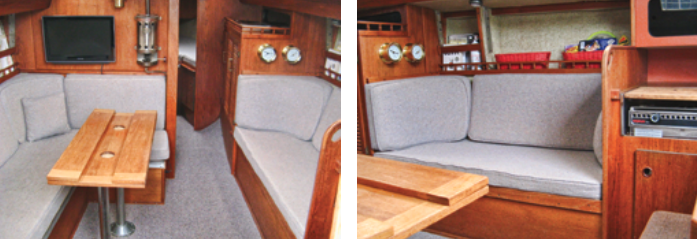
Immediately forward, a table and settee to port — that convert to a double berth — and a 6-foot 6-inch settee berth to starboard provide a well-thought-out eating, lounging, and sleeping area. The table has leaves that hinge on top, offering a choice between large and small surfaces. Along with its pedestals, it’s removable and can be stowed near the quarter berth.
On the port side of the main bulkhead, Greg mounted a flat-screen TV on a movable arm so he can swing it away from the kerosene Force 10 heating stove.
Carpet is laid over the fiberglassed plywood sole and S2 used a carpet-like polypropylene fabric as a hull liner. It was treated to be mildew resistant and contact-cemented to the hull. While a benefit of this liner is easy access to through-bolted deck hardware, over the years the fabric has become faded and blotched with mildew stains, a detraction from an otherwise handsome interior and one not easily put right.
There is an ample head with a vanity sink and shower drain across from a large hanging locker in the area between the saloon and the forward cabin’s 6-foot 4-inch berths.
The engine
I had an Atomic 4 many years ago and had forgotten what a good shipmate it can be: quiet, smooth-running, and without a lingering trace of diesel odor. Greg maintains the engine, keeping a close check on everything to ensure good running order and safety.
Gasoline fumes are heavier than air and can lie in the bilge waiting to turn a good sailing day into a disaster. Like a propane stove, a gasoline engine demands the utmost respect. Greg ran the blower for five minutes and took some good sniffs at the blower vent and deep into the locker before he fired up the engine. We motored over to the gas dock to meet the chase boat and begin our trial sail. With its two-bladed 16 x 8 right-handed prop, the boat handled well in tight quarters, backing predictably and stopping just so.
Many 9.2s were fitted with Atomic 4s during 1977 and 1978. Later boats were delivered with a choice of a 2-cylinder Yanmar or Volvo diesel. Since then, some owners have replaced these smaller engines with 3-cylinder 23-hp Yanmars in the quest for more power. Blast has an 18-gallon fuel tank and burns about 3/4 gallon per hour. Cruising speed is about 5 1/2 to 6 knots. Greg finds the Atomic 4 to be entirely adequate for the cruising he does, in spite of the strong currents, often strong winds, and steep chop of Puget Sound and the islands to the north.
Under way
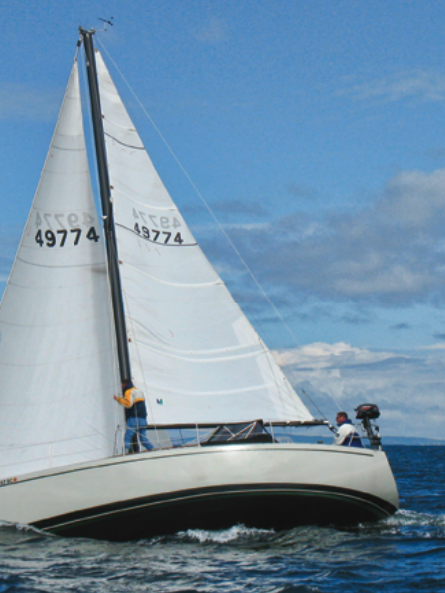
We pulled away from the gas dock and headed into the Sound. The wind was a steady 15 to 17 knots, gusting to 20. Greg and Bret Hart, who helped crew, hoisted the full-battened mainsail and let out the 150 percent genoa. Without much headway we heeled sharply, but as she gathered speed Blast picked herself up and we accelerated smartly, beating to windward before going off on a close reach. We made a rollicking 5 or 6 knots in 2-foot waves and the boat was absolutely dry.
We were heeled well over, however, so Bret rolled in the genoa to about lapper size. We were still heeled well over and I thought we’d be better off tucking a reef in the main, but the skipper thought otherwise. Weather helm increased strongly with the gusts but the boat was always manageable, tracking well in spite of the lumpy seas and considerable wakes of ferries and container ships. I reckoned that reefing the 9.2 for speed and comfort is a serious consideration at about 15 knots, maybe 12.
Conclusion
The above-average condition of Greg’s boat may have skewed my overall view of the S2 9.2. Most boats over 30 years old will more than begin to show their age, but not so with Blast.
The 9.2A’s good looks topside — the smooth sweep of deck and the absence of non-essential gear — make the boat seem more of a racer than a cruiser. In fleets across the country, PHRF ratings range from 180 to 201 seconds per mile. For comparison, a 1970s-era Pearson 30 is 174 and a Catalina 30 is 180 to 192.
Blast’s interior is well organized, serviceable, and tasteful. The only conspicuous exception to this, as mentioned, is in the builder’s use of carpeting glued to interior surfaces.
Apart from the appearance of the 9.2A, the sailing performance is a high spot. It may be a bit tender when compared to other 30-foot cruiser/racers, but this is difficult to judge as weather, sea conditions, and sailing practice vary.
The S2 9.2s seem to hold their value. After 30 years, condition is everything. Other things being equal, an Atomic 4 may detract from market value, but Greg believes Blast would sell for about $20,000 to $22,000, perhaps a couple of thousand less than a boat fitted with a diesel.
Richard Smith, a contributing editor with Good Old Boat, is an architect. He specializes in designing and building very small houses and has built, restored, and maintained a wide variety of boats. These days, he and his wife, Beth, sail their Ericson Cruising 31, Kuma, on the reaches of Puget Sound.
Thank you to Sailrite Enterprises, Inc., for providing free access to back issues of Good Old Boat through intellectual property rights. Sailrite.com