Taking comfort in a little added weight
Issue 80 : Sept/Oct 2011
When sailors get together and talk boats, the topic invariably shifts to anchoring. What follows is a steady stream of stories about lousy anchorages, types of tackle, techniques, close calls, chain versus nylon, and so on.
Sailors live with the nagging fear that their best plans might not be good enough or, worse, will be undermined by someone else without the right gear or knowhow — or either of them. Too many times we have arrived early at an anchorage, sought out a secluded and secure spot, and dug in Ariel’s anchor only to have some Johnny-come-lately zip into the harbor (often at hull speed) and drop his hook and a pile of rode on top of it, without bothering to consider scope, swing radius, or backing on the anchor.
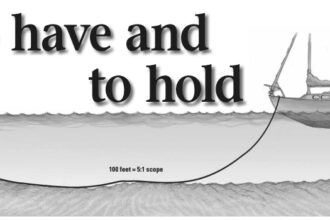
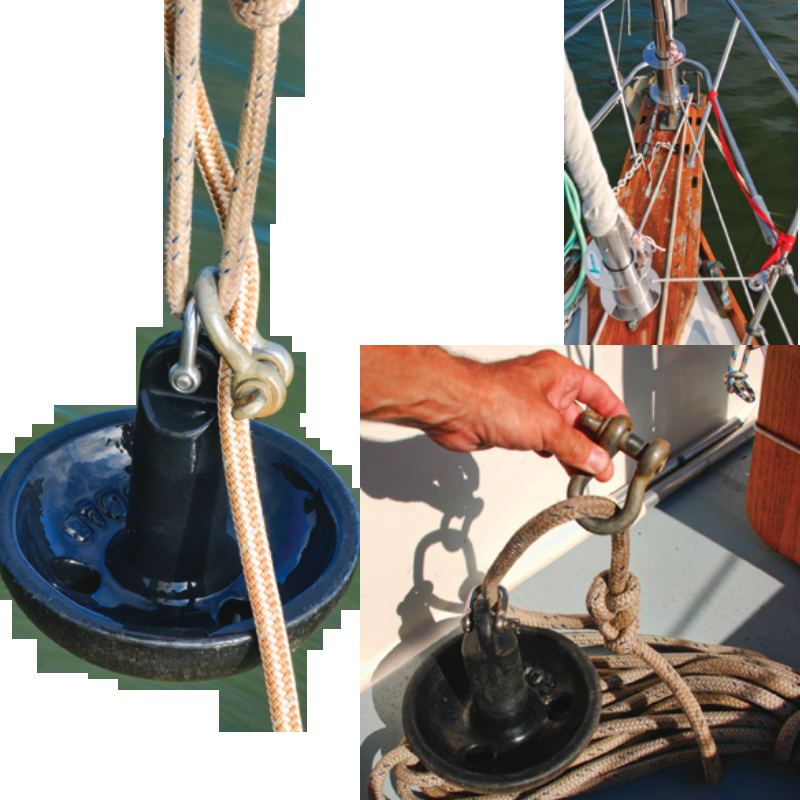
In an attempt to do our part as responsible sailors, we experimented with a new technique during our month-long summer cruise of 2010. The technique, well-known in cruising circles, is an easy way to gain better holding and decrease the swing radius (to a point) without using an all-chain rode or a heavier anchor. The secret is a kellet, or sentinel. Whatever you want to call it, it’s a heavy hunk of something — chain, lead, or steel — that rides down the rode controlled by its own messenger line.
Kellet math
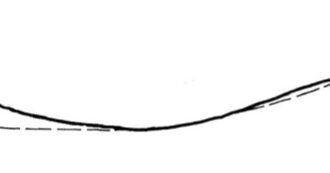
The theory is that the kellet increases the catenary, or curve, of the rode. This decreases the upward pull on the anchor and increases the lateral pull, providing better holding. The effect is the same as if you increased the scope. The catenary effect is more pronounced in a heavy chain rode than a rope rode, which is why many sailors prefer chain (in addition to its abrasion resistance). The added strain on the back is also more evident with all-chain rode, especially if you don’t have a windlass. The kellet mimics the characteristics of an all-chain rode but without requiring you to heave three times as much weight aboard. The handy messenger line allows quick retrieval of just the kellet. Once it’s aboard, you then haul in the rode and anchor.
There are several purpose-built kellets on the market. One is the Anchor Buddy, which is made in 20- and 30-pound weights and sells for $280 to $350. I have no experience with the system, but it appears to be well designed. Preferring a cheaper alternative, we picked up a 20-pound plastic-coated mushroom anchor from a local marine store for less than $20. With a couple of shackles and a length of line we had on board, we were ready to go.
Easy to use
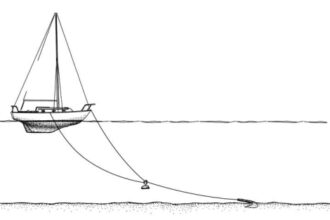
Adding the kellet to your anchoring system doesn’t require you to modifiy your standard anchoring technique, nor does it require any further specialized (or expensive) equipment. Simply anchor as usual, shackle the kellet to the rode, let it slide down the rode until it’s halfway to the anchor, and cleat its retrieval line on deck.
A variation involves sliding the kellet down the rode only until it rests on the bottom, rather than sending it halfway to the anchor. In moderate conditions, this approach keeps the boat sitting over the kellet, further reducing swing radius. Once the wind picks up, however, the boat will stretch the rode and swing within her full radius. The kellet will dampen swinging and bouncing when wind and waves increase.
During our month-long summer cruise in 2010, we used the kellet every time we anchored. We also tried it in different configurations: located halfway along the rode; located 15 feet from the anchor; resting on the bottom at a distance roughly equal to the depth. We found that the most difficult configuration to handle was when the kellet was placed 15 feet from the anchor, because this required hauling up that much chain, the 20-pound kellet, and the 44-pound Bruce anchor together.
Although we’ve never had issues with the Bruce dragging, we certainly slept more soundly knowing that any movement would be more likely to dig the anchor in deeper than it might otherwise do without the addition of the kellet. It was a small price for a lot of peace of mind.
David VanDenburgh started sailing with his parents at the age of three and has been afloat ever since. He’s now introducing his young sons, Jakob and Joshua, to the world of sailing. A high school English teacher, he maintains and sails Ariel, his family’s Cape Dory 36, on Lake Michigan.
Thank you to Sailrite Enterprises, Inc., for providing free access to back issues of Good Old Boat through intellectual property rights. Sailrite.com