Making canny use of nooks and crannies
Issue 80 : Sept/Oct 2011
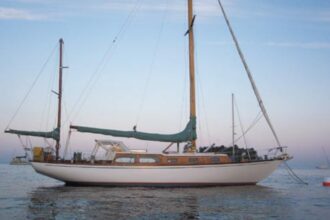
My 37-year-old Cape Dory 28, Nikki, has been my home for five years. We swing on a mooring in Boca Ciega Bay near Gulfport on the midwestern coast of Florida. In 24 years (not consecutive) of living aboard boats, I’ve learned that I always have too much stuff and too little storage space, but I’ve always dealt with it with discipline and ingenuity.
The Cape Dory 28 was not intended to be a liveaboard nor ocean passagemaker; there was (and still is) very little market for such boats. Nikki was designed as a weekender for a couple with two kids . . . and that she did superbly. She also turned out to be an outstanding performer, winning West Florida’s Cruising Boat of the Year for 2010 in a 16-race series, including first overall in the prestigious Michelob Cup in the Tampa Bay area. But as a floating home, she was severely lacking in storage space and other amenities.
My work to improve Nikki’s galley began immediately after I acquired her. As a retired yacht designer, I was aware that a major failing in stock boats is the poor use, or no use, of upper portions of potential storage spaces. That’s much like having a home clothes closet without a top shelf. This was an obvious starting point. Another shortfall is the lack of use of oddly shaped spaces. As these would be extremely costly to improve on the production line, their use would result in pricing increases. Nikki suffered from both maladies.
The port cavern
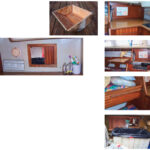
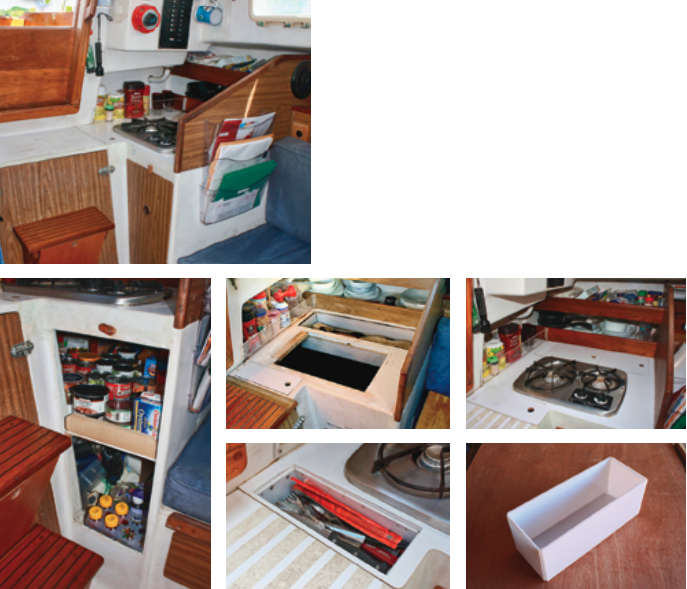
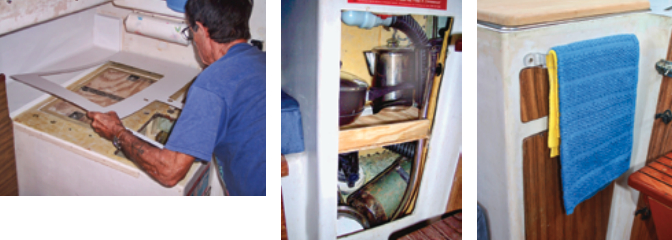
Beneath the countertop stove, her port galley counter enclosed a huge storage space 20 inches wide by 32 inches long by 30 inches high. A very small door facing inboard made it impossible to reach fully into the compartment. By some careful surgery with a right-angle cutoff tool, I was able to almost double the size of the door. I had some matching material to fabricate a new door, and in less than a day I had full access to an otherwise largely useless cavern. I was actually able to crawl fully inside the space to sand and paint. The next job was to design and construct shelving that virtually doubled the utility of this precious asset.
New stove, counters, and bins
Nikki’s ancient, inefficient, and rusty original stove was an alcohol two-burner, countertop style. I replaced it with a new stainless-steel LPG double-burner stove purchased from an online RV accessories dealer for less than $200. This required reshaping the countertop cutout to receive the stove and installing the LPG tank and its plumbing.
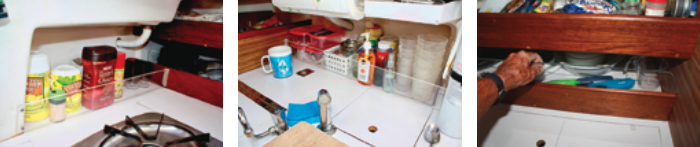
While I was at it, I realized there was a lot of unused upper interior counter space. I designed and installed several countertop bins with finger-lift covers for cooking utensils and silverware. Since the builder had made no provision for galley drawers, the new bins more than made up for this lack of space. I based the new bins on boxes made of thin, but very strong, polycarbonate plastic (Lexan is the best-known brand) suspended from beneath the countertop, each with covers to match the Formica counter surface. To avoid complicated, space-sacrificing construction, I made the boxes by bending the polycarbonate with a special heat strip. These bins have vastly changed my life aboard.
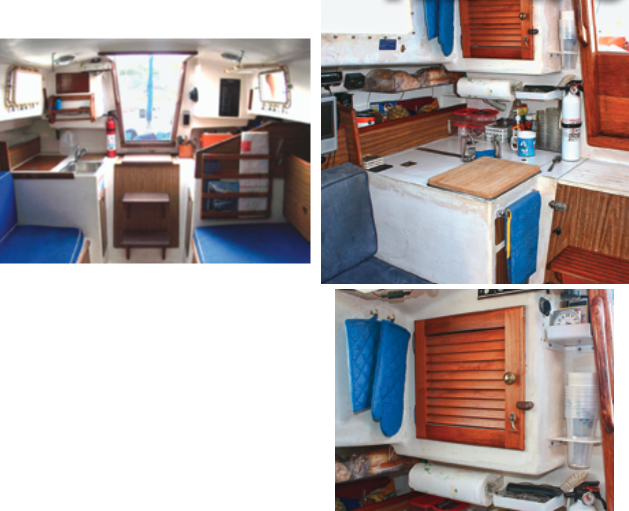
I enjoy working with sheet plastics, so I also made several small shelves and brackets to occupy oddly shaped spaces that were left totally unused. One bracket accommodates the signal horn that is now conveniently accessible from the helm. Another bracket holds plastic and paper cups just over the galley sink. Above that is a small polycarbonate shelf to hold an alarm clock, racing timer, and another small timer that awakens me when I have fallen asleep while watching television. Another little shelf is home to my collection of sun and reading glasses. I replaced a gaudy and space-gobbling teak paper-towel holder with a compact and nicer-looking clear-acrylic one.
A major improvement came from an unexpected place: the interior molded-fiberglass enclosure for the backs of no-longer-used electronic sailing instruments. I patched the holes in the aft side of the cabin trunk, lined the interior of the space with mahogany, and installed a louvered teak door. The space is now a large and attractive food and condiment cabinet.
Icebox
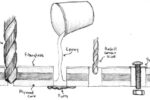
Nikki’s original icebox was pathetically inefficient with a melt rate of almost one pound of cube ice per hour. In a grueling month of messy and complicated work, I added a lot of closed-cell polyurethane insulation (plank and two-part poured) and a new Formica-lined interior. This increased the box’s efficiency by a factor of five. In some places, the insulation thickness now measures 9 inches and the average thickness overall is 5 inches. I gained the first 2 inches by reducing the box interior by installing plank “space foam” that’s available at large home-improvement chain stores. It’s the same stuff used to insulate the International Space Station. Even though adding insulation resulted in a loss of icebox volume, it more than makes up for it with the need for less ice. I replaced the original solid-teak box lid (teak is not an insulator) with a highly efficient closed-cell space-foam lid, covered it with fiberglass, and finished the countertop to match. In addition, I installed a drain loop to prevent cold air from escaping through the icebox water drain.
Nikki now has a 12-volt condenser/evaporator-type refrigeration system capable of making ice and freezing food, something I only rarely do. I would not have considered installing a refrigerator without first improving the efficiency of the box. I also fitted the new icebox with polycarbonate divisions and a removable food tray.
During the icebox rebuilding project, I was able to fashion a very handy, shelved counter cabinet to store pans, coffee makers, and a Thermos jug. The cabinet is also home to the depth-sounder transducer.
Retention fiddles
Two relatively unused countertop spaces on each side of the galley became valuable and accessible simply by installing 1/4-inch clear-polycarbonate fiddles to prevent dish detergent, hand soap, small storage containers, and my instant coffee from moving around when the boat is under way. I then added another longitudinal polycarb fiddle extension to a fixed teak fiddle to prevent my dishes from “jumping the fence” when we’re sailing to windward in heavy weather. This extension can be put in place and removed when not needed in only a second.
When Nikki is sailing to weather or dealing with big seas, I keep pots and pans in place on the stove by using small C-clamps as adjustable fiddles.
Companionway steps
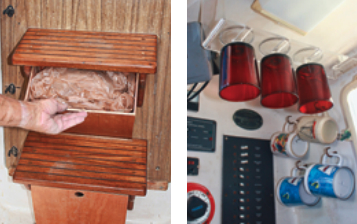
The companionway steps provided more unused spaces. I hate hanging garbage bags in my boat, so I fabricated a teak-faced plywood trash can that fits perfectly under the lower step without interfering with foot room. Under the upper step, I installed a retractable teak bin as the storage space for the plastic shopping bags I use for transporting garbage. Small strips of stick-on Velcro keep the bin and trash cans securely in place.
Further storage
When I bought Nikki she was like an uncut gem. Her previous owners had made little attempt to improve anything. There was no means for storing cups and mugs. I solved that by installing brass hooks over the port galley counter at a cost of about $2. I have added custom-made clear-acrylic glass holders to the cabin overhead for storing the French ruby glass tumblers and wine glasses I’ve been sailing with for more than three decades.
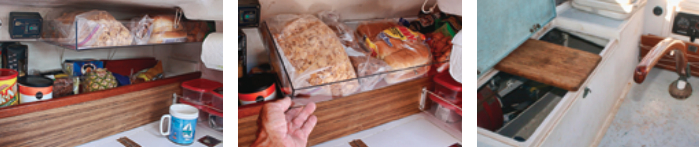
On the starboard side, over the icebox, I made and installed a clear polycarbonate drop shelf, where I keep breakfast cereal, cookies and munchies, rolls, and other bread products. It contains food that I access every day in more than 1 1/2 cubic feet of otherwise unusable space.
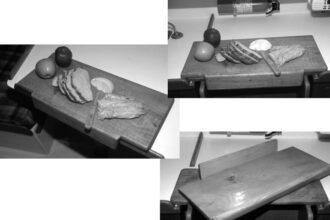
I bought a bamboo cutting board. It doesn’t warp like the more common edge-glued hardwood boards. This cutting board adds work surface by fitting securely over the galley sink. It also serves as a cockpit jump seat that allows me to turn my legs and torso forward when I’m at the tiller, rather than twisting my body for long periods.
I fastened to the starboard inboard face of the galley a very small but tidy dishtowel rack, homemade of 1/4-inch polycarbonate scrap. Any purchased towel rack would have been more than twice as large.
Sink and cooking improvements
Finally, I tapped into the freshwater piping and installed a countertop dish sprayer in addition to the galley water faucet. Then I installed a small tap for dispensing ice water produced in the refrigerated icebox. This eliminated the need to buy and store bottled water that took up valuable space in the icebox. It also ended the practice of keeping and refilling empty water bottles.
When laying down the new Formica on the galley countertops, I had to remove the original teak fiddles. Their replacements will be removable so I’ll gain some working surface when not under way.
Nikki has a small 1,000-watt microwave oven suspended under the port sidedeck in the saloon. My 12 VDC to120 VAC inverter is able to run the microwave and my large hand tools, but I nevertheless run the engine for the short periods when the microwave is in use to support the battery load. I also have a small crockpot that plugs into Nikki’s AC system and is powered by the inverter or dockside connection.
A dollhouse
When planning your own galley improvements, imagine that your boat is a child’s miniature house like those you’ve seen in backyards. You don’t necessarily have to eliminate interior features, but scaling down the size of furnishings is very practical.
Production-boat manufacturers were usually forced by the marketplace to deliver the bare necessities in order to keep their prices competitive. But you don’t have to leave it at that. Your own time and ingenuity will be well spent when improving your galley’s utility. Each improvement will add to the convenience and enjoyment of your days aboard.
Bruce Bingham began sailing before he could walk. As well as being a prolific sailing writer, illustrator, and photographer, he has designed more than 40 boats, the Flicka and the Fantasia among them. Although no longer in print, his book, Sailor’s Sketchbook, has been selling for 30 years. Bruce lives aboard his Cape Dory 28, Nikki, moored near Gulfport, Florida.
Thank you to Sailrite Enterprises, Inc., for providing free access to back issues of Good Old Boat through intellectual property rights. Sailrite.com