Compassion for the lost transcends species
Issue 82 : Jan/Feb 2012
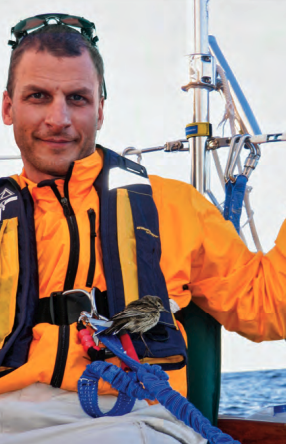
Once, for two nights and a day, in the middle of the Sargasso Sea, I made an unlikely friendship with a castaway bird. He was no bigger than my fist. Gray, mostly. Some black. With his ruffled feathers and seemingly low in energy, he looked a bit travel weary. He landed on our sailboat, hopped around the cockpit, then snuggled himself into a corner between the cabin bulkhead and the cockpit coaming board.
And there he sat, no raven on the bust of Pallas, merely a sparrow in the Sargasso.
The three of us on a Bristol Channel Cutter 28 bound for Bermuda marveled at the little fellow. Was he lost or just taking a break from his regular migration? And if he was migrating, was it normal to be undertaking such a huge journey alone?
We assumed the bird would be with us for a short while and fly off again. But moments turned to hours and he was still aboard. As sailors, who now assumed we had an ailing stranded soul on board, our attention sharpened to nurturing him. We fretted for a while over appropriate food, knowing that rice was deadly but unsure whether crumbled crackers were safe.
We settled on the crackers and a dish of water to wash it down. And indeed, our feathered mate pecked with gusto.
Article 98 of the United Nations Law of the Sea states that any ship shall “in so far as she can do so without serious danger to the ship, the crew, or the passengers . . . render assistance to any person found at sea in danger of being lost.”
It is a deeply unifying humanitarian agreement in our world of differing political and religious beliefs, and one that acknowledges the common necessity of survival over all else. Feeling particularly righteous that we had abided by this international agreement, which in this case applied to inter-species assistance, we bid our friend goodbye, coordinated our night-watch schedule, and fetched into the darkness on a broad reach.
I was awakened shortly before 0300 to assume my three-hour watch. As I climbed the companionway and clipped my harness to a tether before entering the cockpit, I discovered the bird was still with us, and still tucked into his wind-sheltered corner.
Being at sea, alone on deck under a black sky with more stars than you can imagine, night after warm night, you undergo a change. It is a change you can only experience when removed from all human influence. I suppose desert walkers experience it, and I’ve heard astronauts talk of similar feelings. You become aware of how small you are. What a tiny speck you are on the outer skin of this enormous planet in an infinite universe. And yet, this realization is not frightening. In fact, quite to the contrary. You become overwhelmed with a profound sense of appreciation for the good fortune you must have to be part of this world, this existence.
In the midst of this vastness, here comes another life, a tiny bird, and he forms a relationship with us. A relationship he would certainly never choose if we were each among our own. But out here, in the solitude, there comes the necessity to risk dependence on something as fearful and risky as “the other.”
You cannot help but feel touched by this vulnerability and the courage it takes, even if driven by desperation, to trust.
And now imagine my awe, as I sat in my corner of the cockpit, watching my friend, when he hopped over and fluttered up to sit in my lap.
The bird sailed with us for another day and a night. He shared our meals and company. And on the third day, more chipper, he flew around the cockpit, then up around the boat, and then was off on his way.
Though it has been many years since, I still think about that bird every now and then. And I hope I always will. I sense there is still much to be understood by thinking about our encounter.
Mathias Dubilier is a writer. He is cruising aboard his Hans Christian 33 in the Mediterranean and expects to spend this winter in Turkey.
Thank you to Sailrite Enterprises, Inc., for providing free access to back issues of Good Old Boat through intellectual property rights. Sailrite.com