Issue 84 : May/Jun 2012
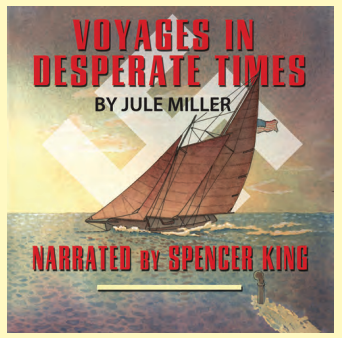
Editor’s Note: We hope you enjoy these excerpts from Jule Miller’s Voyages in Desperate Times. It is a historically based novel about the Coast Guard Picket Fleet, aka the Hooligan Navy, that patrolled the U.S. East Coast during the early days of World War II. In it, Nick Worth, who had been the skipper of one of the sailboats commandeered for wartime service, relates his long-repressed recollections of those times to his granddaughter as she drives him to the funeral of an old friend. In the first excerpt, Nick reminisces about how he joined the Hooligan Navy. In the second, he talks about the first war patrol of Fourteen Boat (formerly the Tiger Lillie). In the third excerpt, he and his six-man crew encounter a force 10 gale and a U-boat.
February 1942 (U.S. Coast Guard Base, New London, Conn.)
“Lieutenant, what’s going on here? Just what is the Coast Guard Picket Line and why is it interested in a 54-foot Alden schooner?”
The officer replied, “. . . In January we lost 31 ships to U-boats right off our coast: nearly 200,000 tons. This month is going to be worse. We just lost a tanker off Block Island about an hour ago. The Krauts either had a bunch of subs waiting right off the coast for the Japs to hit Pearl Harbor, or they sure got over here quick. You need small, handy vessels to hunt subs, but if it doesn’t have at least 8-inch guns or a flight deck the Navy doesn’t want to have anything to do with it. Last year, the president gave the Brits 50 old destroyers and 10 of our cutters, and that didn’t help either. . . Nothing the Navy is doing seems to help, so they have come up with the perfect solution from their point of view. Since most of the sinkings are happening right off our coast, it must be the Coast Guard’s problem. . . We’ve been commandeering every boat that might be even halfway suitable. You saw Nightingale down at the dock? The Number Twelve Boat?”
“The commuter yacht?”
“Yeah. Fast and seaworthy in reasonable conditions, except she’ll roll your guts out in a seaway and those Packard engines give her a range of not much over 100 miles. By the time she gets to a patrol area, she has to come back. We need patrol craft that can go out there, stay on station, and handle rough weather.”
“Are you telling me that you’re going to send sailboats like Morning Glory out into the Atlantic to fight U-boats? Sir, if you don’t mind my saying so, that’s nuts.”
“Not to fight them. To spot them, radio their position, and rescue any survivors they can find. Mainly rescue survivors. How would you like to be on a Carley float on a night like this? The hope is that the U-boats won’t think some dinky sailing yacht pulling people out of the water is worth bothering with. If the picket boat spots a U-boat, we have aircraft, blimps, and our few cutters and Navy destroyers ready to come running, but they’re stretched way too thin.”
“Lieutenant, tell me honestly what you think of this idea.”
“Other than having them out there to rescue survivors, it may very well be nuts, but these are desperate times that demand desperate measures, and no one has come up with anything better. Besides, I understand that the president is behind it. The rumor at the Treasury Department — we were part of the Treasury until the first of last December when they transferred us to the Navy — is that Churchill suggested it to him because of the great job the British yachts did helping get the army off the beaches at Dunkirk. Ignore the fact that the English Channel in summer is not the North Atlantic in winter.
“Anyway, when we started this effort we were only supposed to look at boats over 80 feet, but the 1930s were not a good time for the maintenance of big yachts. Most of them spent years hauled out in boatyards wearing For Sale signs while rainwater leaked through their decks to feed mildew and rot spores.”
“Like Morning Glory.”
“Like Morning Glory, but we’ve found a sister ship that’s sound.”
“She’s only 54 feet on deck, sir.”
“Sixty-four feet with the boomkin and bowsprit. Look, the captain, my boss, is down at a boatyard in Nyack on the Hudson River right now. They built wooden sub chasers in the last war, but after the war the government stuck them with the last three boats they had under construction and refused to pay them. He’s trying to get them to build some patrol craft for us. But until something like that comes along, a picket line of commandeered yachts is the best we’ve got. Worth, the Japs are running riot in the Pacific and we’re well on the way to losing the Battle of the Atlantic. We could lose this war. We have to get that through our heads. And if we do lose, God only knows what the world will be like then.”
“I know what it will be like, sir. I had a glimpse of it in Germany in 1936.”
February 1942 (South-southwest of Montauk Point)
That evening the wind veered into the southeast so they were on a close reach by midnight when Nick, after again plotting their DR position, climbed into his bunk, hoping to get a couple of hours of sleep. He had just nodded off, still thinking about what to do with his seasick cook, when Borg shook him. “Skipper, I just got an Operational Immediate with our call sign.” Nick dragged himself to consciousness. “Huh? What? Operational immediate? Us?”
“Skipper, are you awake? Should I read it to you?”
“Yeah, yeah. What’s it say?” He swung his legs out of the bunk and sat up.
“ ‘Operational immediate. Aircraft reported oil slick at 1820 hrs. EWT, 22 February 42. Bearing 115 True, distance 72 miles from Ambrose Buoy. Investigate.’” It’s signed with Commander Newton’s code group for the present date and time.”
By then Nick was bending over the chart table. “115 True?”
“115 True, 72 miles from the Ambrose Buoy.”
“That’s 22 miles southeast of us.” He moved his parallel rule to the compass rose, then wrote 143 Mag on a piece of white adhesive tape, stepped into his sea boots, and went up the ladder into the cockpit. Over his shoulder he said, “Send: Will comply.”
Langdon and Snow were on watch. “Bring her up onto the wind, Snow. Try for 143 degrees magnetic, but I don’t think she’ll sail nearly that high.” Nick started to haul in the mainsheet and Langdon did the same with the foresail as Jenks appeared in the hatch and went forward to tighten the staysail.
The boat’s motion changed radically. Instead of lazily working her way up and over the ground swell and the waves that were running with it, she now heeled down and began to fight her way up each swell and through the wind-driven waves on top of them. Nick checked the compass. She was sailing a little bit better than due south, but not much.
Jenks came into the cockpit. He was wearing his oilskins and Nick wished he had taken the time to put on his own. Spray was now being blown aft in sheets. “If she has to fight her way through this stuff, Skipper, she’s gonna need more sail to do it.”
“Yup. Set the jib.”
Longo had also come on deck without being called. He, too, was wearing oilskins. Jenks said to him, “Come on, Joe. You can help me fall off the widow-maker.” The jib was hoisted from the end of the bowsprit that was periodically plowing through the head of a breaking wave.
Other than the white of the bow wave and the occasional breaking sea, it was as black as if they were sailing inside a cloud of oil. When the jib was set, Longo and Jenks came aft. Nick sent the other two below and then ducked below himself to get dressed for battle. When he came back on deck in his oilskins, Jenks, who was steering, said. “She’ll go about 175. If I pinch her any higher than that, she can’t get through the slop and slows right down.”
Nick looked at the log on the stern rail. “I wouldn’t trust that. The impeller keeps coming out of the water. I’d guess we’re doing better than 6, but it always seems like you’re going like a bat out of hell when you’re going to weather in the dark.”
Nick went below to the chart table and when he returned said, “We’ll hold onto this until 0400, then go about. That slick, if it was where it was supposed to be at 1800 last night, should be moving north in this wind and I don’t want to overshoot it. We ought to be about where it should be around dawn.”
August 2008
“Were you right, Grandpa? Did you find the oil slick?”
“That and a lot more. The wind kept rising and it started to rain. At two o’clock we had the jib off her again and a little while after that we put a reef in the main. It was a wet, wild, wonderful ride. We tacked on schedule and an hour or so later smelled oil. That’s when the fun — and with it my youth — ended.”
She decided not to question that last statement. If he wanted to clarify it he would.
He sat in silence with his eyes closed for a while and then kept them closed when he said, “You know, Toots, like you said before, everybody thinks of World War II in black and white because of those old movies. But most of my part of it, as I remember it now, really was in black and white. Dirty gray ships and boats. Gray sky, gray sea, canvas sails weathered gray, and everything else either the white of breaking seas or the black of oil.”
July 1942
They ran on before those awful seas for the next two and a half days without broaching while everyone, even those who stayed below, became more and more exhausted. Even lying in a bunk was grueling and if a sort of sleep that was more like a stupor finally came, there was no rest in it with the constant cold dampness, fear, and violent motion. Just lying still was hard physical labor.
By the time the wind began to moderate as the storm moved off to the east, they were somewhere southeast of the Gulf Stream between Bermuda and Cape Hatteras. The seas were still running high but they were less steep and broke less often all along their crests as they had done 12 hours earlier. The rain hadn’t stopped, but the torrential downpours were coming less and less frequently. Jenks was in the cockpit watching Hank Snow steer and Nick was standing at the chart table trying to remember how fast and in what direction they had run for how long. He had made only a half dozen sketchy log entries in the last four days. Most of them said only, “Still running about 180° True at about 8 to 11 knots.” They had lost the impeller of the taffrail log the first night and he could only make the crudest estimate of their wildly varying speed.
The only good news was that the top of the mainmast was still intact.
The backstay had been loosened a couple of inches by the loss of the radio insulator, but the two interlocking spliced loops had held so it hadn’t made any difference to the rig. It made a great deal of difference to the radio, though. With the antenna section of the backstay shorted out, the radio was dead and there was no way they could fix it. Even if they could invent some sort of replacement insulator, it would be impossible for someone hoisted up the wildly swinging backstay to do anything but hang on and throw up.
Jenks called down the hatch, “Skipper, I think we can get some sail on her. It’s lightened up a lot and she’s starting to wallow in the valleys.”
“Better tighten the backstay turnbuckle first.”
“Yeah. Hand me up a pair of pliers and a screwdriver out of Longo’s toolbox.”
They got the small jib on her to keep steerageway and ran on. It was late afternoon before the seas had moderated enough so they dared to turn the schooner toward them and put her on a reach that let her quarter the seas while heading west. Until it cleared enough so Nick could get a fix, that was his best guess of how to find their way home, although home would not be Greenport or New London. It would probably be somewhere on the Carolina coast.
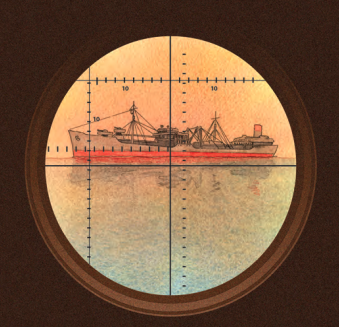
They got the foresail on her to help her fight through the high, leftover seas as the wind backed around into the northwest and kept backing as it moderated, even though it still rained intermittently. The storm was definitely moving off to the east where it would probably raise hell with the Atlantic convoys. At 2 in the morning they tacked and set the main. By then the wind had backed enough so they could still sail northwest on a close reach. The motion was not pleasant as the schooner fought her way through the seas, but the press of sail steadied her so it was not nearly as violent as it had been while scudding before the wind under bare poles. Nick hoped that by morning twilight it would have cleared enough for him to get a fix.
It was still full dark when, as he taped a fresh plotting sheet to the chart table, Langdon and Snow went past him to relieve Jenks and Longo on watch. He put his sextant on his bunk, set the hack watch to the chronometer and hung it around his neck. He put a pad and pencil in his shirt pocket under his oilskins and the thick turtleneck sweater he wore beneath them and climbed into the cockpit to see if it had cleared enough to be able to see the horizon and a few stars just before the sun came up.
As if to answer his question, the clearing ended and it started to rain hard again. He said, “Nuts!” pulled the hatch closed, and sat down on a cockpit seat to see which would come first, the end of the rain squall or the end of the twilight just before dawn that he needed to determine their position.
The squall won. They broke out of it just after the sun had climbed over the horizon blotting out the stars, and a watery sunlight raised their visibility from a couple of hundred yards to several miles.
And there, stopped on the surface, perhaps a half mile away, was U-271, its black painted number clearly visible against the gray of the conning tower.
Operation drumbeat
It has been said that when anything important happens anywhere on earth, the German General Staff already has a plan prepared. Such was the case on December 7, 1941, when Japan launched a surprise attack on the United States without warning its ally, Adolph Hitler. No matter. When Hitler declared war on the U.S. on December 8, Operation Drumbeat (Fall Paukenschlag) was ready to go. On December 16, the initial wave of five U-boats sailed for America from Lorient on the French coast. In the next few weeks 16 more followed. The attacks were coordinated and began on January 14.
Before returning to port for supplies and more torpedoes, the initial five submarines had sunk 23 ships totaling 152,000 tons. And that was only the beginning. Soon, oil and bodies were commonly washing up on beaches from Cape Cod to Cape Hatteras. In January, U-boats sank 31 ships totaling almost 200,000 tons. In February they sank 69 ships. By the end of June, they had sunk more than 400 ships totaling two million tons.
To counter this carnage, the U.S. Coast Guard had seven seagoing cutters, three 1919-vintage patrol boats, four wooden sub chasers left over from World War I, two gunboats dating from 1905, and its fleet of inshore patrol boats, most of which had seen duty chasing rumrunners. It also had about 85 aircraft, 51 of which were obsolete trainers.
The Navy was preoccupied with its horrendous losses in the Pacific and could spare only a few destroyers to help. They had none of the small, handy vessels needed for anti-submarine work. The Army Air Corps (predecessor of the USAF) could provide only six aircraft sorties a day. Most of the Air Corps and Coastguard aircraft available were unequipped for anti-submarine duty and were manned by crews who had not been trained for it.
To augment this ragtag force, with which it was confronting the most deadly submarine navy in history up to that time, the Coast Guard commandeered yachts of all sizes and descriptions and sent them out into the Atlantic with orders to rescue survivors and report the location of any U-boats they encountered. Some of these yachts were manned by Coast Guard personnel and some by civilian volunteers.
It was one of the most desperate times in American history.
The Japanese had crippled the U.S. Pacific fleet at Pearl Harbor, utterly destroyed the U.S., Dutch, and British Asiatic fleets, and were running wild in the western Pacific. They appeared to be about to invade Australia. France had fallen and the Germans were at the gates of Leningrad (St. Petersburg) and Moscow. If the Battle of the Atlantic were lost, Britain and Russia would be cut off from American supplies and the war would be lost. If that happened, as Winston Churchill put it, “The world would sink into a new Dark Age made more protracted and more sinister by the light of perverted science.”
America had to do everything possible, not to win (that would come later), but just to keep from losing. The Coast Guard’s picket line of commandeered yachts, officially named the Corsair Fleet by Congress, but called the Hooligan Navy by everyone else, was one of those things.
To read further . . . Voyages in Desperate Times by Jule Miller is available from Amazon.com and on Kindle. Or let us read it to you. Good Old Boat has produced this book in unabridged audio format. It is available as an audiobook from www.AudioSeaStories.com, Good Old Boat’s download site.
Thank you to Sailrite Enterprises, Inc., for providing free access to back issues of Good Old Boat through intellectual property rights. Sailrite.com