A dinghy makes a tender and fitting gift
Issue 64 : Jan/Feb 2009
A sailing dinghy was the most perfect wedding gift Jonathon could have given me, but I was not thrilled about my new husband spending our honeymoon in the basement building it. Others had their own reservations. Could Jonathon really build a boat or would it end up as one of those projects that takes up room in the basement for 16 years? Would she fit through the basement door once completed? How would she sail? Wouldn’t she be too small?
Work began on January 1, 2005, two days after our wedding. By spring, he had completed Selway Fisher Design’s Redshank, a 7-foot 6-inch English stem dinghy. Jonathon spent three weeks of vacation and most of his spare time during that winter in the basement (when he wasn’t busy tending to his new wife, buying a new sailboat, and training as a pediatric resident). A rough estimate of the total time spent is 400 to 600 hours.
Now, the dinghy we’d dreamed of for years — one that would be stable and easily rowed, sailed, and lifted on deck — is a reality. During our summer cruises, we used to spend breezy afternoons talking about how great it would be to sail around the anchorage in a dinghy. Now we spend these afternoons talking about discoveries made while sailing around the anchorage or reliving exciting moments in the puffs.
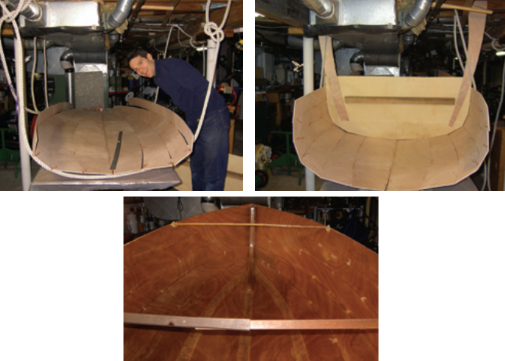
We liked the Fatty Knees dinghy of Lin and Larry Pardey fame, except for its price and weight. When Jonathon saw the photo of the Redshank on the Selway Fisher webpage, he knew it was the boat that he wanted to build for me and immediately ordered the plans. A good friend of ours, who is a very talented cabinetmaker, shared a few basic woodworking tips, which went a long way. Jonathon learned about the stitch-and-tape method of building a wooden boat from the books Ultralight Boatbuilding, by Thomas J. Hill, and A Manual of Modern Small Plywood Boat Construction Techniques, by Paul Fisher, and basically followed the instructions therein. Stitch-and-tape (also referred to as stitch-and-glue or tack-and-tape) is an easier alternative to the traditional clinker (lapstrake) method and produces a lighter craft. The basic technique, as the name indicates, is to:
- Stitch together the plywood hull planks (the Redshank has six on each side) using wire ties. Lines slung underneath the hull and a template set inside the hull assist in the process. The bow pieces are stitched together once the transom is nailed in.
- Lightly epoxy the seams together, then remove the stitches and fill the holes left by them (this is not part of the standard process, but we feel it added to the aesthetics of the boat). Tape the seams on the inside of the hull with fiberglass and apply several coats of epoxy.
- Fiberglass the outside of the hull and sand until smooth.
By January 19th, these steps had been completed, and the basic structure, consisting of 6-mm okume marine plywood for the hull and laminated mahogany for the transom, was finished. But a lot of parts still needed to be added before the dinghy would be ready to leave the basement: the keel and stem (they would be made of white oak for its hardness), the daggerboard trunk (9-mm okume marine plywood), the seat mounts (fir), the seats (mahogany), the mast step (white oak), and the inner stem (laminated 9-mm okume plywood).
Jonathon enlarged the middle seat to encompass the daggerboard trunk and to make a bigger seat. He made the seats removable for ease of future refinishing and, to keep our bottoms dry, constructed a dummy to insert in the daggerboard slot when not sailing.
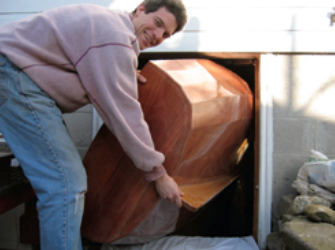
Then the big question: would we be able to get the Redshank out of the basement? We had measured the doorway and thought there was about 1 inch to spare. As it turned out, it was a very tight squeeze, even after removing the door and doorframe and leaving the seats out of the dinghy to allow the boat to flex.
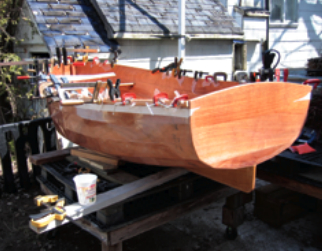
Once outside, there were still some outstanding items: the mahogany rails (we used all the clamps in the neighborhood); the quarter knees, the breasthook, and the oarlock beds (all made of mahogany); the bronze protection on the stem and keel; a few coats of white two-part polyurethane paint on the outside; and lots of varnish.
May 22nd, launch day, was one I will never forget. A small parade of neighbors, cheering and beating on drums, escorted us and the Redshank from the backyard to the lagoon a few blocks away. We opened a bottle of champagne and, in his toast, Jonathon announced that our Redshank would be named Nina. We waded into the water, boarded Nina, and ventured out for a row to celebrate our 12th anniversary of becoming a couple.
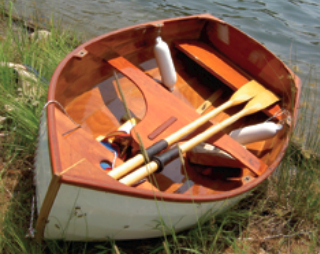
With her nearly 7-foot-long spoon-shaped spruce oars, Nina rowed beautifully, as expected. Jonathon had decided on two sets of oarlocks, one for a single occupant and one for when two or more would be aboard. But how would she sail?
Cat rig
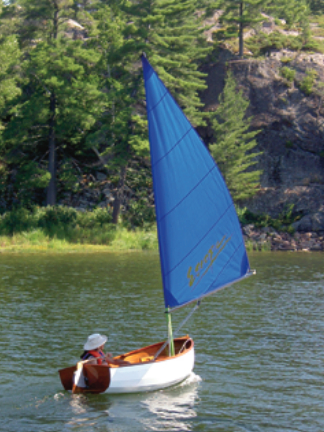
Nina’s sail plan was for a gaff rig, but we thought a cat rig would be more practical and efficient. We purchased an Escape sail on eBay and, to accommodate it, Jonathon installed the mast step farther forward than called for on the plans. We also purchased a used two-part Windsurfer mast, which can be stored more easily. The sail was blue (we could live with that) and the mast was fluorescent green (it has since been painted white). The boom is part of a broken spinnaker pole from a racing dinghy and fits snugly inside Nina for storage, as do the oars. Jonathon fashioned the daggerboard out of laminated teak and made it longer than designed. The rudder and cheek plates are from an old Albacore.
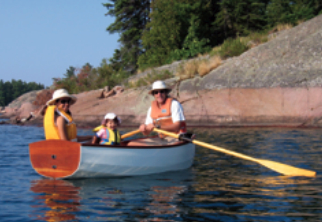
Nina sails delightfully, even in light winds. It takes about 5 knots of wind to get her going, while 10 knots makes for a lively sail. When sailing in 15 knots, we wish we had put in more flotation.
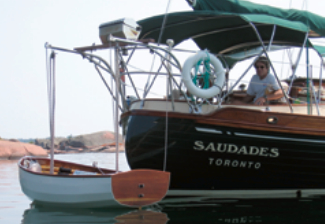
At the outset of this project, people thought two would be a crowd in a dinghy that, at 7-foot 6-inches, is shorter than an Optimist. We have since become a family of three and we fit comfortably. During the summers of 2006 and 2007, we used her almost daily for excursions while cruising in the North Channel of Lake Huron.
We had planned to stow the dinghy on the deck of our Dufour 27, but the dinghy was not the only thing conceived that winter. To accommodate our growing family, we bought a Tayana 37, named Saudades. Jonathon jokes that we had to buy a boat to match the dinghy. Saudades had davits — perfect! During a midwinter visit to our new boat, we measured the distance between the davit falls so we could fit corresponding lifting points on the dinghy.
So our family fits in Nina nicely, Nina fits nicely on the stern of Saudades, and she fits most beautifully and wonderfully into our life afloat.
Nina Nakajima and Jonathon Maguire take Saudades from their home on Toronto Island, Lake Ontario, Canada, to the North Channel of Lake Huron during the summers. Their daughter,Joni, is now 3 years old and the family still fits comfortably in the dinghy.
Thank you to Sailrite Enterprises, Inc., for providing free access to back issues of Good Old Boat through intellectual property rights. Sailrite.com