There’s safety in (specification) numbers
Issue 83: March/April 2012
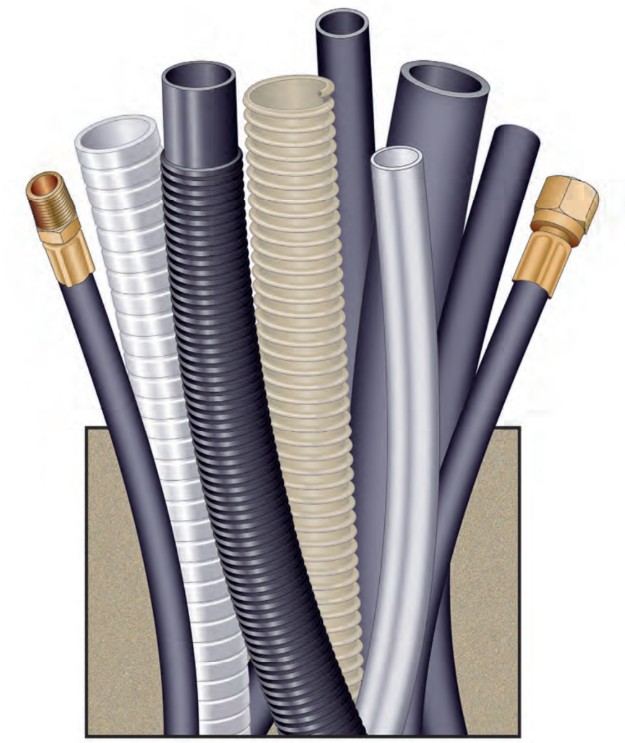
Hoses are used in many places aboard the typical sailboat. Each hose should be of a type designed for its particular application and, for some uses, must even meet federal specifications. Even hoses in applications that are not subject to regulation can sink a boat if they fail, so if you have to replace a hose, do so in accordance with American Boat and Yacht Council (ABYC) recommendations.
In the U.S., hose sizes are usually specified in increments of 1⁄8 inch and almost always indicate inside diameter. In most of the rest of the world, sizes are metric.
Fuel
From a safety standpoint, probably the most important hoses on board are those that go from the fuel tank(s) to the engine. Originally, federal law required these hoses to be either U.S. Coast Guard (USCG) Type A1 or, under special circumstances, USCG Type B1. From the fuel inlet on a gasoline engine (usually at the fuel pump) to the carburetor, the hose must be either USCG Type A1 or USCG Type A2.
The Environmental Protection Agency (EPA) has added a requirement that, in most cases, the hose must also meet evaporative emission standards and be labeled USCG Type A1-15, A2-15, B1-15, or B2-15. This same type of hose must be used for fill and vent hoses to the fuel tank. In the U.S., hoses must be lettered in English, in block letters, showing the USCG type of hose, the year of manufacture, and the manufacturer’s name.
Fuel hose with an “A” rating has passed a 2 1⁄2-minute fire test; “B” hasn’t. The difference between “1” and “2” is the hose’s permeability. “A1” and “B1” are less permeable and pass less fuel vapor than “A2” and “B2.”
Since boat manufacturers want to avoid this numbers game and don’t want to stock a large variety of hose, most use Type A1 everywhere. This is a plus.
Propane stove and heater
Liquefied petroleum gas (LPG), or propane, is the most dangerous fuel that can be used for galley stoves and cabin heaters. It’s also the most common. The line that runs from the LPG tank to the stove or heater can be either copper tubing or flexible hose. If the galley stove is gimbaled, then flexible hose must be used. Although copper tubing might seem safer, it can suffer from stress fatigue and corrosion. Connections for copper tubing should be “long-nut” are fittings because “short-nut” fittings are more prone to fatigue failure due to vibration. When copper tubing is used, it should be Grade K or L and conform to American Society for Testing and Materials (ASTM) B88-75A specifications for seamless copper tubing.
Hose in your propane system should be specifically approved for LPG in compliance with Underwriters Laboratories standard “UL 21 LP-Gas Hose.” LPG will rapidly break down other hoses chemically, resulting in leaks and disintegration. Flexible hose must have permanently attached end connectors, such as swaged fittings. Hose clamps are unacceptable. LPG equipment suppliers sell hose in many lengths with this type of fitting installed by the manufacturer and tested under pressure. Attaching end fittings to an LPG hose is not a do-it-yourself project.
LPG hose is usually made from high-pressure thermos-plastic and some varieties have a copper lining.
Wet exhaust
Hose is used in a water-cooled exhaust system in the section after the engine’s exhaust riser where cooling water from the engine is injected into the exhaust. To comply with ABYC standards, this hose should have the label “Marine Exhaust Hose” along with either Society of Automotive Engineers “SAE 12006 R1” or “SAE 12006 R2.” R1 hose has no spiral-wire reinforcement and is subject to sagging or kinking. R2 hose has spiral-wire reinforcement that allows it to be bent without kinking.
Engine raw-water intake and head intake
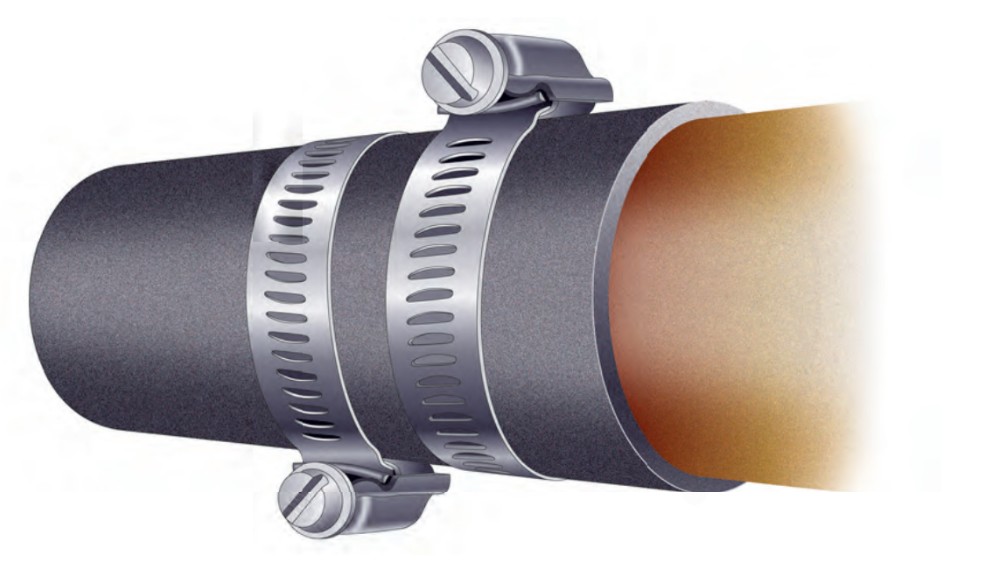
Hose for the engine’s raw-water intake as well as for the head inlet should be marine-grade rubber with a minimum of two-ply and spiral reinforcement to prevent kinking or collapse. Auto heater hose is generally thin-walled and not an acceptable replacement. Since these hoses are below the waterline in your boat, you should not skimp on quality. As with all critical hoses, they should be double-reverse clamped, that is, with two hose clamps arranged so the screws are 180 degrees apart and facing in opposite directions. The clamps should be all-stainless-steel.
Cockpit drains
A portion of the hose in most cockpit drains is below the waterline, making flooding possible if a hose ruptures. For these hoses, follow the same guidelines you would for any other hose used below the waterline and inspect them regularly.
Potable water
Potable water hose must be approved by the Food and Drug Administration (FDA) for drinking water. If a pressurized-water system is installed, the hose must be able to withstand the pressure. The hose for cold-water lines is usually nylon-reinforced PVC, while that for hot-water lines is usually FDA-approved reinforced rubber hose.
The quality and pressure rating of freshwater hoses is especially important if a boat is connected to dockside water, even when a pressure-reduction valve is incorporated in the system. A burst hose can sink a boat hooked up to pressurized dockside water and left unattended. Dockside water should never be left connected to an unattended boat.
Sanitation hose
Sanitation hose should be so labeled. Understandably, these hoses are constructed to have low permeability to odors. A hose’s permeability, however, can change with time, particularly when chemicals, such as anti-freeze or alcohol, are pumped through it annually at winter-layup time.
Quality is key
When replacing hoses it’s imperative to use the correct type of hose. This is no place to skimp on quality, since the proper hose and the quality of that hose is what stands between you and a fire, explosion, or sinking.
Don Launer, a Good Old Boat contributing editor, built his two-masted schooner, Delphinus, from a bare hull and has held a USCG captain’s license for more than 36 years. He has written five books, including The Galley: How Things Work and Navigation Through the Ages, and frequently gives talks on the history of navigation.
Thank you to Sailrite Enterprises, Inc., for providing free access to back issues of Good Old Boat through intellectual property rights. Sailrite.com