Use an upside-down blade to cut without tears
Issue 65 : Mar/Apr 2009
For anyone fitting out a boat’s interior, the jigsaw is a very versatile tool. Unless you are familiar with a few simple techniques, however, it has some drawbacks that might appear to limit its usefulness.
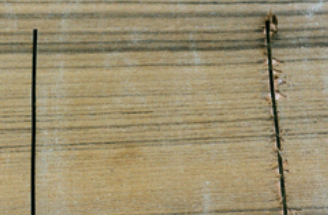
One of these, which often becomes evident when you cut plywood, is the way in which the blade tends to tear and splinter the top surface. This is of special concern if the cut will be visible and if the plywood is faced with an expensive veneer. The splintering occurs because the teeth on a conventional jigsaw blade point upward and therefore cut on the upstroke.
A well-known trick to combat this, and one that is quite effective on melamine-faced lumber, is to put masking tape along the line of the cut. Other methods include using a blade with finer teeth, setting the saw to a low speed, and cutting very slowly. These are only partial solutions; the top veneer will always suffer a certain amount of damage. To compensate, you have to cut the panel a little oversize and clean up the edges with a plane or spokeshave.
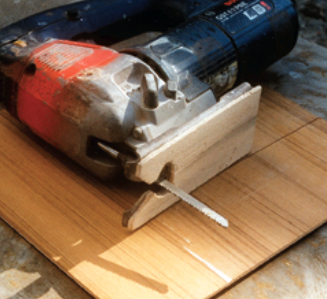
Cut on the downstroke
One way to eliminate this problem completely is to use an upside-down jigsaw blade. The teeth on such a blade point downward and cut on the downstroke. When cut with an upside-down blade, the top surface will remain completely undamaged, although there will still be some splintering on the underside.
I have found that the only difficulty with these blades arises if the lumber I am cutting is very thick. Because a conventional blade cuts on the upstroke it actually pulls itself into the wood as it cuts. All the operator has to do is guide the saw. With an upside-down blade, which cuts on the downstroke, the blade is trying to push the saw and work apart. Unless you lean very heavily on the saw, it will sometimes bounce if the blade meets a little extra resistance while cutting thick wood.
As well as the upside-down blades, other blades are available to help the woodworker produce high-quality results from a jigsaw. Very narrow blades are made for cutting tight curves and, conversely, extra-wide ones are made for straight cuts. Blades also come with teeth of different sizes. Large teeth provide a fast cut, while the smaller ones create a finer, cleaner saw kerf. It’s also possible to find metal-cutting blades, which I have used in a small saw to cut steel up to 3⁄16 -inch thick, although the rate of cut was very slow.
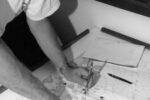
One other shortcoming of the jigsaw, which can be especially significant for anyone carrying out fine work, is the way in which it can bruise or mark the surface of the lumber as you work. A solution is to fit the saw with a shoe. You can make one from a small scrap of thin plywood cut to shape and then glued to the foot of the saw. By using a shoe, you can cut even previously painted or varnished surfaces without fear of damage.
Richard Toyne and his partner, Magali Bellenger, left England in 1998 on their 32-foot gaff cutter, Joass, and sailed to the Mediterranean via Gibraltar. In 2000, they sold Joass and bought Sigfrid, a 34-foot steel ketch, and have been exploring the Western Mediterranean in her ever since.
Thank you to Sailrite Enterprises, Inc., for providing free access to back issues of Good Old Boat through intellectual property rights. Sailrite.com