A true cruiser/racer, with emphasis on the latter
Issue 83: March/April 2012
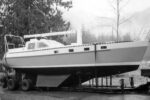
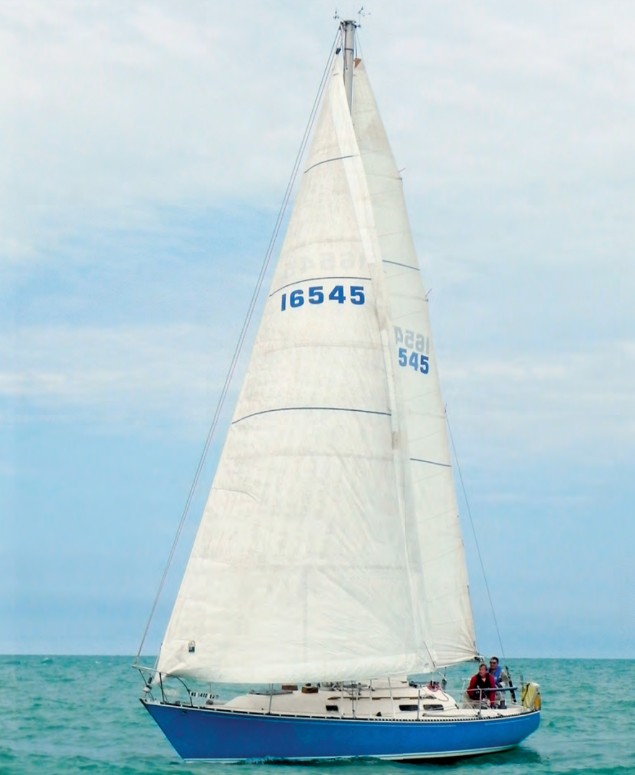
Skylark already had a long Great Lakes racing career when Al and Lorelei Goodman of Beloit, Wisconsin, acquired the 1974 C&C 35 Mk II in 1998. Her blue topsides were attractive and the long tapering ends appealing. As they say, “If it looks right, it’ll sail right.” And Skylark looked right.
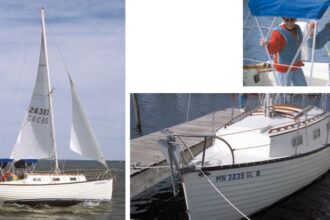
Skylark is based in Racine, Wisconsin, on Lake Michigan, where Al and Lorelei use her as intended — a cruiser/racer. During much of the short Lake Michigan sailing season they take Skylark out for local daysails and the occasional one- or two-week harbor-hopping cruise along the lake’s sandy shoreline.
Three times a season, Al and crew let Skylark stretch her racing legs by participating in some of the longer Lake Michigan sailing events. The Hook is a 190-nautical-mile race sponsored by the Racine Yacht Club that departs Racine and hooks around the end of Wisconsin’s Door County peninsula to finish at Marinette, Michigan. The Queen’s Cup, run by the South Shore Yacht Club of Milwaukee, runs roughly 70 miles across Lake Michigan from Milwaukee to one of the western Michigan harbors. The Double Hander runs from Chicago to Port Washington, Wisconsin.
As Great Lakes sailors will tell you, conditions can be easy or tough, depending on which way the wind blows, and those conditions may change several times in the course of one passage. The C&C 35 is well suited for Great Lakes and saltwater sailing.
This Canadian toughness is genetic. The evolution of the C&C 35 began when George Hinterhoeller commissioned the design team of George Cuthbertson and George Cassian to pen the Invader 35, of which 24 were built. He also built the C&C-designed Redwing 30 and 35 just before partnering in 1969 with Bruckmann Manufacturing, Belleville Marine, and Cuthbertson and Cassian to form C&C Yachts. Following the creation of C&C Yachts, the Redwing name stuck with the 30-footer, but the 35 lost its name and was simply known as the “35” and, later, the 35 Mk I.
The principals of the new company guessed correctly that focusing exclusively on racing boats would put it in a difficult and limited market. Thus, the C&C 35 became the first of many boats the industry would call cruiser/racers, with powerful rigs, quick handling, and good boat speed, but fitted out for cruising comfort. Their boats also have the distinction of being among the first to use balsa coring in the hull and deck to save weight while providing structural stiffness. C&C Yachts quickly sold all they could build.
The C&C 35 production run totaled 351 deliveries of both models: the Mk I (1969 to 1973) and Mk II (1973 to 1975). In addition, 15 Mk IIs were built by Anesty Yachts in Poole, England. A new design, the C&C 35 Mk III was produced from 1983 to 1987 and the cruising C&C Landfall 35 from 1981 to 1985.
George Hinterhoeller left the group in 1975 to again form his own company. C&C Yachts continued as a respected and pro table builder until a takeover in 1982 and the economic uncertainties of the 1980s led to receivership in 1986. In 1998, Fairport Marine Company, which already owned Tartan, bought the brand name and currently has four Tim Jacket designs in production.
Design
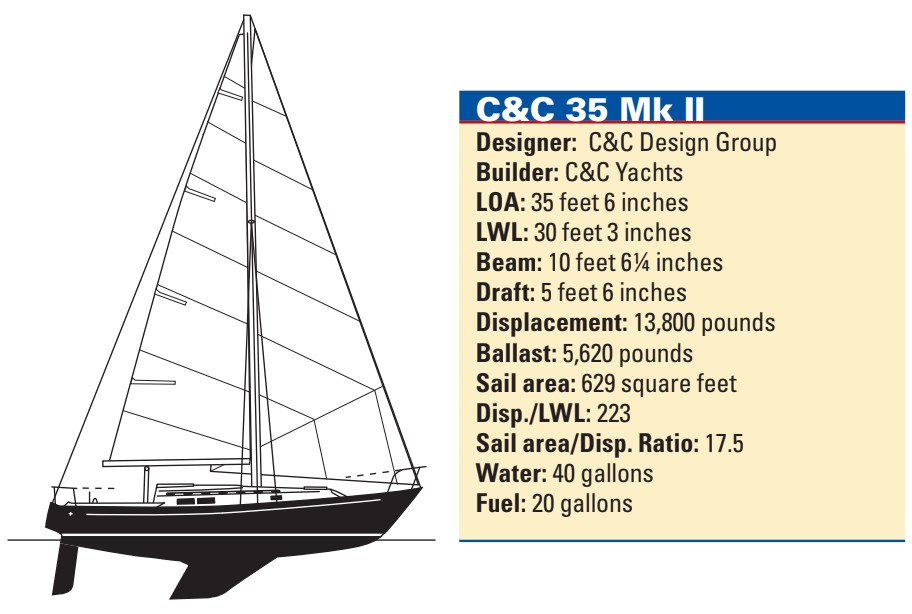
The Mk II is a development of the Mk I and therefore only slightly influenced by the IOR (International Offshore Rule) that was introduced in 1970. The Mk I’s scimitar-shaped rudder was replaced with a more vertical semi-balanced spade rudder and a bustle was added forward of the rudder. The Mk II has a taller rig and more ballast than the Mk I. It also has higher freeboard and, as a result, greater length on deck (35 feet 6 inches versus 34 feet 7 inches) and increased cabin volume.
In theory, the Mk II should be faster, but real-world results have shown the Mk I does quite well against its younger sibling. The Mk I has a shorter waterline but also is quite a bit lighter; their displacement/length ratios are nearly identical: 226 vs. 223. But there’s a big difference in sail area/displacement ratios: a generous 19 for the Mk I against 17.5 for the Mk II.
Both models feature beautiful, sweeping sheerlines, raked bows, and reverse transoms at the same angle as the backstay, an effect that is pleasing to the eye while it maximizes the load-handling ability of the backstay chainplate.
Construction
Being of early fiberglass construction, the C&C 35 Mk II was built with solid hand-laid mat and woven roving. The bulkheads are marine plywood, and are tabbed to the hull but not to the deck because of the fiberglass overhead liner. The deck is laid up with mat and roving and has a balsa core.
The flat edge of the deck lands on top of an inward-turning hull flange, with a butyl sealant between, and the joint is bolted on 4-inch centers through the toerail. The foundation for the furniture is a molded fiberglass liner and the surface of the overhead liner is textured to look like vinyl.
The keel is an external lead casting secured with stainless-steel bolts.
Deck
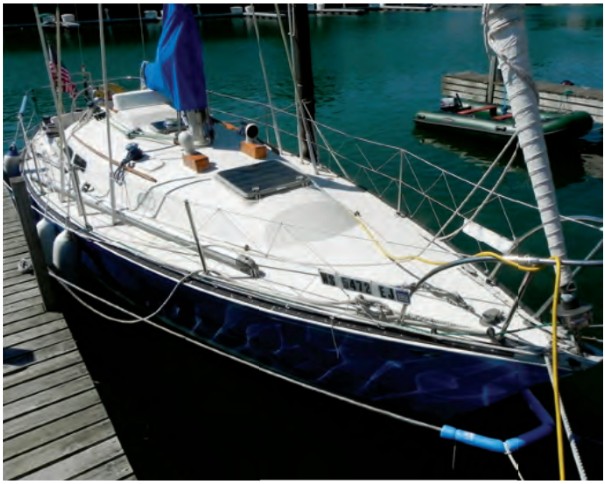
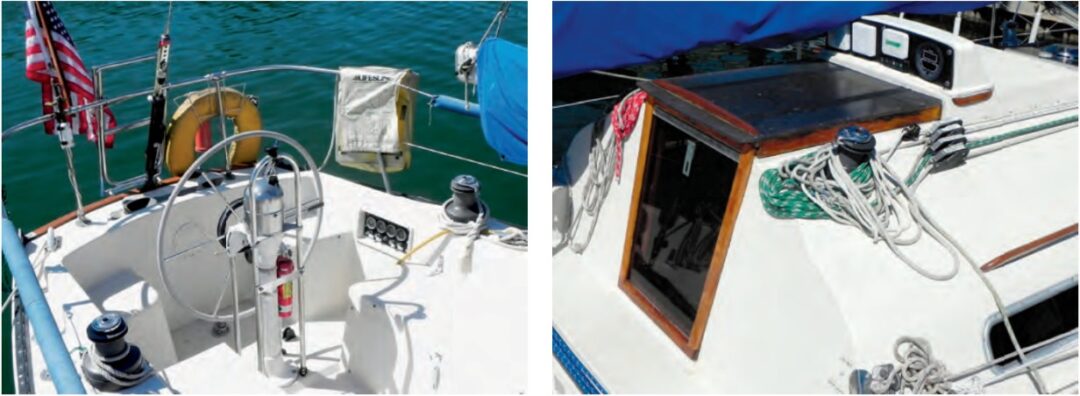
At the bow is a sturdy stemhead fitting of cast aluminum. There’s no anchor locker, but a hawsepipe allows the rode to be stowed in the forepeak. There are four substantial cleats and double lifelines with stainless-steel bow and stern pulpits. The cream-colored deck is easy on the eye while the non-skid that’s molded into all the working surfaces is aggressive enough for wet sailing work. Slotted aluminum toerails (developed by C&C and adopted by others in the industry) provide sturdy attachment points for running rigging blocks in addition to being a substantial component of the hull-to-deck joint. Teak handholds run along the rounded cabin trunk on both sides. Ventilation and light enter the cabin from a large forward hatch above the forward cabin and another smaller hatch over the saloon. Two Dorade vents are mounted forward of the mast.
The companionway is on centerline. The smoked translucent hatch slides into a sea hood that has an instrument pod mounted on its aft end. On Skylark, a smoked acrylic washboard closes the companionway entrance above the seat-level bridge deck. There is enough teak on deck to please the eye without it being a chore to maintain.
The 8-foot long cockpit is roomy and fairly comfortable. It has small seats in the aft corners but no seat behind the helm. Both cockpit seats open to storage lockers below, allowing access to the engine via inner panels. However, Al says the best way to access the Atomic 4 is through the panel behind the companionway ladder.
The deep cockpit well has four scuppers; the starboard and port pairs are connected to single hoses and through-hulls. To use the swim ladder, it’s necessary to climb over the stern pulpit.
I was surprised to see a white steel cylinder in the port compartment. Al explained this is the CNG canister for the stove (being lighter than air, CNG is not subject to the same ventilation requirements as LPG).
Rig
You can tell you’re on a racing boat when it takes more than one hand to count the winches. Skylark has eight Barient self-tailers, four on the cockpit coaming, two astride the companionway, and two forward of the mast. The two forward winches serve the spinnaker-pole topping lift and a spare halyard. Otherwise, all of Skylark’s halyards are led aft to the cockpit through rope clutches. The mainsheet is shackled to a traveler mounted on the bridge deck, making for easy sail adjustments.
Skylark has a keel-stepped, single-spreader mast with double lower shrouds and solid rod rigging. A substantial hydraulic backstay tensioner is ready to take the sag out of the forestay and flatten the mainsail as needed. The 150 percent genoa is on a furler. Skylark has a rigid Garhauer boom vang that eliminates the need for a topping lift.
Accommodations
Heading below, the first impression is of a lot of teak. The furniture is nicely finished in teak-veneer panels and solid teak. A teak-and-holly laminate (veneer on plywood) sole runs the full length to the forward cabin and over a shallow bilge.
The layout can be described equally as classic or conventional, with a U-shaped galley and U-shaped convertible dinette to port, a nav station at the head of the starboard quarter berth, and a long settee forward of it. Outboard of each seating area are closed bookcases with access to the hull-to-deck joint. The upholstery, a bright red, white, and blue plaid fabric, is original and in excellent condition.
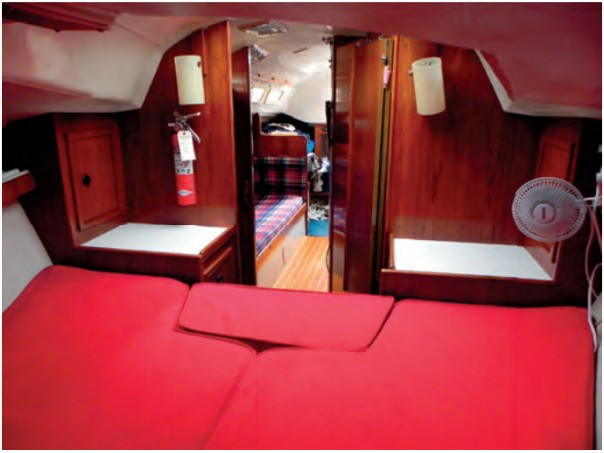
Forward of the saloon to port is the head, with standard equipment but no shower. Opposite is a wet or hanging locker. The V-berth is 80 inches wide by 70 inches long. Cabinets with drawers are fitted on both sides at the head of the berth. A folding door closes off the cabin for privacy.
Cabin ventilation is provided mostly by the overhead hatches and Dorade vents. Two long fixed portlights on each side of the saloon let in light. An opening port is fitted in the head and a fixed port above the wet locker. Standard lighting in the saloon is four incandescent lights, to which Al has added some fluorescent lighting. The main bulkhead provides a nice spot for the Goodmans’ small flat-screen television.
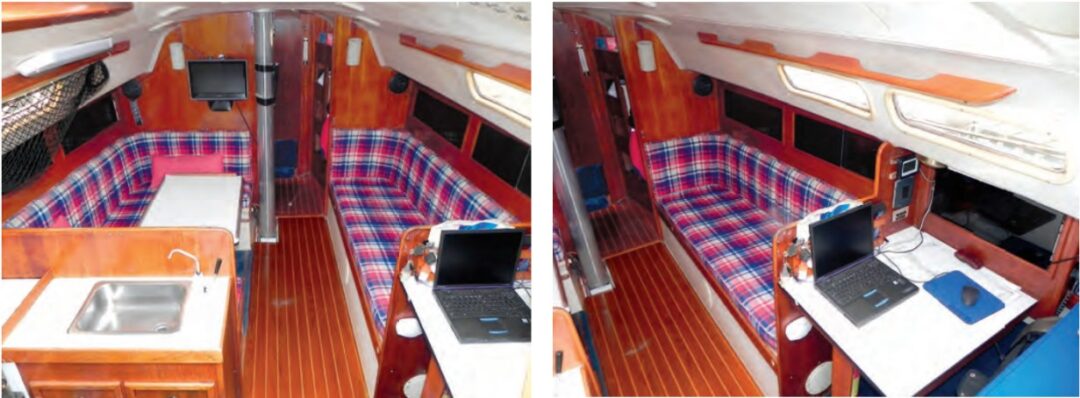
In the galley, the refrigerated icebox forms the aft arm of the U while the sink and a deep storage area occupy the forward arm, with a Regal 2 four-burner CNG stove between them. There are plenty of cupboards and storage pockets for galley necessities. Skylark uses only a manual pump for the fresh water.
Teak grabrails on the overhead make moving around relatively easy while under way.
Without an anchor locker or lazarette, I was not completely surprised to find Skylark’s Danforth anchor hiding under the dropped saloon table. The Goodmans use the saloon double as their berth and don’t use the table much, so it is the preferred place for the anchor. The shorepower cable is kept there as well.
Under way
We took off from Racine on a bright September morning heading south along the low Wisconsin shoreline. With the wind from the west at 10 miles per hour, we didn’t encounter any significant waves. Al says Skylark handles Lake Michigan’s larger swells and chop with aplomb with little tendency to hobbyhorse. The boat tacked reasonably quickly for a yacht of its size; the fin keel and spade rudder help it come about without hesitation. The steering system has good feedback and there is little weather helm. Skylark tracks straight ahead as long as her sails are properly trimmed.
With light wind and the genoa fully unfurled, Skylark heeled to 20 degrees and was able to pinch up to 40 degrees apparent wind. Like most boats under genoa, she was in the groove at 60 degrees apparent, where we saw 6.3 knots. Al reports seeing almost 9 knots while surfing and regularly makes 8 knots with the spinnaker pulling. He says he rarely reefs the mainsail below 20 knots, and then only the first reef, never the second reef.
Skylark’s PHRF is 126 seconds per mile, plus 3 with the roller furling factored in. For comparison, a Catalina 36 has a stodgy PHRF of 141 and a J/35 a quick 72.
When hoisting the mainsail, I found the sail’s standard slug-slides a bit recalcitrant, making a good case for an external T track or, better yet, bat cars.
I found the backstay impinged on the helmsman’s position . . . not to mention having to dance around the rudder head protruding from the cockpit sole just aft of the wheel. The small seats in the aft corners are not particularly comfortable when steering under sail. Perhaps a taller person might find the stretch to the longer seats to his comfort. Personally, I like to sit to leeward while at the helm of a wheel-steered boat because it’s a nice, comfy, secure spot from which to keep an eye on the jib and to see forward. Because of the narrow stern, sitting on the cockpit coaming worked best for me. I would consider bridging the gap between the small stern seats and the main cockpit seats with hinged teak slats to create a comfortable place to sit while steering.
The engine controls and gauges are readily at hand as are the two self-tailing winches for the jibsheets. The mainsheet is controlled from farther forward, necessitating crew action or leaving the helm. The instrument pod on the sea hood is a nice feature for heads-up monitoring of performance under sail.
Conclusion
The standard engine was the Atomic 4. Some boats were equipped with either Westerbeke or Universal diesel engines and may command a somewhat higher price. Prices for the few C&C 35 Mk IIs listed as of this writing ranged from $17,000 to $33,500. The older Mk I models command nearly the same prices.
The C&C 35 Mk II is a well-built boat but it is almost four decades old. Many problems can arise from that long a life on the water. Since the deck is balsa-cored, a complete sounding of the deck would be prudent to discover any water damage or voids in the fiberglass sandwich. Likewise, leaks may be present along the hull-to-deck joint and cabin windows, and these can be difficult to trace to the source. Boats that have been raced hard should be carefully checked for broken tabbing between the bulkheads and the hull. Some boats were apparently built with mild-steel washers on the stainless-steel keel bolts; a quick inspection will confirm whether they have been replaced with proper washers or not.
Despite the brief list of shortcomings, the C&C 35 Mk II is a great boat that should sail well for many more years. Skylark certainly carries her years quite well.
Allen Penticoff is a freelance writer, sailor, and longtime aviator. He has trailersailed on every Great Lake and on many inland waters and has had keelboat adventures on fresh and salt water. He presently owns three sailboats, an American 14.5, a MacGregor 26D, and a 1955 Beister 42-foot steel cutter that he’s restoring.
Thank you to Sailrite Enterprises, Inc., for providing free access to back issues of Good Old Boat through intellectual property rights. Sailrite.com