Impermanent illumination for impromptu parties
Issue 85 : Jul/Aug 2012
Every once in a while, although the Vera May is really not a party boat, her cockpit is the venue for a small evening gathering. When it happens, the lighting is great through sunset, but after that we would find ourselves sitting in the dark. Since the cockpit is intended for cruising, I didn’t want to install and wire fixed lighting for those rare, but valued, occasions. The solution was a combination of passive-solar garden lights and magnetically mounted battery-powered spotlights.
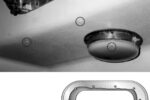
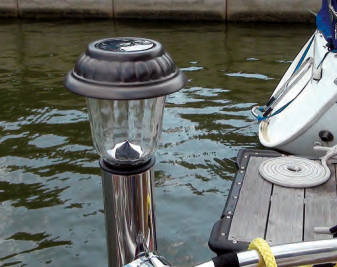
Hardware and big-box stores sell a variety of inexpensive solar-powered garden lights that are meant to be stuck into the ground around your house. They charge during the day and have a sensor that turns the light on after sunset. Depending on the amount of sunlight they receive during the day, they stay on for 5 or 6 hours.
Typically, these lights have an aluminum shaft that mounts on a plastic stub that protrudes from the bottom of the light. The lights come in a couple of sizes and, as it happens, the plastic stub at the bottom of the heavier size fits very nicely into the drive socket of a cockpit winch. If you want to raise the light up a little higher, you can use the aluminum shaft as a spacer and insert the second plastic plug supplied as a point for pushing the light into the ground (but this should be mounted with the point of the plug facing inside the tube). If the fit in the winch socket is a bit loose, wind some electrical tape around the plastic plug to make it a tighter fit. Two lights will cast a comfortable background light . . . enough that you can see people’s faces and avoid stepping on things in the dark.
Roaming spotlights
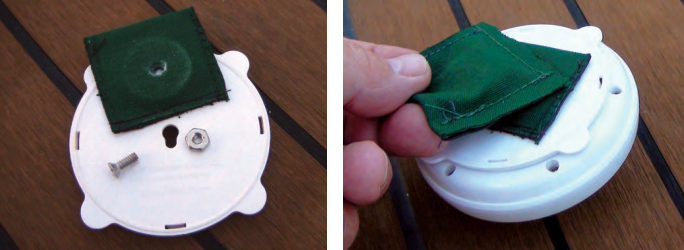
For areas where I wanted more light, I purchased some battery-operated lights intended to be screwed directly to a hard surface or mounted with an included adhesive Velcro patch. I didn’t want parts of the lights to remain mounted while I was sailing, so I devised a way to attach them magnetically.
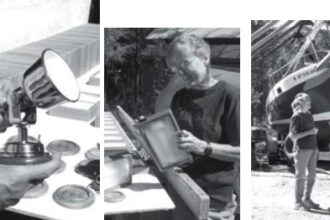
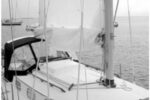
I purchased some rare-earth magnets (available from places like Woodcraft and Lee Valley Tools) and bolted steel washers to the backs of the lights. I encased the washers and magnets in little envelopes made from the same Sunbrella material as my boat canvas so any corrosion would be hidden or contained. The result is temporary spotlights that can be installed anywhere on the dodger or Bimini covers with the lights on the underside and the magnets above them on the outer surface.
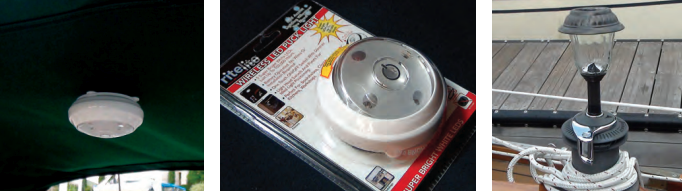
The system works very well. I generally leave the garden lights up all the time. It’s nice to return to the boat at night and have just enough light to see things in the cockpit. When I go sailing, I have to remove the lights from the winches, of course. To keep them charging, I drop them into the fishing pole mounts on the pushpit rails where they can be in the sunlight.
People tend to drop by if the cockpit is lit up, and that’s a good thing. She’s no party boat, but every now and then, the Vera May and I are happy to entertain in the cockpit patio.
Stephen Thompson is a professional mechanical engineer. Having sailed on inland lakes as a boy, at 50 years of age he successfully built a small sailing vessel from scratch and caught the bug once again. Over the past few years, he has completely restored the Vera May, a 1970 Hallberg Mistral 33, in Houston, Texas, and in the process wrote several articles for Good Old Boat describing some of the projects he undertook along the way. His most recent article is in the May 2012 issue. We published a profile of Stephen and the Vera May in September 2011.
Thank you to Sailrite Enterprises, Inc., for providing free access to back issues of Good Old Boat through intellectual property rights. Sailrite.com