. . . and CCA centerboard contemporaries
Issue 85 : Jul/Aug 2012
First built in 1960, and rigged as either a yawl or a sloop, the Mercer 44 goes back to the dawn of fiberglass boat-building. That made it a challenge to find contemporary fiberglass boats with which to compare this classic Bill Tripp design.
The obvious choice would be either the Block Island 40 or its near sister, the Hinckley-built Bermuda 40, but both of these were also designed by Bill Tripp. The Phil Rhodes-designed Bounty, which was built in fiberglass by Coleman Boat Works and made its debut in 1957, would suit the time frame and would be the right size, but she sported a full keel rather than a centerboard.
The Nevins 40 was commissioned from Sparkman & Stephens by the Nevins yard in New York as a wood-built production boat based on the phenomenally successful Finisterre. With its winning S&S CCA lineage, it would suit nicely but, although encouraged to build it in glass, the Nevins yard never made that leap. As Dan Spurr points out in Heart of Glass, Nevins considered building the deck in fiberglass, but backed off after some curing problems with the resin. Yes, this was the dawn of fiberglass boatbuilding.
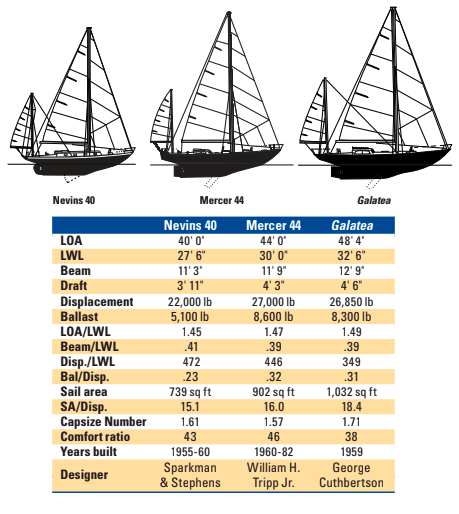
So, this being the transition period in the boating industry, when builders and customers were weighing the advantages of fiberglass against the traditional wood and even steel, it may well be appropriate to look at three centerboard CCA designs from three different designers built in three different materials — that is, wood (Nevins 40), early fiberglass (Mercer 44), and welded steel (Galatea) by George Cuthbertson.
Galatea was custom-built in steel in Germany and the interior and deck were installed in Bronte, Ontario, by Erich Bruckmann at Metro Marine. She was a direct development of an earlier Cuthbertson design, the 53-foot wooden centerboard yawl, Inishfee, and ultimately led to a line of fiberglass center- board sloops built by Belleville Marine that included the 31-foot Corvette, designed in 1966 (of which I own a 1970 model).
Looking at the numbers to see how the three designers approached the typical CCA centerboard yawl, we don’t see a lot of differences. This is to a large degree because the CCA rule was predicated on an “ideal” hull form and did not encourage departures from that form. Their underwater profiles and sail plans are also very similar. The amount of overhang forward and aft is evident in LOA/LWL ratios consistently in the 1.45 to 1.49 range. Nowadays, with maximum interior volume the goal, no production boat is graced with almost 50 percent of its waterline length in overhangs.
Of special note are the low ballast/displacement ratios of .23 (!) for the Nevins to a high of .32 for the Mercer. These do not indicate low stability as much as they do exceptionally high displacement (much of it in unmeasured ballast), as witnessed by the displacement/length ratios of 472 for the Nevins, 446 for the Mercer, and a comparatively light 349 for the Great Lakes Galatea. The relatively lighter displacement of Galatea is also reflected in a higher sail area/displacement ratio of 18.4 due to greater sail area, which again may be due to her freshwater origins and would result in better light-air performance. All the capsize numbers are well under 2, indicating good offshore stability. This is despite shoal draft and light ballast, which are more than made up for by very high displacement. Their high comfort ratios, again due to high displacement, indicate an easy motion at sea.
The true keel/centerboarder has a lot to offer, especially for cruising in areas of shoal water, and these three boats, from three influential design firms and in three different materials, show the height of development of the species under the CCA rule. However, none of these boats, with full keels and attached rudder, are going to be especially maneuverable, as I know from my own C&C Corvette. She’s great when going in a straight line, but needs speed to carry her through a tack and the engine ready in reverse when turning in tight marinas!
Rob Mazza is Good Old Boat’s newest contributing editor.
Thank you to Sailrite Enterprises, Inc., for providing free access to back issues of Good Old Boat through intellectual property rights. Sailrite.com