Years of devotion and labor lifted Spirit
Issue 85 : Jul/Aug 2012
Coincidence, destiny, serendipity — call it what you will, chance must play a strong hand in matching aging boats with their rightful owners. How else to explain the lengths to which owners will go to restore, revamp, or rebuild their good old boats?
For Floyd and Ellen Hollister, chance took an early lead. With Annapolis as his home port, Floyd was living aboard a Niagara 35, a good bachelor boat but not ideal for a new couple. Thus began the search for bigger and better — different, but not necessarily new. The next boat should have enough space for two to comfortably satisfy the someday dream of bluewater cruising. How easily such a simple statement ignores the number of specifics involved.
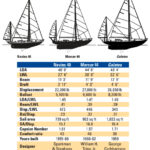
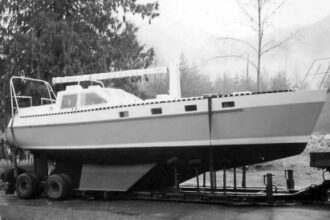
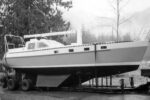
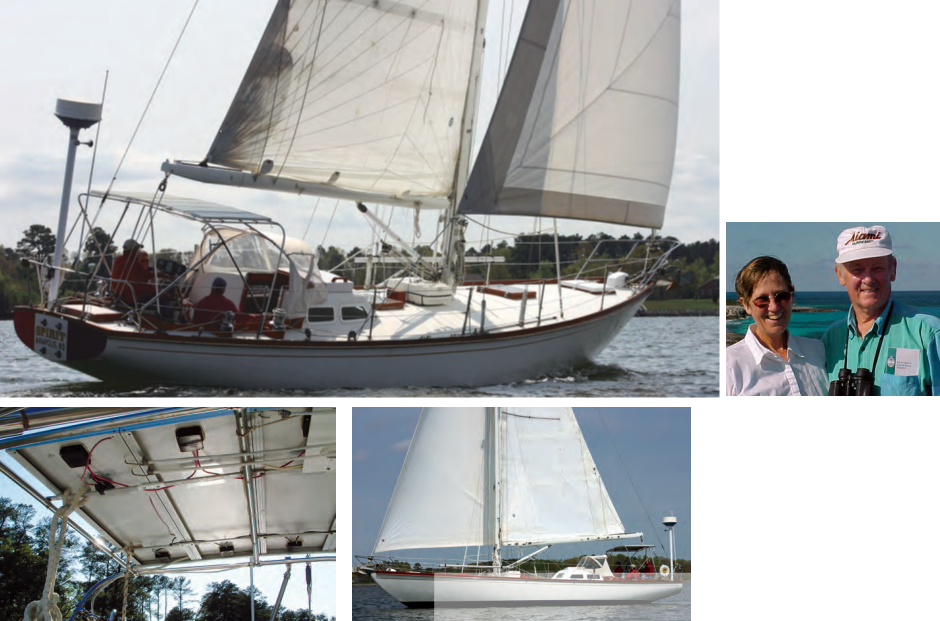
By chance, two Mercer 44s were listed for sale close enough to Annapolis to warrant a look. Floyd and Ellen’s research revealed that the Mercer 44 was first built in 1960, the largest production fiberglass boat built at the time. Designed for ocean racing by the legendary Bill Tripp, the boat proved to be a winner, yet it was readily adapted for cruising when the change in raceboat requirements brought dramatic changes to yacht design. Bill Tripp’s boats were always recognized for their high standards of rigging and construction. Like other fiberglass hulls of the era, this one was overbuilt: the hull is 2 inches thick at the stem and 7⁄8-inch at the gunwale. Her classic lines are a given and, even with only a small doghouse to break the flush-deck profile, she has plenty of space belowdecks. The Mercer 44 joined the lineup of now-famous Tripp racer/ cruisers: the Block Island 40, Pearson Invicta, and Bermuda 40.
The Hollisters rejected the first boat they saw. “I didn’t think I had the time, money, or energy to put it into the condition I wanted,” Floyd recalls . . . an observation that might have come back later to haunt a less dedicated sailor. By contrast, the second boat looked great, and soon Spirit, the one-time SORC racer Jolie Madame, had a new home.
“The previous owner had done an outstanding job with the boat’s cosmetics,” Floyd says. “He provided an unbelievable amount of information about the boat. He and his wife had owned Spirit for 28 years. When we picked up the boat, the day became an emotional experience for all.”
Like many new owners, Floyd thought he’d do much of the needed work himself, projects like new wiring, a new sink in the head, and new hoses. The engine was only three years old, surely it was not yet time for any problems there. But on the way home, Spirit’s engine quit, effectively bursting the excitement bubble for the new owners and forcing a tow to her slip. “It was just a clogged fuel filter,” says Floyd, “a minor problem. But you might say that was the start of a problem stage in Spirit’s life.”
Beneath the surface
Problems surfaced in layers, sometimes literally. Defects that didn’t seem serious at purchase time became very serious at repair time. Her decks had been cored with end-grain balsa, commonly used for its weight-saving advantage. Water-soaked core has unfortunately become a common complaint on older boats, though this problem is truly one of hardware installation rather than of material. Wherever hardware penetrates core, water is sure to follow.
That’s what happened to Spirit’s decks. Though the doghouse structure seemed to be dry, a re-coring project was not one to do only partway. “I bit the bullet,” Floyd says. “I decided to have the entire deck and doghouse re-cored.”
Spirit’s core was replaced in sections. Beginning at the bow, workers removed the outer fiberglass skin from the first section and then removed the wet balsa. Once the bottom fiberglass skin was cleaned and dried, new core material was placed in the void and a new outer fiberglass skin of cloth and vinylester resin was laid up over the core. As the workers moved aft, the layers of cloth on each adjacent section overlapped the previous section, so no two layers of cloth would end at the same line.
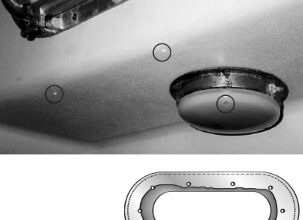
“When the balsa was removed,” Floyd says, “you could wring it out like cloth. The new core material is Divinycell. Wherever hardware would penetrate the deck, the core in that section was removed and the void filled with fiberglass-reinforced vinylester resin. Once this mixture cured, they drilled holes for the fittings through the solid patches. This is a time-consuming process but one that is necessary to keep water from reaching the core and forcing skin delamination.”
The next area of concern was the hull itself. No core had been used in its construction. It was solid hand layup with no indication of the blisters often found on older fiberglass boats. Ironically, despite the absence of blisters, tests showed that water had indeed infiltrated the fiberglass to a depth of 0.1 inch. The probable cause of this intrusion was that, over the years, as a little gelcoat was sanded away each time the bottom was painted, the underlying laminate became exposed, allowing water to wick into it.
The permanent repair required that the hull be planed, removing about 1⁄8 inch. It was then resurfaced with two layers of biaxial fiberglass fabric saturated with vinylester resin. The final finish is AwlGrip.
A new rig
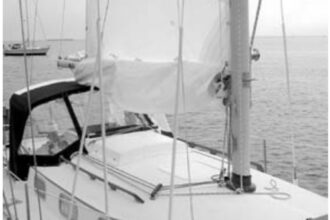
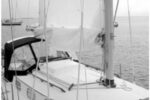
Spirit now had a new hull and deck, but that wasn’t the last of the major changes. When the mast was pulled, Floyd checked the rig thoroughly. He spotted some corrosion, which raised a familiar question: repair or replace? Certainly, on the basis of age alone, the stays and shrouds should be replaced. “I wanted to remove the roller-furling boom,” Floyd says, “and also change the clearance beneath the boom. It had only a 6-foot clearance. I worried about the hazards of an accidental jibe. And there was no room for a Bimini. The more I thought, the more I leaned toward redoing the entire rig, with safety being the primary objective. I had visions of sailing to Europe and the Caribbean, after all. That didn’t happen, but that was the plan. I was outfitting a boat that could go around the world.”
The new mast and boom are by Forespar. The headstay is heavier than the original. Floyd added a removable inner forestay for a staysail, which required strengthening the chain-locker bulkhead belowdecks. He also added a shroud to each side, necessitating two new chainplates. “I used Norseman fittings for the standing rigging, and I carry extra wire and fittings,” he says. “The boom now has a 7-foot clearance. The main has slab reefing with four sets of reef points and Spirit has a storm trysail.”
As expected from a Tripp design, Spirit is a fast boat. “On a reach as Spirit heels, speeds of more than 8 knots are possible,” Floyd says. “The overhangs create an abundance of reserve buoyancy that eliminates pounding and makes a comfortable ride . . . even in heavy seas.”
Yet another cruising advantage is the centerboard that can reduce draft to less than 5 feet, allowing cruising in shallow waters like the Bahamas.
Renew and restore
The extra clearance under the boom allowed Floyd to fit a Bimini, and he made it dual purpose. “Since I wanted
to add solar power, I decided to make the Bimini top with solar panels,” he says. “Six 55-watt panels now form the Bimini, to shade the cockpit and provide enough power for cruising comforts below. Aluminum tape seals the joints between panels, making the ‘solar Bimini’ waterproof.”
Spirit’s electrical system needed to be rewired, and this was a do-it-yourself project for Floyd, his true “piece of cake.” As an electrical engineer whose business, at the time, involved installing and troubleshooting electrical systems and marine electronics, Floyd was happy to handle this part of the refit himself. Spirit now boasts new and meticulously labeled AC and DC wiring throughout, not to mention assorted radios (he’s a ham) and navigation aids (he’s a computer guru).
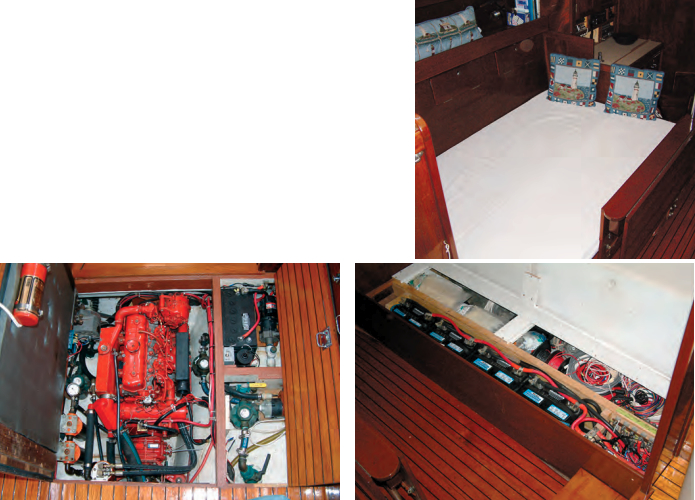
As mentioned above, the engine, a Westerbeke 42, was just three years old when the Hollisters bought Spirit. Perhaps in response to the first-day engine quitting, Floyd installed two large Fram diesel-truck filters to replace the existing filter. But, all too soon, it became necessary to rebuild the engine to correct a manufacturing defect. In 2003, at just 1,900 engine hours, Floyd had the engine rebored and fitted with new pistons, rings, bearings, camshaft, valves, tappets, and a redesigned head gasket. With the major rebuild work finally done, Floyd turned to upgrades and customization projects . . . now came the fun part!
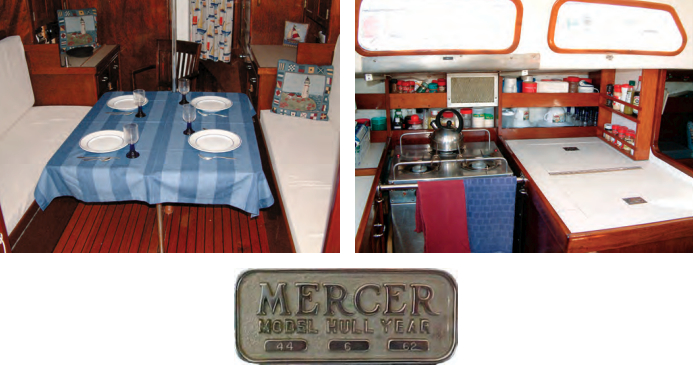
Below, the Mercer 44’s layout is typical of boats of its era: galley aft to port, quarter berth opposite to starboard; two settees, dining table, and nav station in the main saloon; head, hanging locker, and V-berth forward. Spaces are open and comfortable and storage is ample. The cabin sole is unique and handsome. Instead of traditional teak-and-holly, the sole is teak-and-ebony, with the ebony strips installed to be slightly proud of the teak. Ebony is an extremely hard wood — shoes touch the ebony, not the varnished teak.
The galley has a three-sided view outside, a big plus for the cook. As another galley benefit, Floyd added a vent to remove excess heat. In the locker behind the stove he installed a blower that vents outside through a conveniently located, custom-made 2-inch-diameter lifeline stanchion. The base of the stanchion tube extends through the deck to meet the blower outlet. The stanchion/vent pipe is capped when the stove is not in use.
In the main saloon, Floyd found the settees to be too low for comfort. He raised them so the cushion tops would be at the standard recommendation of 17 inches. “Besides improving the seating,” Floyd says, “that alteration made room for a bank of four batteries to fit under the starboard settee. Under the port settee, I installed a custom-made 40-gallon stainless-steel holding tank, vented at both ends. We made the tabletop narrower, which made room for a fold-out double bunk to port.”
Scaling to fit Ellen
Other changes were made to accommodate Ellen. “When I saw the first Mercer, I liked the idea of all that space,” she says, “but once we started sailing Spirit, I realized my personal scale was smaller than the boat’s scale. It was so different from the 30-footer I’d been sailing. Floyd added handholds for me and he converted the quarter berth to a storage area for galley gear and a lot of the extra stuff we accumulate when preparing for a cruise.”
Another small change made a big difference. Floyd put in a low step at the helm so Ellen can see better while sailing. “When we’re sitting at anchor,” says Ellen, “it’s a footrest. It fits my dimensions!” (And, Floyd mentioned, it also serves as a workbench.)
A recent addition is a Webasto diesel heater that guarantees comfort in the early spring and late fall, when sailing on Chesapeake Bay is its best.
“The heater also allows us to keep the boat dockside in the winter, rather than hauling it,” says Floyd. “Our dock has no electricity, but the boat’s solar panels provide the necessary power for the heater’s controls and pump. With the thermostat set at 38 degrees, the heater cycles on and off to maintain that level. In the coldest weather, it used 5 gallons of diesel a week. Last winter was a good test, with its record cold and snow.”
More add-ons include new bow pulpit, ground tackle, anchor rollers, stanchions and lifelines, steering system, 140-amp alternator and Freedom 25 inverter/charger, DC refrigeration, cabin cushions . . . the list goes on.
While Floyd was busy with the practical details of each project, Ellen applied her experience with genealogy searches to gather background information on manufacturers (two companies built the Mercer 44), Spirit’s previous owners, and other Mercer 44s and their owners. She traced and corresponded with a number of people, tracking race records (quite a few wins), noting cruise destinations (Spirit had already seen the Caribbean and Tahiti), and generally amassing an impressive record of the high praise given to these boats. Mercer Reinforced Plastics built the first six 44s — Spirit is hull number 6 built in 1962. Cape Cod Shipbuilding later acquired the molds and built several more. (Ellen enjoys being the “history detective,” an interest that began when she learned her great-great-great-grandfather had gone to California with the Gold Rush.)
Before moving to Annapolis, Ellen’s sailing experience was limited to a small boat on a small lake, but once she found the Chesapeake Bay YachtRacing Association, she began racing on a 30-footer.
“Sailing was my getaway, a way to separate myself from the stress of home and work,” she says. “As I drove to the Bay, I was already mentally involved with the upcoming race. I like good teamwork on a boat.”
Aboard Spirit, Floyd takes the lead, a likely throwback to his single handing days. “Floyd is so good at all aspects of cruising,” says Ellen. “He has excellent concentration and focus. We work together, but he’s the decision-maker.” For example, when anchoring, Floyd chooses the spot and stays at the wheel while Ellen moves forward to anchor. “We use hand signals,” she says. “They really are best.”
For their first trip along the Intracoastal Waterway, Ellen made a spreadsheet showing the main towns along the way, noting distances between ports, and marking the things she and Floyd might want to see. On each cruise, she keeps notebooks with sheet protectors to hold maps, postcards, brochures, and the other memorabilia cruisers collect. Spirit traveled north to Maine, then south to the Bahamas, a fitting reward after the many months of work lists.
Spirit shows what happens when a perfectionist takes on the restoration of a classic. There’s no room for “good enough.” If it’s not right, it’s not done. Floyd has a graduate degree in electrical engineering, and his background is peppered with research assignments, first for the U.S. Navy and later for private corporations.
I asked Floyd if, looking back at the effort that went into rebuilding Spirit, there was a particular time when his thinking moved from “fixing up an older boat” to “saving a classic.” He was surprised at the question. “Oh that probably happened even before I bought Spirit. This is a beautiful boat. It needed some TLC. Of course, I didn’t realize how much initially — few new owners do. But still, I thought at the time, ‘It’s worth it.’ And I still think that. This boat will be here for another 50 years — it needs a new and devoted owner.”
That will be one new owner who won’t need to consider restoring, revamping, or rebuilding a classic. Spirit is as close to new as a good old boat can get.
Zora and David Aiken are the authors of several boating books, including Good Boatkeeping, 2nd Edition; Cruising, the Basics; and Fiberglass Repair, Polyester or Epoxy and are currently working on their sixth children’s book. Their movable studio, office, and home is Atelier, a good old, now classic, 1963 Chris-Craft sloop.
Thank you to Sailrite Enterprises, Inc., for providing free access to back issues of Good Old Boat through intellectual property rights. Sailrite.com