It launched sound boats but foundered in shoal financial waters
Issue 87 : Nov/Dec 2012
A few ocean-going sailboats are familiar to almost every sailor: the Pearson Triton, generally accepted as the first large production-run fiberglass cruising sailboat; the Valiant 40, an ocean greyhound that has made many long-distance cruising dreams come true; the Tayana 37, so beautiful and well mannered, and still in production to this day; and the Allied Seawind, the first fiberglass sailboat to circumnavigate the world.
But the boat that made the largest impact on the cruising-boat market throughout the 1970s and onward was arguably the Westsail 32. Sturdy yet elegant, stout yet sweet, it was a ship for the average person, a boat that bore the dreams of a thousand couples and countless others who have owned them over the years. The Westsail 32 was the best-known cruising sailboat of the 1970s and prompted scores of companies to launch hundreds of similar models in bids to capitalize on its popularity.
Kendall and Crealock
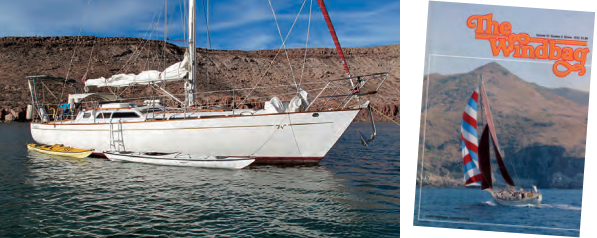
Around 1968, in Costa Mesa, California, a boatwright named Larry Kendall and a group of four or five other boatbuilders got together to build for themselves what they conceived as the ultimate offshore sailboat. The design they chose was a well-proven Norwegian-style double-ended cutter penned by William Atkin of Long Island, New York, for construction in wood. Called the Thistle by William Atkin, the design was a heavy-displacement, 32-foot, flush-decked cutter with low freeboard and a full keel. Because their intention was to build in fiberglass, Larry and his group approached an up-and-coming British naval architect and Southern California resident by the name of W. I. B. “Bill” Crealock, who had done quite a bit of offshore cruising on various sailboats during the 1950s. He understood well the requirements of a safe bluewater cruiser and was able to assist Larry by modifying and adapting the design for construction in the relatively new material of fiberglass.
By the end of the 1960s, four or five hulls had been built and were being fitted out in meager facilities on a small property in Costa Mesa. The hulls were built in two halves, one side at a time, because the workshop was too small for an entire hull. As work progressed, the boats drew a lot of attention and, before long, orders for additional hulls became a possibility. Larry worked out an arrangement with his fellow builders to use the molds to build some additional boats and the Kendall 32 was born. Larry ran a small ad in one of the yachting magazines offering bare-hull kits and had an overwhelming response. The newly formed company built another 25 or so boats, but by 1971, because of less-than-ideal management and escalating material and labor costs, Kendall Yachts declared bankruptcy.
Enter the Vicks
At the subsequent auction of assets, Lynne and Snider Vick, who recognized that the world market was ready for a true ocean-going sailboat, managed to snap up the molds for a mere $1,000. Until then, most ocean voyaging was being done on small custom yachts or in converted coastal cruisers, many with small tank capacities and with hulls and rigs that were not well suited to offshore sailing conditions.
By the early 1970s, many families in America were beginning to feel the new prosperity created in the post-World War II economy. Suddenly, the second home, whether a camper, a cabin in the woods, or a sailboat, seemed like an affordable way to get more enjoyment out of life. A general “back to nature” trend was in full swing, and the economies of mass-production fiberglass boatbuilding made it financially realistic for the average family to own a small sailboat. And with the right boat, anyone could satisfy an innate wanderlust and cruise to exotic destinations like the South Pacific or the Mediterranean Sea, or even brave Cape Horn. The thirst for adventure is human nature, of course, and this manifestation of it during the 1970s was very similar to the trend to the sea that followed the Depression, when John Hannah designed the Tahiti Ketch as an affordable boat on which to escape the economic and social troubles of the 1930s.
Racing and coastal cruising were the most popular ways of fulfilling the sailing dream, but coverage of the Golden Globe nonstop round-the-world race (won in 1969 by Robin Knox-Johnston on a 32-foot double-ender very similar to the Kendall 32) and the OSTAR (Observer Singlehanded Transatlantic Race) in the popular media, and the National Geographic series about young Robin Lee Graham (who sailed around the world on a couple of small fiberglass production boats) opened eyes to broader horizons. A lot of people started thinking, “Why don’t we buy a boat and sail around the world?”
Lynne and Snider Vick recognized the opportunity to capitalize on these dreams, and now owned the Kendall 32 molds. After enticing Larry Kendall to join them as production manager, they started the Westsail Corporation to build the boats.
Production begins
Orders for the boat, now dubbed the Westsail 32, began to trickle in. After a few months of production, hull number 50 was launched. With a demonstrator boat in the water, a move to a new larger production facility, and a well-planned advertising campaign, orders soon increased to a stream. Just prior to the move to the new factory, and with pressure on the company to increase production to keep up with all the new orders, it was a tense time at Westsail. In the midst of all this activity, Larry Kendall left the company.
With no production manager and more and more orders for boats coming in, the Vicks quickly cast about for a production manager. They were able to locate Bailey “Bud” Taplin right in Costa Mesa. A well-traveled sailor, boatbuilder, and engineer by training, Bud had earlier revamped the production line at MacGregor Yachts, setting up a more efficient operation to increase output from five to 20 boats a day. He had then moved over to Coastal Recreation, which had just relocated to a new facility and needed help setting up a production line to build the Aquarius 21 and 23 and the Balboa 20 and 26 swing-keel trailersailers.
Lynne Vick was in the advertising business and was doing the advertising for Coastal Recreation, so one day she asked the owner if he knew anyone who might be able to help them ramp up production at Westsail. Bud’s contract with Coastal Recreation was nearly finished and after a few weeks of negotiations, Bud joined the fledgling Westsail Corporation.
Great things were about to happen. Carefully reworking the building sequence, setting up a more efficient production line, and improvements in the molds and tooling led to a substantial increase in production. By the time hull #100 rolled out of the yard, a hundred more were on back order. One Westsail 32 was purchased by a well-known actor, and a feature article appeared in Time magazine, complete with a full-page photo. The lines at the boat shows to see the Westsail 32 were the longest of any builder’s. In the July 1976 issue of Playboy magazine, an article titled “The Playboy Boat Stable” featured the Westsail 32.
Like Larry Kendall, the Vicks offered the Westsail 32 as a bare hull and in various stages of completion, to be finished by the owner.
One such owner was author Ferenc Máté, who wrote a book about his experiences. From a Bare Hull inspired even more people to act on their dreams, and though the promise of huge savings was seldom realized, many fine (and not so fine) boats were completed in this way.
Orders continued to pile in much faster than the production line could handle. In 1974, a second production facility was opened in North Carolina. Over disagreements on how to best increase production and keep the company profitable, Bud Taplin left Westsail in mid-1974 to begin his own custom-yacht firm, Worldcruiser Yachts (which is still in business today supplying parts and consultation to Westsail owners). Hans Weerman was hired to replace Bud and yet no major restructuring of the business was undertaken.
Times were good and the money was flowing. A 28-foot version, designed by Herb David, was introduced, and new 42 center-cockpit and 43 aft-cockpit Crealock designs were in production by the end of 1974. Famous newsman Walter Cronkite bought a Westsail 42. The last model was a 39-foot Robert Perry design. But even as Westsail 32 hull #700 came off the line in early 1977, there were problems in the making.
Storm clouds brew
Because of double-digit inflation and the effect of embargoes on the price of oil-derived products, the cost of resins and other building materials was rising exponentially throughout the mid-1970s. Sales prices that should have assured profits when contracted incurred losses when the boats were delivered a year later. By early 1977 the company was nearly bankrupt, and by hull #800 the end was in sight. A Chapter 11 reorganization gave ownership to the production manager, who kept on building boats until 1979, and two subsequent production attempts under different ownership resulted in a few more hulls being built, but by early 1980, Westsail was no more. After producing close to 830 Westsail 32s, along with 120 Westsail 42s, 60 or so Westsail 43s, about 78 Westsail 28s, and a handful of Westsail 39s, by the early 1980s the company was only a legend.
The legacy
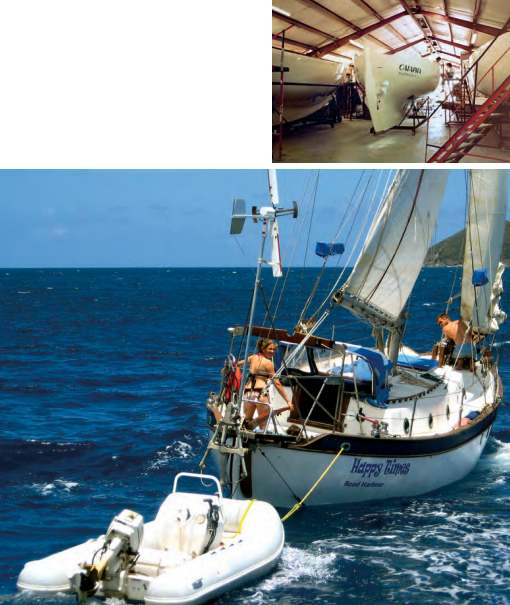
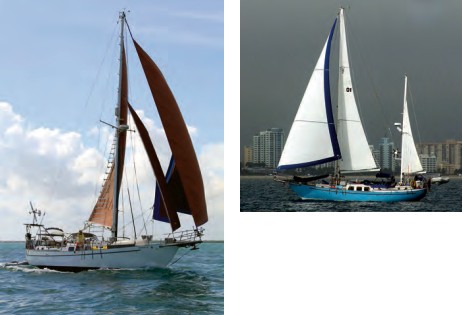
And what a legend it has proven to be. At one point in time it was estimated that more Westsails had circumnavigated the globe than all other fiberglass sailboats combined. People have taken Westsail yachts to every ocean and every continent, including Antarctica. Movie buffs will know that the Westsail 32, Satori, abandoned in the storm that was the subject of the book and movie The Perfect Storm, washed up on a beach weeks later with no significant damage. She is still sailing today.
Westsails have been through the Northwest Passage, rounded the five great capes, and visited the far reaches of the Amazon. To this day, in almost any major port in the world, a Westsail yacht might be seen at anchor, or will have just left on yet another voyage of discovery for its proud owners.
Because of superior lamination techniques and good materials, Westsail hulls have rarely experienced the problems with hull blistering or deck delamination that plagued other manufacturers. Along with the use of quality parts and hardware and simple rigging, this has allowed Westsails to withstand the test of time.
In fact, Lynne and Snider Vick are still the happy owners of the Westsail 42, Clea, which was built while they owned the company, and are regular customers of Bud Taplin’s Worldcruiser Yachts. The Vicks continue to maintain their boat in good cruising condition; she is now based in Honduras and the Vicks spend half of each year cruising the Western Caribbean.
Todd Duff is a marine surveyor and writer. He lives with his fiancée, Gayle Suhich, aboard their Westsail 42 ketch (hull #1), Small World. On this and previous boats they have visited 23 countries under sail and are currently in the Bahamas, bound for more Eastern Caribbean adventures in the coming season.
Thank you to Sailrite Enterprises, Inc., for providing free access to back issues of Good Old Boat through intellectual property rights. Sailrite.com