A personal checklist from a 7-year liveaboard
Issue 69 : Nov/Dec 2009
When my wife, Jan, and I decided we wanted to live aboard a sailboat and cruise the East Coast, the Bahamas, and the Caribbean for several years, we started reading all we could about the lifestyle, the kind of boat needed, the kind of equipment needed, and how we should prepare ourselves. We also talked to everyone we could find who had done it. We then bought a 1983 12-meter (41-foot) Catalac catamaran in December 1998 and moved aboard a year later.
We lived aboard Sojourner for more than seven years before reluctantly moving ashore not long ago. We cruised up and down the East Coast twice, spent many months in the Bahamas and Turks and Caicos, and enjoyed nearly five years in the Caribbean. Here are some ideas, based on our experience, that you might find useful if you’re planning to live aboard and cruise on an older boat.

Preparing ourselves
Hundreds, if not thousands, of books and magazines contain articles about living aboard and the cruising lifestyle. We read a lot and kept talking to people who had done it. I had been trained on electronics in the Air Force and had fooled around with car engines since before I could drive. And, like most homeowners, I had repaired a lot of plumbing and done other household projects. Jan had experience working with wood, fiberglass, and paints. But we felt totally inadequate when it came to reading weather charts, navigating offshore, operating a diesel engine, handling large sails, and facing much of what is involved in caring for a boat complex enough to live aboard and cruise for several years.
A friend recommended that we join the local U.S. Power Squadron and take some courses. This was some of the best advice we were ever given. Even new boats have their share of equipment problems, but older boats are bound to have more. Besides, any bluewater cruising boat can be very complex, with AC and DC electrical systems, diesel engines, gasoline outboard engines, lots of batteries, refrigeration, not to mention plumbing with through-hulls, vacuum breakers, anti-siphon designs, holding tanks, water pressure systems, and other fun stuff. The Power Squadron didn’t make us experts, but we did gain confidence and saved a lot of time and money over the years by either supervising repairs to the boat or fixing equipment ourselves. We also learned from other Power Squadron members the importance of inter-crew communication while anchoring, mooring, arriving at or departing from a pier, and handling sails.
Selecting the boat
We had owned a couple of lake- and coastal-sized monohulls before deciding to live aboard and cruise for several years. We naturally figured we’d get a larger mono to cruise in, but some of our Power Squadron friends pointed out that, if we were going to cruise the Intracoastal Waterway and the Bahamas, we should consider a shallow-draft boat. They pointed out that many areas of the ICW are very shallow. The Bahamas and the Turks and Caicos have thousands of square miles of water less than 20 feet deep and limitless coves and islets where the water is less than 10 feet deep. A deep-draft monohull would not be comfortable in those areas but a catamaran would be ideal.
We chartered a catamaran for a weekend and found it to be easy to handle, very stable, and very roomy. It also rolled little at anchor and, since we were guessing that we would spend a lot of time at anchor, this feature appealed to us. As it turned out, a lot of anchorages in the Caribbean can be rolly, but we never felt uncomfortable or spilled a drink due to Sojourner rolling at anchor.
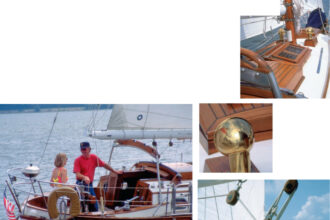
We looked at dozens of catamarans, including many new ones. It was quickly apparent that an older boat offered several advantages, such as a lower purchase cost and lots of installed cruising equipment. In the case of the 12-meter Catalac, the bonuses included inside and outside helm stations, an enormous cockpit, and cavernous stowage.
The main disadvantage of an older boat is that much of its equipment will be worn and will eventually have to be replaced. During the first two years with Sojourner, we replaced both engines and transmissions, the mainsail, all the radios, the GPS, autopilot, standing and running rigging, and the dinghy and outboard. We also overhauled the watermaker, re-bedded all the windows, and did a lot of varnishing. The result was a boat we were comfortable on and equipment we had confidence in.
It was important too that the top of her mast was less than 50 feet off the water, so we’d be able to get under all the fixed bridges on the ICW. At her widest, she’s 17.5 feet, so she can be hauled by an 18-foot travel lift. This proved to be an asset whenever we hauled out for bottom painting; wider lifts are not always available.
Getting her cruise-ready
Sails – We carried two mains, two jibs, and two spinnakers. We never had a blown-out sail, but we consider ourselves chicken sailors. We always studied the weather closely before making a crossing, so we never sailed in adverse weather. But the tropical sun is very hard on sails and stitching, so we carried spares.
Mast steps and bosun’s chair – Sojourner came with folding mast steps and two bosun’s chairs. These came in handy for changing light bulbs and checking rigging. When I climbed the mast, I also used a safety line tied to a halyard with a Prusik hitch that slides until pressure is put on it and then locks in place. This was easy to tie and to remove and added a great deal of security.
Equipment and safety
This is a subjective topic. What one person feels is absolutely essential, another may not care about. Here’s what we found to be essential for us.
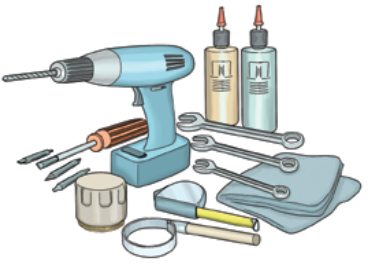
Tools and repair supplies – We carried all the tools we needed for routine maintenance and essential repairs. These included adjustable wrenches, open-ended and box wrenches, socket wrenches, Allen wrenches, screwdrivers, a battery-powered electric drill, drill bits, a hammer, hacksaw, wood saw, a few pieces of scrap wood to protect the boat finish from damage when working on some equipment, oil-filter wrench, a volt/ohm meter, and a small clamp-on vise. We also carried some extra wire of various sizes, spade terminals, a wire stripper, and a crimping tool for reconnecting electrical fittings. And, since Sojourner is fiberglass, we carried epoxy, hardener, and some fiberglass cloth. Although we never had occasion to use them, we also had aboard several sizes of wooden plugs in case a through-hull failed.
Spare parts – We carried a sail repair kit with appropriate patch material and thread, hose clamps of various sizes, extra hoses for all applications, bulbs for all lights, engine oil and filters, fuel filters, stainless-steel nuts, bolts, and screws, and shackles of various sizes. We had electrical tape, duct tape, caulking, sealant, and insulating material (such as Fluid Film) for electrical connections. We also carried spare bilge pumps, fuel pumps, and pressure-water pumps. These items can be found in the Caribbean but at much higher prices than in the States. When we were forced to order something from home, we usually had to pay an import tax and experience delays in receiving it. We also carried books on diesel and electrical repairs.
Radios and inverters – We never sailed offshore without a working single-sideband or ham radio. We felt we needed the long-distance transceiving capability for safety and weather information. In short order, we purchased a modem that allowed us to connect our laptop to the SSB so we could download weather charts and send and receive email at sea. We also installed a NOAA-registered EPIRB. The laptop needed 120-volt AC to charge its battery, so we installed a 1,500-watt inverter.
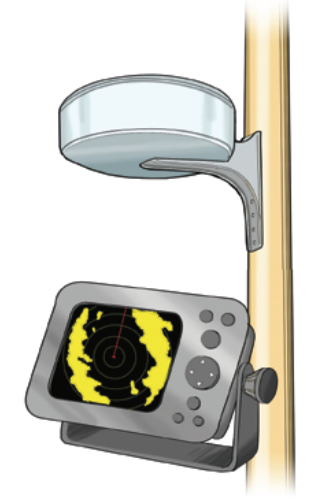
Radar – We recommend having radar. Many cruisers we met were not so equipped, but we found it to be essential, especially when sailing at night through busy shipping lanes. It was also extremely helpful while cruising eastward at night along the north coast of the Dominican Republic and the north coast of Venezuela. Easting along these coasts is best done at night because of the beneficial effect of adiabatic winds off the mountains, which tend to neutralize the trade winds. Since there are numerous fishermen in small boats in the same areas, radar helps identify and avoid them and their nets. We did most of our passagemaking between islands in the Caribbean at night also, as we felt it desirable to arrive at our new destination in the morning, giving us the day ahead to find a good anchorage or marina. The distances between most islands allow for an easy overnight sail. We also installed a radar reflector to help others see us.
Navigation – We carried paper charts for backup but we primarily used GPS. We had a mounted Garmin color moving-map display and two hand-held backups.
Autopilot – Sailing a boat is fun but can become tiresome. The longest nonstop voyage we took was from Puerto Rico to Marathon, Florida: 7 days. This would have been a chore without an autopilot.
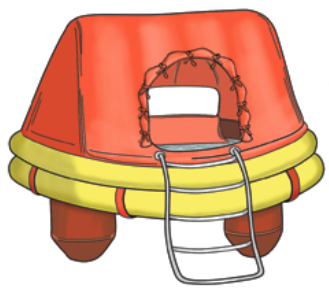
Life raft – Although we met many cruisers who did not have one, we felt that a life raft was essential. We carried a six-person enclosed type. We were convinced, after attending a Seven Seas Cruising Association seminar on life rafts, that a six-person raft would be minimally comfortable for two.
Ditch bag – We never used it, but we kept a waterproof bag handy that could be thrown in the life raft if we had to abandon ship. The ditch bag contained a hand-held GPS, a hand-held VHF, a strobe and flashlight, extra batteries, copies of our passports and other documents, first-aid supplies, and extra water and food. All certified life rafts have some of these supplies aboard, but it never hurts to pack your own and carry extra water.
Life jackets – We carried six Coast Guard-approved offshore PFDs. We had two Sospender inflatables, which are not uncomfortable to wear, and four vest types. Many states require PFDs even for short trips in a dinghy.
Jacklines, lifelines, and toerails – Some newer boats do not have toerails or adequate lifelines or an easy way to connect a jackline. Toerails may not seem to be a major issue, but ours have saved many a tool from going overboard. Lifelines should be strong enough to live up to their name. A jackline is a must if you do any serious sailing, especially at night. We have often discussed which would be the worse scenario: falling overboard and your partner doesn’t know it or waking up to find you’re alone on the boat.
Fire extinguishers – Small extinguishers are readily available at any marine-supply store. They’re cheap and easy to install. We kept seven aboard.
Bilge alarms – One of our bilge pumps came on one night and we didn’t hear it. Although it probably pumped only a small amount of water overboard, its float switch stuck and the motor burned out. We did smell the motor. After that experience, we installed an 8-light alarm that would identify an activated pump with visual and aural alarms. We never had a sticking float switch after that, of course, but the monitor gave us peace of mind. This is a good place to mention hand pumps. We kept a manual bilge pump aboard with a long hose on it just in case.
Safety inspections – The Coast Guard Auxiliary and Power Squadron offer safety inspections. We took advantage of them more than once. We didn’t want to take a chance on overlooking something that was unsafe or something required by a local law enforcement agency or the Coast Guard.
Emergency steering – Sojourner has hydraulic steering, which is very dependable, but we also had an emergency tiller. We practiced using it and it worked well, but that taught us to keep it handy, as the first time we tried it, it took us 10 minutes to locate it and dig it out of a locker.
About pirates – No discussion of safety would be complete without a mention of pirates. We never had a problem with pirates, but we met a few cruisers who did. Problems ranged from boardings while offshore to break-ins at anchor. The trouble spots in the Caribbean when we were there were St. Vincent and Venezuela. There are many desperately poor people in those countries and the governments are so inept or uninterested that very little is done to protect cruisers.
We stopped only once in St. Vincent, even though we sailed past the island several times. When in Venezuela, we kept to safe areas — those where lots of cruisers could be found — as much as possible. If we had to traverse a troubled area, we sailed with at least one other boat. We did not carry firearms, as most Caribbean countries have strict laws prohibiting them. We also learned never to leave a dinghy in the water overnight, especially one with an outboard on it, and we carried a chain and padlock to lock our dinghy to a pier when going ashore. We also had a padlock on the outboard. The best source of information about where to cruise
safely is the Caribbean Safety and Security Net, discussed below.
Watermaker – Many cruisers did not have watermakers; we provided a great deal of fresh water to several of them. If you plan never to be more than a day or so away from a marina, you may not need a watermaker, but if you plan to anchor off an idyllic island for a few days, you’ll wish you had one. We once spent six weeks anchored off Isla La Blanquilla, about 100 miles off the north coast of Venezuela. We loved every minute of it and could not have done it without a watermaker. Be sure to carry spare filters for the watermaker.
Anchors – We learned how to properly set an anchor through the Power Squadron. We also learned to carry at least three types: Danforth, Bruce, and Brittany (similar to the Danforth, but stockless). Different anchors are necessary for different bottoms. Plus, there were times when we deployed two or more anchors. In narrow anchorages with minimal swinging room, or those where the tide reversed the direction of the current, we used fore-and-aft anchors in a Bahamian-style deployment. If the winds were particularly strong, we used two anchors for safety.
Electric windlass – Sojourner’s anchors are heavy. Pulling in a 65-pound anchor plus another 200 pounds of chain by hand is no fun. We carried 230 feet of chain rode and needed it all on occasion. There are some lovely, but deep, anchorages in the Caribbean.
Refrigeration – Refrigerators, freezers, and icemakers come in all sizes and types from engine-driven to electric to propane. We have met many cruisers who would not fool with any kind of refrigeration. We also met cruisers who would not leave a marina without a functioning icemaker. We landed somewhere in the middle. Sojourner has a top-loading 12-volt refrigerator capable of making ice, although we rarely needed ice. The fridge was adequate for items that had to be refrigerated: cheese and fresh meat or fish. We never refrigerated eggs, vegetables, or fruit.
Generators – The more electric stuff on board — such as refrigerators, freezers, and watermakers — the more need for a way to charge batteries or generate 120-volt AC. We met cruisers who installed a 120-volt AC generator on the engine, but we had a separate diesel-powered 4-kilowatt Onan that could run our air conditioner and watermaker while charging our batteries at the same time. We never used solar panels or wind generators.
Air conditioning – At anchor, we rarely ran our air conditioner because we had nice trade-wind breezes, but in marinas, we really enjoyed it. The heat can get stifling if a marina is tucked behind hills or buildings that block the breeze. Ours was a 16,000-Btu water-cooled Mermaid.
Propane – Almost everyone carries propane to fuel a water heater or stove and range. We carried three 20-pound tanks because we liked to stay at anchor for extended periods. Only one tank could be connected at a time, and we installed a safety shut-off switch for the propane supply. We sure didn’t want a leak to go undetected. A propane detector is a good idea. We never had any problem getting tanks refilled.
Clothing – We started cruising with all kinds of extra clothing until we realized that all we needed was a couple of pairs of pants and shirts, skirts and blouses, and shoes in case we had to fly back to the States. Other than that, it was bathing suits, cargo shorts, T-shirts, and sandals. Because the tropical sun is hard on clothes and our clothes were frequently ruined by oil, caulk, or grease, we were always on the lookout for cheap replacements. Finding replacement T-shirts, shorts, and sandals was not a problem.
Sunshades – A sunshade covering for the entire boat is important in the Caribbean. The tropical sun can be brutal, but a shade can make an otherwise sweaty day very enjoyable. We carried a sewing machine, and Jan made our sunshade and roll-up side panels out of a material called Griffolyn. It’s tough as nails, half the weight of Sunbrella, and waterproof. We chose white after trying blue and green. The darker colors looked nice but got very hot and cut down on the light inside the boat. The sunshades enabled the air conditioner to do a more effective job. Reef Industries makes Griffolyn.
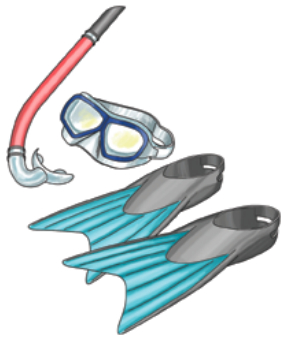
Snorkel and scuba – We got along fine with snorkels for the first three years in the Caribbean. Then we had the opportunity to get certified for scuba. What a wonderful experience that proved to be. Even if you use it for nothing else, it makes cleaning barnacles off the hull and props very easy.
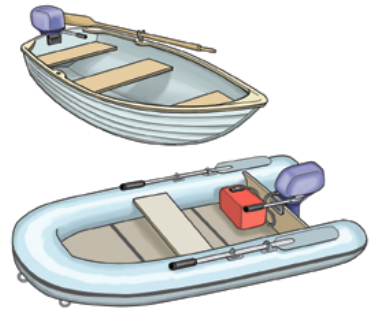
Dinghy and outboard – Our first dinghy was a 10-foot Avon inflatable. The advantage of an inflatable is that it can be deflated for storage. We never deflated ours intentionally, although it deflated itself at some inopportune times. We eventually purchased a 10-foot Livingston fiberglass dinghy. It had the same overall dimensions as the Avon and weighed the same. It never deflated and we didn’t have to worry about it getting torn by a barnacle or sharp piece of coral. We also had a cantankerous 10-hp Evinrude outboard, so we purchased a new Yamaha 15-hp replacement that ran like a dream. A dependable dinghy and outboard are absolutely essential for getting to shore or the marina when you’re anchored out.
Food – When we started cruising, we carried lots of dried and canned food. This was unnecessary. Food can be purchased everywhere. We started eating like the natives do with lots of local fruit, vegetables, chicken, and fish. We did eat beef and pork occasionally, but outside the United States no one seems to age beef, so it doesn’t taste the way we expect it to.
Finances – ATMs are everywhere, so we didn’t carry lots of cash or traveler’s checks. However, we had to pay a conversion fee for the local currency and a bank fee each time we used one, so each time we used an ATM, we drew as much as we felt safe carrying. We also kept about $1,000 in cash hidden aboard for use in an emergency. U.S. dollars and euros are accepted everywhere, so spending money is not a problem. We developed a budget that worked for us. When we were cruising (from 1999 through 2007), we met cruisers who were spending as little as $1,000 a month and others who were spending $5,000 a month. Obviously, the amount of fuel you require, the type of food and beverages and entertainment you prefer, and the maintenance costs for your boat will have a great influence on your budget. We found that talking with other cruisers was the best way to find out about current prices in various locations.
The Caribbean Safety and Security Net – We always monitored this wonderful net on our SSB radio in order to learn what was going on in the Caribbean. It was also a great source of information on where to get services.
Herb Hilgenberg and South Bound II – We had not heard of Herb Hilgenberg and his call sign, South Bound II, before we started cruising. Herb has been broadcasting Atlantic weather and helping cruisers for more than 20 years. He specializes in advising transatlantic cruisers about weather in the Atlantic, but he will also help Bahamas-bound cruisers. He draws the line at the Caribbean because of the many other nets and aids in that area. Herb is one of the cruising community’s greatest assets.
Our experience
We felt the cruising lifestyle was very healthful, and provided us with plenty of exercise and fresh air. We found the cruising community to be made up of lovely people who were always willing to assist whether we needed advice or a helping hand with a project, and we still correspond with dozens of them.
We had a wonderful time and will always treasure the memories of our cruising days.
Cruising was nothing like living ashore. Even with a watermaker, we took Navy showers or we bathed in the ocean and rinsed with fresh water. We also learned to conserve battery power. We snorkeled and went scuba diving. We read and swapped dozens of books, DVDs, and computer games with other cruisers. We played hours and hours of dominoes and worked hundreds of crossword puzzles.
We learned about the history and culture of the countries we visited and took many tours inland. We made an effort to learn a little Spanish and French. And even though our accents and grammar were terrible, we had fun at least trying to communicate with the locals. We know our efforts were appreciated. We found an excellent book, titled Spanish for Cruisers, by Kathy Parsons, that covers all the Spanish words and phrases we needed in order to obtain parts or repairs for our boat. (Note: Kathy has published a French version also. –Eds.) We learned that a smile is understood in any language and paid big dividends when dealing with officials in the various countries we visited.
We tried to use common sense, be safe and, more than anything else, we really enjoyed being on Island Time.
Dan Ahart, and his wife, Jan, found they had a common interest in boating when they were dating, about 42 years ago. They later owned a 17-foot O’Day and a MacGregor 26. When retirement loomed, they became interested in ocean sailing and bought Sojourner.
Thank you to Sailrite Enterprises, Inc., for providing free access to back issues of Good Old Boat through intellectual property rights. Sailrite.com