Her name is symbolic of a cruise and a career
Issue 87 : Nov/Dec 2012
George Smith began reading about boats when he was in grade school. As he grew older, his reading focused more on sailing books, especially stories of singlehanded sailors on around-the-world-voyages.
In 1959, when he was 29, he completed his doctorate in physics at the University of Chicago and moved to the East Coast to join Bell Telephone Laboratories in Murray Hill, New Jersey. There, he worked as a scientist/inventor in micro-electronics.
In 1969, George and Willard Boyle together invented the charge-coupled device (CCD). A CCD can hold a charge corresponding to variable shades of light and is a technology that has made digital cameras possible. Because of its superior sensitivity, the CCD has also revolutionized the field of astronomy and is used extensively in astronomical telescopes, such as the orbiting Hubble telescope.
“CCD technology was translated into a TV camera within six months,” George says. “Creating a CCD camera to replace a film camera was more of a challenge, since the picture information had to be easily stored and that technology wasn’t available until several years later.”
George and Willard were named Fellows by the IEEE (Institute of Electrical and Electronics Engineers) and the American Physical Society. They are also members of the National Academy of Engineering. Their invention of the CCD has been recognized with the Ballantine Medal of the Franklin Institute, the Morris Lieberman Award of the IEEE, and the Draper Award of the National Academy of Engineering.
Sneakbox to Southern Cross
The sailing dreams inspired by the books George had read while growing up finally turned into reality when, after receiving his Ph.D., he bought his first boat. It was a Barnegat Bay Sneakbox, a shoal-draft boat originally designed for fowl-hunting in marshes and shallow water. Without any previous sailing experience, George took his sneakbox out on Barnegat Bay and learned to sail.
Janet Murphy was an elementary teacher in Barnegat, New Jersey. She began sailing on Barnegat Bay in the early 1960s in a Morton Johnson catboat. She and George met at the Barnegat Bay Boating, Boozing, and Bailing Society, which George had organized and where they shared their enthusiasm for sailing.
Subsequently, George and Janet began cruising the East Coast during their summer vacations in a Morgan 22. They sailed north to Maine and south to South Carolina. During that cruise they circumnavigated the Delmarva Peninsula.
Cruising the East Coast in the Morgan 22 was an adventure, but George had not forgotten the tales of circumnavigations he’d read in his youth. An around-the-world cruise was clearly on their horizon, so he and Janet decided to hone their bluewater skills with two voyages to Bermuda.
“Picking a boat for our Bermuda trip and our planned around-the-world cruise wasn’t difficult,” George says. “Through the years, I had compiled a list of everything I wanted on a bluewater boat, and the Southern Cross 31 filled the requirements of strength and simplicity. We had the boat semi-custom built to our specifications.”
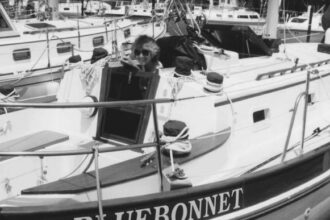
George and Janet took delivery of their world cruiser in 1983 and named her Apogee. The non-astronomical definition of “apogee” is “culmination or apex.” Their boat was aptly named, for it would be used to bring a lifetime dream to its culmination.
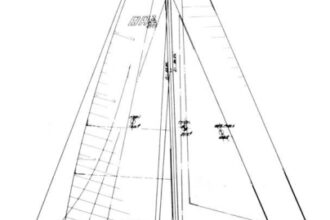
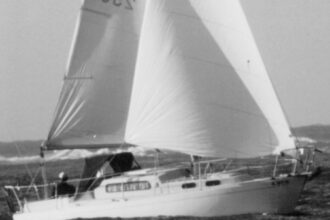
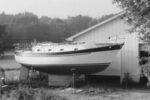
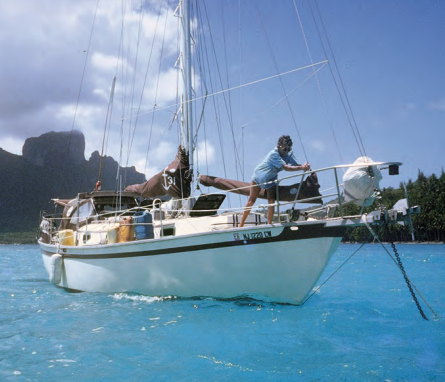
The Southern Cross 31, a full-keel double-ender designed by Thomas Gillmer, is reminiscent of Colin Archer’s work nearly a century earlier (Note: For more about Thomas Gillmer and his designs, see our article in the July 2002 issue –Eds.). It’s cutter-rigged, has a bowsprit, carries 447 square feet of sail, and has a very low capsize ratio. It has an outboard rudder with a tiller and a small cockpit suitable for a boat that will make ocean passages. The hull is fiberglass with an Airex foam core and the deck and cabinhouse are balsa cored.
The first Southern Cross 31 was built in 1976 by Clark Ryder in Bristol, Rhode Island. When production ceased in 1987, 130 boats had been made.
Onward from Bermuda
“The year we took delivery of the boat we made a trip to Maine,” Janet says, “and the following year, 1984, we sailed to Bermuda and back. We made another Bermuda trip in 1985, and in 1986, after George retired from Bell Labs and I retired from teaching, we sold all our possessions — except for George’s summer house. We stowed away all the things we would need on Apogee and sailed to Bermuda again . . . then just kept going.”
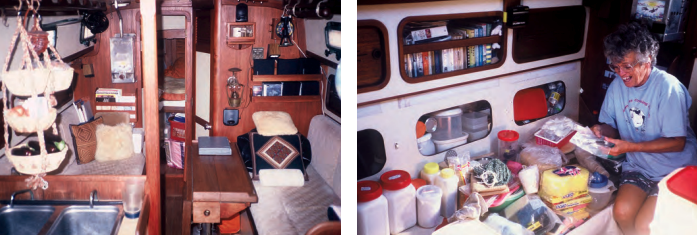
With all their supplies, an estimated 3,000 pounds, Apogee was down 4 inches on her waterline. They removed the labels from all their canned goods, wrote the contents on top with a waterproof marker, and varnished each can. They used the V-berth for sleeping when in port, but at sea slept in the main cabin, where the motion was less pronounced.
Since kerosene was readily available worldwide, they used it as the fuel for their stove and oven, cabin heater, and lights. They carried 45 gallons of diesel and 70 gallons of water and supplemented their water supply with a reverse-osmosis system. Solar cells on deck kept the batteries charged. Their Aries windvane self-steering system used no power but they had an electronic autopilot aboard, just in case.
George and Janet expected their world cruise to last about four to five years, but it turned into an adventure lasting 17 years.
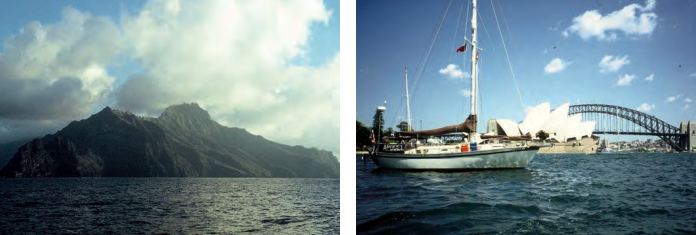
The first circumnavigation of the globe was attempted nearly 500 years ago by Magellan. His ship completed the three-year voyage without him. A chronicler at the time wrote: “Nevermore will any man undertake such a voyage.” The chronicler was wrong. Scores of sailors have completed world circumnavigations in small boats, but this in no way diminishes the challenge and the expertise needed to bring such a cruise to fruition.
“We ran into a really bad storm between Bermuda and the Azores,” Janet says. “We figured if we could survive that one, we could survive anything.”
“On our whole ’round-the-world trip,” George says, “we never had any major equipment failures.” Obviously, their choice of the Southern Cross 31 and their specifications to the builder were vindicated.
“From the Azores, we sailed to Madeira and the Canary Islands, where we joined the ARC (Atlantic Rally for Cruisers) to race back across the Atlantic to Barbados with 203 boats.”
“We took first place in the handicapped race out of the 80 boats participating in the couples division,” Janet says. “We spent six months sailing the Caribbean. Then, in May 1987, took the Panama Canal into the Pacific, sailing to the Galapagos Islands, where we spent 27 days.”
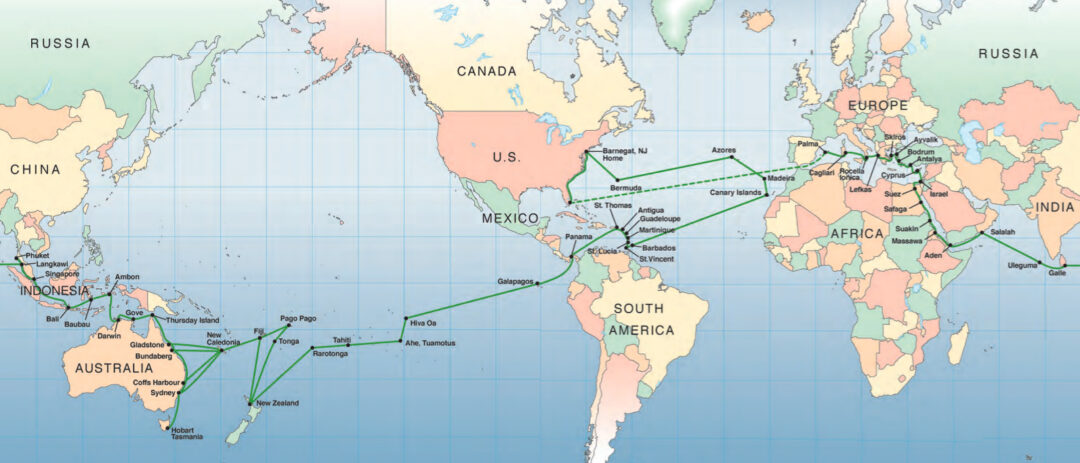
“At that time,” George says, “if you applied to the Ecuadorian government, you could get a permit to take your boat into the islands. They don’t allow private boats to visit the Galapagos anymore.
“From the Galapagos Islands, we made a 3,000-mile run to the Marquesas, all of it downwind. We just set the sails wing-and-wing, left them alone for a couple of weeks, and let our Aries windvane do its job.
“From the Marquesas, we sailed to Tahiti, Moorea, and Bora Bora in the Society Islands. Then we were off to the Cook Islands. From there, we headed toward the North Island of New Zealand, arriving in November of 1987. We made New Zealand our home base for several years but, since a visa was only good for six months, we spent the cyclone season in New Zealand and after six months sailed to the Fiji Islands, Tonga, and American Samoa before returning and applying for another six-month visa. We did that from 1987 until 1992, when we decided to continue our trip by returning to Fiji, then New Caledonia, and finally Australia. Australia had the same six-month visa restrictions as New Zealand, so in our six months out of the country, we made return visits to New Caledonia and Vanuatu.
“In 1995, we went around the coast of Australia to Darwin and entered the Darwin-Ambon race to Indonesia, where we spent three months before heading to Singapore. After two months in Singapore, we sailed to Malaysia and Thailand, seeing as much of the backcountry as possible.
“In 1997, we sailed from Malaysia to Sri Lanka, the northern Maldives, Oman, and up the Red Sea, visiting Yemen, Eritrea, Sudan, and Egypt. In those days, the pirate activity was not what it is today. We then went through the Suez Canal to Ashkelon, Israel, where we spent a year. From Israel we went to Cyprus and then Turkey, where Apogee spent two years before sailing to Greece.”
Apogee of a cruise
“While in Greece, with the Atlantic hurricane season approaching,” Janet says, “we decided that we’d spent 16 years on our voyage and we just didn’t want to make a third crossing of the Atlantic. It was time to call our voyage to an end and return home.”
They booked their boat on a Dockwise Yacht Transport seagoing dry dock. The Dockwise ship would depart from Mallorca, so they sailed Apogee there by way of Italy, Sicily, and Sardinia. In Mallorca, their boat was loaded aboard the ship.
George and Janet took a flight home and 10 days later the Dockwise ship arrived in Fort Lauderdale, Florida. They drove to Florida, took possession of Apogee once again, and placed her in a marina for the winter. In 2003, they cruised north up the Intracoastal Waterway, arriving home again in New Jersey’s Barnegat Bay in July of 2003, 17 years after they had left.
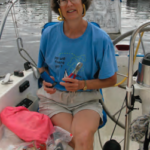
Apogee is now docked next to their home on a waterway off the bay. George and Janet Smith had completed a voyage of a lifetime. But none of this could have happened unless first it was dreamed.
Apogee of a career
On October 6, 2009, at 5 a.m. their phone rang, but they ignored it as a probable wrong number. The second time the phone rang, the caller left a message. “This is Stockholm calling. We will call you back later.”
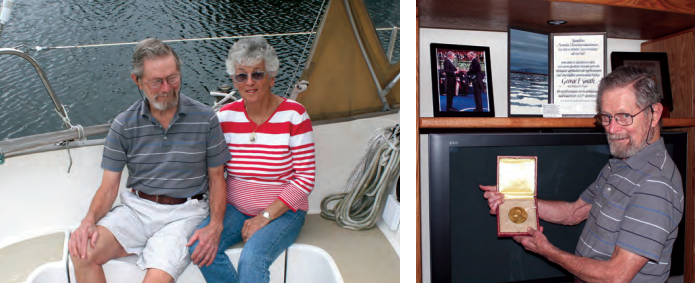
George wondered to himself, “Is it possible?” He went on the Internet and saw that the Nobel Prize for Physics was being awarded that day in Stockholm. The next phone call confirmed that he had, indeed, together with Willard Boyle, won the Nobel Prize for his invention of the CCD 40 years earlier.
“After that it was mayhem,” Janet says. “There were phone calls from news organizations all over the world and reporters started arriving at our door at 8 a.m., before we were even dressed. It was one group after another, taking photographs and asking questions and all the TV networks sent their remote trucks to our home the next day to do interviews for the evening news.”
In December 2009, George and Janet set off on another journey, this time to Stockholm, Sweden, where George received his Nobel Prize.
Don Launer, a Good Old Boat contributing editor, built his two-masted schooner, Delphinus, from a bare hull. He has held a USCG captain’s license for more than 38 years and has written five books. All of his 101 articles are now available for downloading as a collection from the Good Old Boat download website, www.audioseastories.com. Look under Archive eXtractions.
Thank you to Sailrite Enterprises, Inc., for providing free access to back issues of Good Old Boat through intellectual property rights. Sailrite.com