A boat — but not the dream — goes down in flames
Issue 88 : Jan/Feb 2013
Jennifer and I were on the verge of the grandest part of our grand voyage. We were anchored in a peaceful cove in the harbor of Mahon, Minorca. Jennifer was below making dinner. I sat in the cockpit enjoying a beer and thinking about the three-day passage to Sardinia we were to begin the next day.
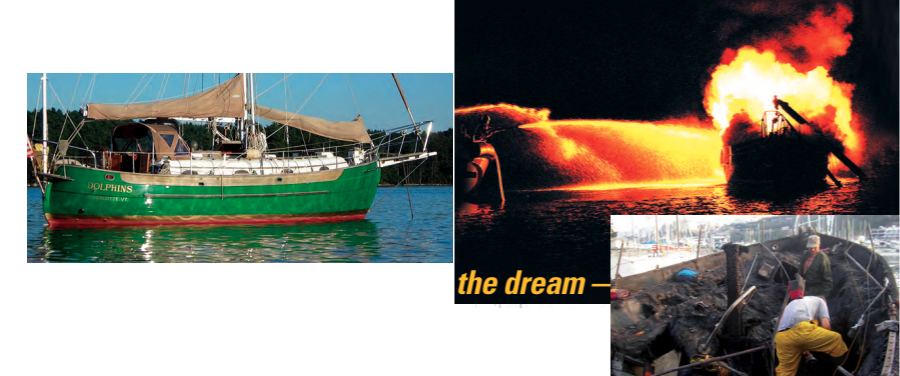
Four months earlier, my wife and I had sailed our beloved Dolphins, a 1986 Hans Christian 33, from her home waters of Lake Champlain across the Atlantic to Portugal. We had since passed through the Pillars of Hercules into the Mediterranean, along the coast of Spain, and onward to the islands of Formentera and Minorca.
We were proud, happy, and almost giddy. When we docked in Portugal, the wave of pride and accomplishment we felt was greater than any of the waves we had encountered at sea. To cross an ocean is to transit a space about six inches wide. That space, the inside of your head, is where you face the greatest danger and the greatest challenge: the danger of overconfidence and the challenge of calming yourself and understanding that your fears are disproportionate to the circumstances you will encounter.
In the weeks sailing along the Iberian Peninsula we had worked together as a smooth team, even mastering the Mediterranean moor. We had accomplished the repairs necessitated by the crossing and had fine-tuned our boat and our lives to the rhythm of life aboard. I caught fish and Jennifer grilled them to perfection.
With the sun soon to set over the castle walls of Mahon, we were happy because Dolphins had become so much our home we were sure there was no other boat like her. It’s silly to talk of soulmates when it comes to boats, but that’s what we felt. From the moment I saw Dolphins six years earlier, I knew she was “the” boat and cruising was what I wanted — truly, deeply wanted. Not clearly knowing your “want” in life is like trying to sail without a compass.
A compass to follow
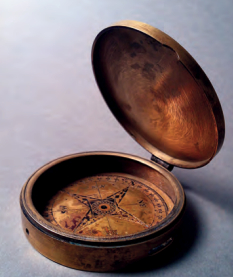
In fact, for many years now, I’ve owned a brass compass given to me by my daughter. Early on, I smashed the glass, removed the needle, and thus made it my magic compass. I would occasionally consult it to find the orientation of my want. Over the years, it always pointed me toward this voyage.
With the help of my professional boat guru, Gordon, I had spent six years prepping Dolphins for this voyage. During that time, Jennifer and I met and married. While Gordon and I revamped, replaced, and renovated, Jennifer sewed curtains, decorated, and organized our life on board into pleasantly perfect order.
Up until the birth of the double-ended Hans Christian 33 in 1980, conceived in the mind of Harwood Ives, no boat had a layout to match hers in efficiency and comfort, with its queen pullman berth amidships and a double quarter berth. Even since her introduction, despite many copies, none has matched her arrangement of U-shaped galley, nav desk, standing saloon table, separate shower, and easily accessible, sole-level engine, all in 33 feet. With her weight of 20,000 pounds, a Hans Christian 33 parts the water like a stately ship of yore.
We were giddy because, until now, we had sailed the less-scenic parts of the voyage. Before us lay the intriguing islands of Sardinia, Sicily, and the myriad mythical isles of the Adriatic.
My daydreaming was interrupted by Jennifer, who called out from the galley.
“All the lights in the cabin just flashed on and off.”
“What about the breaker panel?”
“That too,” she said.
A minute later, it happened again. I poked my head into the companionway and, just as I did, we noticed smoke rising from the cracks in the companionway steps.
A sailor’s worst nightmare
I scrambled below and ordered Jennifer into the cockpit. I dashed her utensils and salad bowl off the steps, sending them clattering to the sole. Upon pulling the companionway steps aside, I saw a steady, wide wall of white smoke rising from behind the engine.
I grabbed a fire extinguisher and swept it back and forth into the compartment, trying to get it behind the engine. In my mind, I thought, “Jennifer will hate me because it will take days to get this engine clean.”
The blast stemmed the smoke a bit. I grabbed my portable VHF and issued a securité call saying our boat was smoking and possibly on fire. I climbed into the cockpit and checked the lazarette to see if the batteries were the source. No smoke there.
By now, the smoke was rising thicker and turning black. I hesitated before jumping into a smoky cabin, knowing this is how people die. I issued a mayday call and then monkeyed my way back into the cabin minus companionway steps. I found the second extinguisher and emptied it into the smoke.
It had no effect. My throat was itching as I climbed through the wall of smoke into the cockpit. I made another mayday call on the portable and turned to Jennifer.
“Follow me,” I said, “We’re getting off.” From the foredeck, we heaved our RIB overboard, threw in two oars and clambered down. We were barefoot, minus my glasses, and our pockets were empty. With nothing more than the clothes on our bodies, we paddled toward the only boat reacting to our situation. They were hauling anchor and had their fire extinguisher in hand.
We climbed aboard and watched in shock as our boat — that barely 15 minutes before had been a serene scene of domestic bliss — belched tall flames from the companionway. For the next 45 minutes our beloved Dolphins burned from stern to stem, practically to the waterline. We jerked involuntarily when the propane tanks exploded like cannon fire.
All we had heard from the local authorities, whose fireboats were a mere 10 minutes away, was an inquiry whether all persons were safe. Once confirmed, there was radio silence. We were too shocked to cry. But when we saw Dolphins’ mast waver and fall, it was too much. We asked our hosts to take us to the nearby port.
Robbed of everything
Fire is a savage thief. Not content with just valuables, it robs you of all you have that reminds you of who you are. We lost art, homemade jewelry, our journals, some poems and short stories, and, particularly hurtful, 12 years of photographs . . . most of my 16-year-old daughter’s life in pictures.
In the hours and days that followed, we were overwhelmed by the extra-ordinary kindness of strangers. People went above and beyond to help us with money, cell phones, clothes, shoes, and food. Friends and family were in tears as they heard our account.
Everyone tried to console us and urged us to look for a new boat. But we didn’t know if that was what we wanted. We were numb. The savage thief, along with all the rest, had stolen my want.
At times, we wanted only to crawl into bed and pull the covers over our heads. But emotional retreat isn’t granted to the suddenly homeless. We were forced to face the immediate onslaught of details: temporary shelter, police reports, and regaining access to communication and money. Before I could deal with what I wanted next, we had to, quite literally, establish who we were. We had lost all of our identification.
The next morning we heard that Dolphins had been utterly eviscerated by the fire and sank while the fire department, which eventually showed up, extinguished the flames. On the bright side, our passports were found floating in the waterproof suitcase we had kept them in.
Within 24 hours, my brother arrived on the scene with emotional and financial support. We would return with him to his home in Germany to plan our next steps. But before we could leave, we had to wait for the boat to be floated and inspect it to see if anything was salvageable.
I dreaded that moment. But we were informed a few days later that the wreck of Dolphins awaited us at the marina. Arriving at the wharf and seeing her charred remains was like being swamped with a wave of blackness. I was drowning in numbness. No feelings. Not even sadness. Just overwhelming numbness.
The insurance investigator boarded first, took photographs, and poked through the mess.
“Electrical,” he concluded. Exactly what, was hard to tell. I suspected an old wire to the starter motor or the alternator that carried a lot of juice.
Then it was our turn. My brother Roland and I donned coveralls, slipped into rubber boots, pulled on industrial work gloves, and stepped into the cold, soggy, black charcoal pit.
We found some items, but very few. Jennifer’s soggy wallet inside a melted handbag. A bracelet of mine. We dug deeper. It was like grabbing into coal slurry and pulling up a fistful of soggy char and rubbing it slowly, letting it sift out of your hand to see if anything valuable remained.
A compass restored
On one scoop, I felt something distinct. I pulled it out. It was my brass compass. With sudden clarity, I felt a bolt of certainty shoot through me. I looked at the blackened compass in my hand and instinctively thought, “I want to continue this journey.”
Having my inner self suddenly swing toward such surety buoyed me with relief. For the first time in a week, I knew what I wanted.
Our emotional landscape is not a flat plane. We all have many wants in us. Some are equally strong, yet conflicting. During the ensuing weeks and months, Jennifer and I discussed all kinds of alternate plans. I had a desire to go back to Vermont and start a sailing program. She might open a shop in Burlington selling Turkish rugs. Maybe we could rent a house in the Mediterranean for a year. I could write and Jennifer would study Turkish cuisine.
But then I would look toward my compass again where it sat in each of the places we stayed. The needle was steady most days. It pointed to a small town on the southwestern corner of Turkey: Marmaris. While the town itself is nothing special, we were told it’s home to the Mediterranean’s third-largest yacht harbor with thousands of boats . . . many of them for sale by people whose needles of desire point elsewhere.
Perhaps we will sail again from there with a new deck under our feet and an old magic compass in my pocket.
Mathias and Jennifer Dubilier found their new boat; another Hans Christian 33, named very appropriately, Phoenix. You can follow their adventure at their blog, www.dolphinsvoyage.blogspot.com.
Thank you to Sailrite Enterprises, Inc., for providing free access to back issues of Good Old Boat through intellectual property rights. Sailrite.com