. . . and its club-racer contemporaries
Issue 89 : Mar/Apr 2013
Almost every production builder in the late 1960s and early ’70s initially entered the market with a 27-footer, if not as its first boat, certainly as its second. The S&S-designed Tartan 27 introduced in 1961 and the 1967 Bill Shaw-designed Pearson 27 Renegade are good early examples. And in 1974, Warren Luhrs’ new company, Hunter Marine, began with the introduction of the Hunter 27. No surprise in this, since 27 feet is about the smallest size that can comfortably accommodate standing headroom, an enclosed head, dining and cooking facilities, and an inboard engine. That is, a real yacht and a definite cut above basic “camping.”
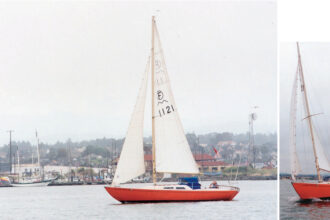
So there is no shortage of candidates to compare with the Catalina 27. If we confine our choices to close contemporaries, the Cuthbertson & Cassian-designed C&C 27, introduced in 1970, and the Bruce King-designed Ericson 27, introduced in 1971, are logical choices, as they represent a good cross-section of the dual-purpose fin-keel, spade-rudder, sloop-rigged racer/cruiser of the time. Indeed, all three of these boats are still very active today. Each of these designs was influenced by what was happening on the racecourse at the time, when masthead-rigged, fin-keel, spade-rudder boats, as embodied in the Bill Lapworth-designed Cal 40 and the George Cuthbertson-designed Red Jacket and Redline 41s, were taking home the trophies.
As well as similar underbodies, these three boats also have similar masthead single-spreader rigs with double lowers and a fixed backstay. This configuration of rig and hull quickly became the standard for production boatbuilding in the ’70s and ’80s and persists today as the best compromise between performance and price.
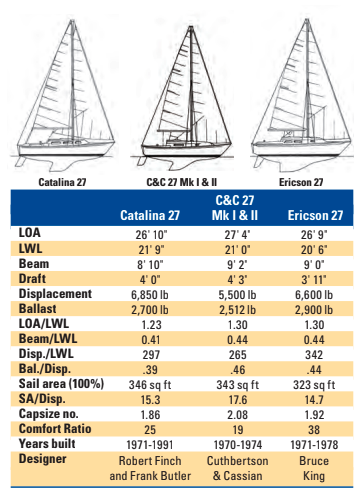
Since these boats are designed to show a good turn of speed around a racecourse, it’s worth looking at the performance ratios.
In terms of the displacement/length ratio (D/L), which measures the relative weight of the boat, the C&C at 265 and the Catalina at 297 have a distinct edge over the Ericson at a fairly high 342. For acceleration in a puff or out of a tack, the C&C would have the edge over the other two.
The C&C also has an advantage with its high sail area/displacement ratio (SA/D)of 17.6 compared to the Catalina’s 15.3. Even though their sail areas are almost equal, the Catalina’s heavier displacement (by more than 1,000 pounds) is a distinct disadvantage, especially in light air. The Ericson’s anemic 14.7 SA/D is due primarily to a smaller sail area.
Note that the C&C 27, despite having the lightest ballast, has the highest ballast/displacement ratio (B/D), due to its substantially lighter displacement. So reading this as a measure of higher stability can be seriously misleading.
The conclusion here is that the C&C 27 would have a distinct advantage in light air, upwind and down, with a higher SA/D ratio and faster acceleration. However, as the breeze builds, the C&C will be forced to reef first, reducing her SA/D ratio in line with the other two boats, both of which will have higher stability due to higher displacement. This is particularly true because all three boats have similar beam measurements and B/L ratios, meaning that their relative stabilities are entirely displacement dependent. In much heavier air upwind, the Ericson, and especially the Catalina, considering its longer waterline length, will come into their own.
The lighter displacement of the C&C 27 gives it a higher capsize number and lower comfort ratio, but considering the use of these boats as club racers and coastal cruisers, neither of these ratios is alarming. In fact, all three of these boats have proven to be excellent designs for their purpose.
These three designs from the early days of production fiberglass boatbuilding represent some of the best classic good old boats on the market. Each is a well-designed good-looking boat that has provided years of excellent performance.
Rob Mazza is a Good Old Boat contributing editor. A sailor by passion and yacht designer by vocation, his long career around sailboats began at C&C Yachts back when now good old C&Cs were cutting-edge new.
Thank you to Sailrite Enterprises, Inc., for providing free access to back issues of Good Old Boat through intellectual property rights. Sailrite.com