A journey alone around the world by sail and by foot
Issue 91 : Jul/Aug 2013
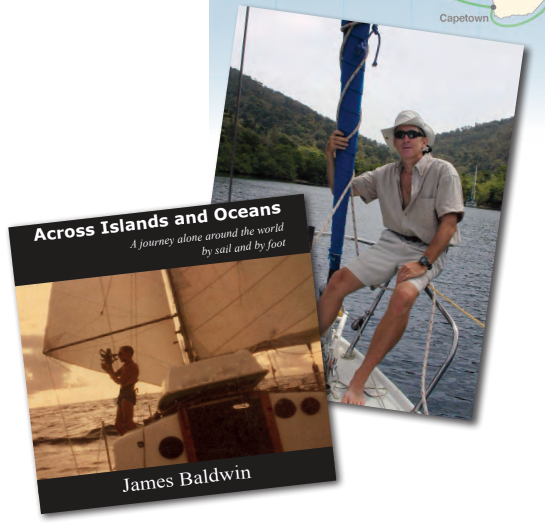
Good Old Boat is proud to announce our 15th audiobook, this one by James Baldwin about the wonderful and rather unusual two-year circumnavigation he made starting in 1984 in his Pearson Triton. James summarized that voyage in an article in our May 2001 issue. Since we couldn’t offer a better summary, we reprint part of that article here to explain what’s in his new book, Across Islands and Oceans, and in the unabridged audiobook we produced from that book. The audio version is available from AudioSeaStories.com. If you’re a reader, rather than a listener, this book is available through Amazon in paperback and as a Kindle book.
As a child watching sailboats glide across the flat waters of Michigan’s Lake St. Clair, I used to imagine they were all bound for distant adventures. Looking back, it seems I’d always dreamed of a sailing voyage that would take me beyond the confined waters of the Great Lakes to explore the open seas, particularly to the fabled islands of the South Pacific.
These thoughts recurred as I spent my teenage years finishing school and then moving into my own apartment and earning a living. I nearly married and settled down at one point. Then, at the age of 21, an impulsive decision brought my dormant dream within reach when I spent my entire savings buying a used 28-foot Pearson Triton from a Detroit yacht broker.
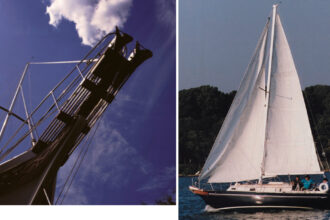
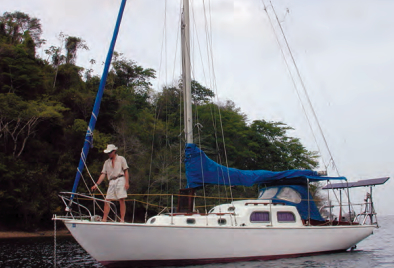
I knew little about boats when I bought this 13-year-old 1966 Triton. Fortunately, my broker gave me sound advice when he recommended this as the best boat available in my price range. Some 700 of these Carl Alberg-designed boats were built by the Pearson cousins in Rhode Island between 1959 and 1967, and many of them are still sailing.
Although my broker rightfully viewed this minimally equipped boat as a coastal cruiser, I admired her long keel, low profile, and handsome lines. Instinctively, I knew she was the boat to take me across oceans. Obviously, she would need more equipment and a few structural modifications, but exactly what would be required to make her into my ideal boat would remain a mystery until I gained more sailing experience.
My sailor’s apprenticeship began two years later when I quit my factory job in Detroit and convinced two friends that the best way to avoid the coming Michigan winter was to join me on a voyage to the Caribbean. That September, we set out for the Atlantic by sailing through Lakes Erie and Ontario and motoring down the barge canal to the Hudson River and New York City. We reached Florida by a series of short offshore passages and longer detours inland through the Intracoastal Waterway. In the waterway, we practiced running aground and (unknowingly) annoyed impatient bridge operators and road traffic by trying to pass through under sail. Offshore, I nervously plotted our course and speed each hour and made wildly inaccurate first attempts at celestial navigation.
Despite some further misadventures, we enjoyed an idyllic winter cruising among the low sandy islands and shallow gin-clear waters of the Bahamas. After making a crew change, we sailed through the Caribbean as far as Trinidad before running low on funds and turning back to Florida.
Strengthened resolve
That first voyage introduced me to a cruising life that suited me perfectly and strengthened my resolve for the ultimate adventure — to sail alone around the world. I renamed my little big-hearted boat Atom, in honor of Jean Gau who, decades earlier, made two solo circumnavigations in his 29-foot Tahiti ketch named Atom. After working as yacht delivery crew and training as a marine service engineer for one year at a boatyard in Ft. Lauderdale, Fla., I prepared for my upcoming voyage by undertaking the first of several refits.
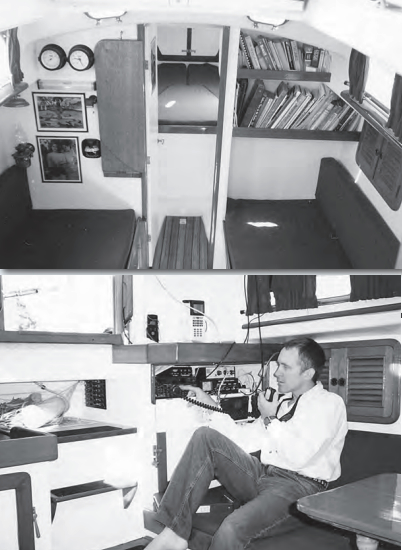
To free me from the drudgery of the tiller, I installed new Aries windvane self-steering gear. I beefed up the original 7⁄8ths mast rigging by adding a set of forward lower shrouds, upper shrouds, a masthead forestay, a second backstay, and a pair of running backstays. By leaving the original fractional rigging in place, I gained the security of redundancy at the expense of some windward efficiency. A weak point on the Triton is the light overhead beam supporting the deck-stepped mast. When I noticed a small crack in the beam and the cabintop beginning to deflect downward, I reinforced it from underneath by bolting a stainless-steel U-channel frame around the original wooden beam and supporting bulkheads.
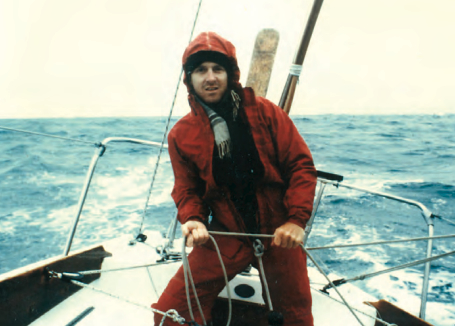
When the boat was as ready as my youthful impatience and limited funds allowed, I found I had only $500 left. Yet I refused to consider delaying the voyage for another year or two. There is a certain wisdom to reckless youth. After all, if lack of money stopped me this year, then other insecurities could just as easily keep stopping me until my exploring instinct faded into a life of vague regrets. With an undiscovered world before me, I set out alone from Miami in June of 1984 and threaded my way nonstop for 15 days through the islands of the Caribbean to Panama.
In all but the lightest of winds, the self-steering gear held Atom on her course, giving me the freedom to take short naps, prepare meals, and navigate by sextant. To find some kind of harmony with the creatures who would be my sole companions, I stopped fishing and became vegetarian. After locking through the Panama Canal, I entered the 10,000-mile-wide Pacific Ocean. For six months I explored among the stunningly beautiful islands of Polynesia, Tonga, and the Solomon Islands.
Anchor lines parted
During this two-year voyage, I visited 10 islands. At each, I left Atom moored securely to two or three anchors while I went out with a backpack for days or weeks to walk across the island and climb its highest peaks. Always I returned to find her unmolested, though sometimes one of the anchor lines had parted from chafing on coral. At that time, I used only a short length of chain next to the anchors because I lacked a windlass to handle an all-chain rode.
On the little island of Tikopia, I was delighted to find one of the last remaining outposts where native Pacific island culture was bravely resisting the onslaught of Western technology. Several times
I was tempted to settle down among the welcoming people of these happy
isles, but the dream of completing the voyage and the adventures just
ahead over the western horizon always lured me on.
Bribed with brides
While awaiting the end of the Indian Ocean’s typhoon season in New Guinea, I spent three months walking alone through the island’s forbidding rainforest. Staying in thatched huts in remote mountain villages, I learned how to live as a primitive man — narrowly escaping death from recurring malaria, getting caught between warring tribes, and once falling 50 feet down a hidden shaft in an abandoned gold mine. A village chief who befriended me in the Highlands — an ex-cannibal who had four wives himself — tried to convince me to stay by offering me two of his daughters in marriage. This was a bargain, since daughters as fine as his were usually commanding a “bride price” of 100 pigs each. New Guinea was pure Adventure Country. I loved it, but knew I had to leave before it killed me.
From the smothering rain forests of New Guinea, Atom and I sailed nonstop for 30 days through the wreck-littered Torres Strait and past the long, empty, northern coast of Australia to the open waters of the Indian Ocean. The trade winds blow at their strongest here, often at gale force for several days at a time. We made fast passages between the islands, running with deeply reefed sails at average speeds of 130 miles a day. Although the islands of the South Indian Ocean are less numerous than those of the Pacific, they are no less exotic. I was again lured away from the sea to walk across Mauritius and the French territory of Reunion Island. With its active volcano, knife-edged mountains rising 10,000 feet above the sea, and uncountable waterfalls pouring into lush hidden valleys where small communities live in complete indifference to the mad goings-on of the outside world, Reunion Island qualifies as the nearest thing to paradise on this earth.
Perhaps my view of the island is biased, as I remember the girl there who waved goodbye from the shore when Atom sailed reluctantly out of the bay. The only illness I suffered at sea on this voyage occurred after I departed Reunion for Durban, South Africa. Somewhere south of Madagascar, in a region known for frequent gales and unsteady winds, I became incapacitated from a relapse of malaria. As I lay in my bunk for three days in a lonely, helpless fever, Atom dutifully looked after herself, and somehow covered 200 miles through disturbed seas in the general direction of Durban.
Increasing deck leaks forced me to take drastic action during my two-month layover in Durban. Many Tritons suffer from waterlogged balsa-cored decks. I removed every deck fitting and cut off the deck’s upper fiberglass layer. I removed bucketsful of stinking balsa mush, refilled and leveled the deck, and reinstalled the hardware. It was a miserable job I had been putting off for a long time.
First serious storm
Having an absolutely dry boat inside made it worthwhile. Off the aptly named Wild Coast of South Africa, I met the first serious storm of my sailing career. As the southwester blew up some impressive seas, I turned and ran directly downwind under a bar-tight storm jib sheeted amidships.
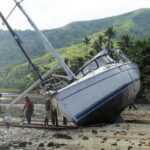
While dropping headlong down one of these slab-sided waves, the strain from the windvane steering lines snapped the wooden tiller. Atom instantly broached, roughly plunging her lee spreader into the sea. I remember a loud snap signaling a broken intermediate shroud. But thankfully, due to the extra rigging I had installed, the mast stayed in place. As Atom rolled wildly while being hammered by the beam seas, I bolted on the emergency tiller. Ironically, days later we were carried gently past the rocky buttress of the Cape of Good Hope by a favorable current in a flat calm on a brilliant sunny day.
From Cape Town back to Florida, I enjoyed the life alone at sea so much I visited land only twice, stopping briefly at St. Helena Island and Martinique. For navigation, I usually fixed my position with three star sights during evening or morning twilight. The night sky of the Southern Hemisphere had become a familiar field of fiery beacons and signposts. At night in the South Atlantic, I could even maintain my course from my bunk by keeping the frosty streak of Halley’s Comet lined up in view through the open hatch.
As exhausting and frightening as it was at times, I now remember the easy days far outnumbering the bad. The personal rewards of the voyage were incalculable, and I never for a moment regretted my decision to go. Those two years as a vagabond sailor created an unbreakable bond between Atom and me and ended any chance that I could remain satisfied with the normal life of a land dweller. Within a year I would set out again, this time on a voyage alone to China and what would become a 12-year-long second circumnavigation.
James went on in this article to tell about his second circumnavigation in Atom. We hope he’ll write that book someday. Meanwhile, he and his wife, Mei, live in Brunswick, Georgia, where they have a business helping cruising sailors prepare their boats and themselves for extended voyages. Visit them at www.atomvoyages.com.
Thank you to Sailrite Enterprises, Inc., for providing free access to back issues of Good Old Boat through intellectual property rights. Sailrite.com