When super-human effort isn’t enough, humanity succeeds
Issue 90: May/June 2013
This is a story of disaster, struggle, despair, and dreams lost . . . but also one of friendship, creativity, redemption, and triumph through sheer stubbornness. It begins with a cyclone.
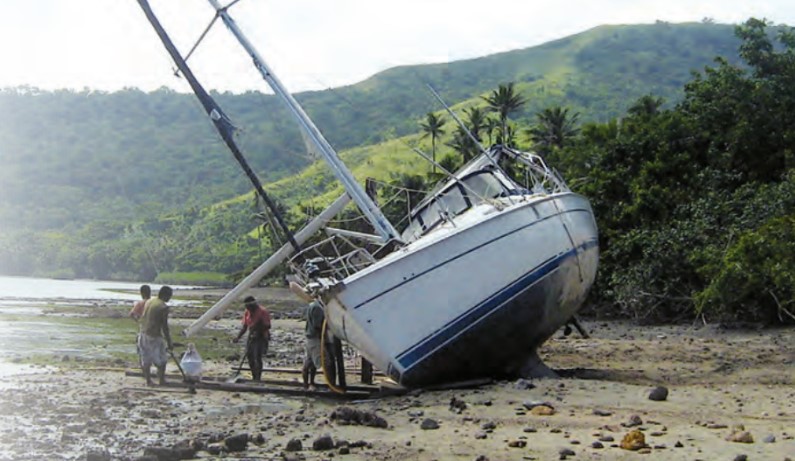
It was late in the season for tropical storms in the south Pacific when a deep low formed between Fiji and Samoa. It developed quickly and swept onto the north coast of Fiji’s northern island of Vanua Levu on the ides of March 2010 as Category 4 Cyclone Tomas. It then slowed dramatically, its 145-knot winds and pounding rain leveling villages, stripping coconut palms bare, and flooding cropland.
In a remote corner of the island at Viani Bay, a late-model Hunter 41 was catapulted onto the reef like a toy boat. Those aboard were rescued through the heroic efforts of the crew of a nearby motorsailer. In the storm’s aftermath, local boys undertook a salvage operation — mostly with bush knives — and the damaged vessel was left abandoned.
A seafaring nomad
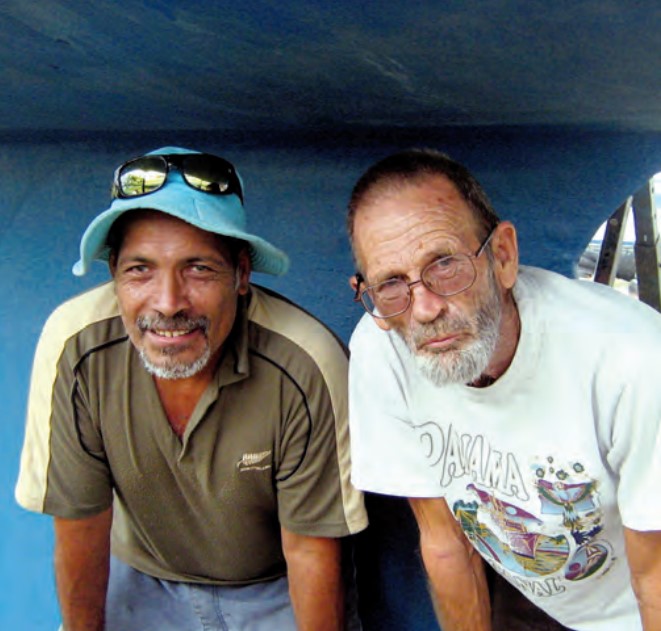
Brian Taylor is a Kiwi and a voyaging nomad who sails mostly by himself. By definition, singlehanders sail on a slightly different tack than the rest of us and Brian is no exception. Buzz-cut and bespectacled with a perpetual cloud of smoke hanging about his gaunt frame, Brian is cheerful, kind, and softly erudite even when just passing along great jokes . . . an all-around good mate.
We met Brian at a well-known watering hole in Tonga’s Vava’u group during the 2009 cyclone season. Although he occupied “his own bar stool” at the Mermaid, he wasn’t as entrenched as Jack Wagoner, a sprightly, seemingly ageless WWII veteran who not only had a bar stool dedicated to him but also had his picture as “Commodore” above the bar. While Jack stayed near his bar stool, Brian set sail downwind for Fiji in his slow but reliable, rust-streaked, much-patched, one-off steel cutter, Kyogle.
When you cruise distant ports for any appreciable amount of time, characters like Brian drift in and out of your life, so we were pleased and not too surprised to see him again in Savusavu, Fiji, a funky, sleepy town of friendly Fijians living peacefully among wacky expats. We felt right at home.
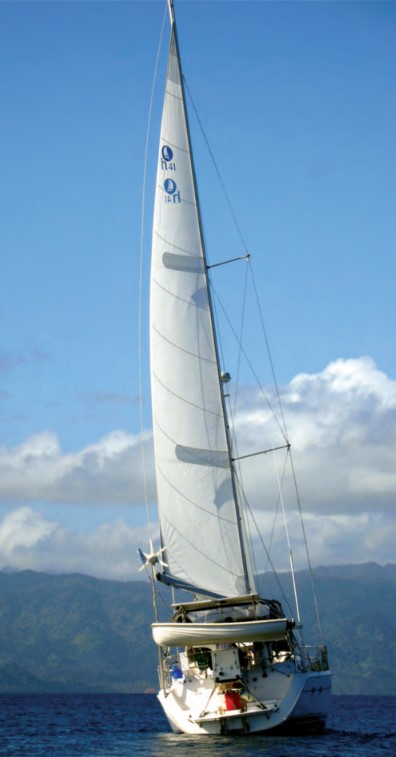
We learned that Brian had purchased the wrecked Hunter 41, still ashore in Viani Bay and now renamed Viani. Brian was in the throes of a seemingly impossible salvage operation. Viani Bay is fringed with reef, yet incredibly deep and inconveniently located 200 miles from the nearest yacht haulout facility, in Lautoka. No roads reach Viani Bay. Two small villages perch on its shores, most of the homes occupied by the extended clan bearing the name of Fisher. Transportation in or out is by tortuous footpath across the mountains or by local boat, 15 miles to Buca Bay to catch the once-daily, rickety former school bus that travels down the pothole-strewn Hibiscus Highway for a kidney-busting 6-hour ride to Savusavu.
The remote location didn’t diminish Brian’s enthusiasm for saving this previously well-found modern yacht. He dreamed Viani would someday become his comfy floating RV (or caravan as they say Down Under). Armed with enthusiasm and aided by friends who often questioned his sanity, he began the salvage operation.
The first major challenge was to recover Viani’s looted instruments and equipment. This was eventually accomplished with the intervention of the village chief (this is Fiji, remember). The loot, or most of it anyway, was eventually returned in a pile of dirty cardboard boxes. Spaghetti-like bundles of cables and connectors protruded from the equipment as wires had been snipped or hacked hastily and without regard to future use.
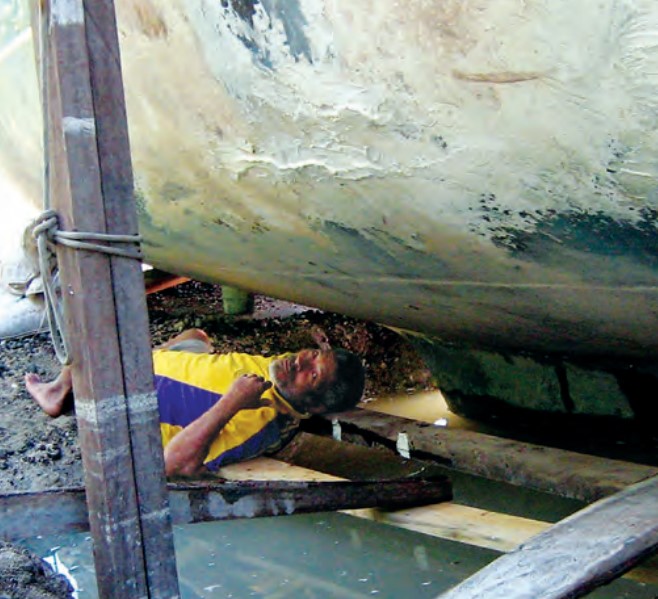
At this juncture, Viani was afloat, thanks to the extraordinary efforts of Brian’s friend Tuki Langdon and a team of Viani Bay locals. (Without Tuki there would be no story to tell.) Cyclone Tomas had deposited Viani on her port side, leaning landward and with a large hole at her waterline. Lacking heavy equipment, Tuki and the boys ingeniously righted her for patching by excavating the ground beneath her with shovels. The hole quickly filled with water, but Viani stood tall and was soon patched, tilted to seaward, and floated.
Viani may have been patched and floating but she was essentially sinking, and sinking fast. Her keel and the stump of her rudder wobbled alarmingly with each passing wake. Wires that had previously connected bilge pumps dangled in the sloshing water. All hands concentrated on keeping Viani afloat long enough to allow her to sail, motor, or be towed to a site where repairs could be made.
Quest for a safer haven
Brian’s first step was to move Kyogle, the mother ship for the salvage, to Fawn Harbor, a safe haven 15 miles downwind. Meanwhile, back in Viani Bay, Tuki was diligently manning the hastily wired bilge pumps and keeping batteries alive by hot- wiring the auxiliary engine (the engine panel had been looted).
After setting sail for Fawn Harbor, Viani’s crew battled capricious winds and an inoperable engine well into the night as they floated toward Vanua Levu’s barrier reef, roaring with surf. Unable to confirm a safe course into the narrow, dog-legged entrance to Fawn Harbor, Brian decided to leave Tuki on board Viani while he took his inflatable in search of the break in the reef. Tuki — who is not a sailor — drifted through the night dangerously close to disaster.
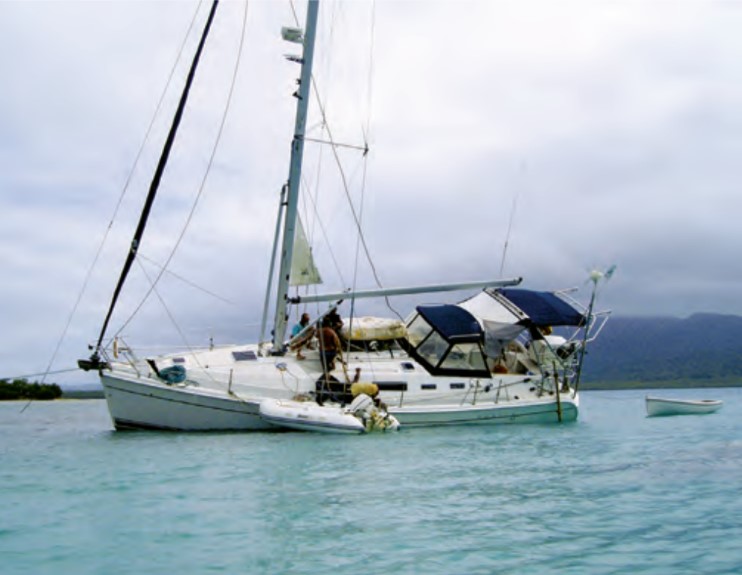
The moon had set and Brian was unable to find the unlit tree trunk that marks the entrance to Fawn Harbor. Exhausted, he fell asleep while his dinghy drifted. When Brian did not return, Tuki picked up his cell phone, saw a faint signal, and called for help from the Pickering family in Fawn Harbor. Tony Pickering jumped in his skiff and drove through heavy seas to reach Viani, took her in tow, and guided both boats through the pass and into the calm waters of Fawn Harbor. They immediately filed a missing persons report for Brian.
Spirits were low up and down the coast, but the dawn brought Brian into Fawn Harbor, groggy but very much alive. His good friends, though relieved he was safe, joked that they wanted to kill him for undertaking such a crazy escapade. Meanwhile, Viani’s bilges continued to fill at an alarming rate and she couldn’t be left unattended in case the hastily assembled connections to her temporary bilge pumps failed.
A reunion
Into this adventure we sailed a day later, almost, but not quite, oblivious to it.
Our first order of business was to organize some sustenance for the team. Brian seemingly exists on tea and cigarettes, but Tuki and the Fawn Harbor boys (led by chief Maya) needed food. The boys were important for the planned careening that all hoped would reveal the cracks and allow for effective patching. While Brian traveled to Savusavu in the hope of negotiating with customs authorities, we assisted Tuki as he applied gallons of automobile filler to Viani’s hull while free diving. His efforts seemed to have little effect on the leak.
The day of the careening, chosen for its tides, started with a squall followed by a magnificent rainbow that made everyone optimistic. Armed with anchors, miles of line, and trunks of wetland trees, the team eased Viani onto a shallow patch near the reef and propped her up. They watched the water recede and then rise again but could not locate the secret to her damage. Viani continued to take on water.
Into this scene stepped the unflappable Rita Nesdale. Rita travels from Perth each year to spend a month or two accompanying Brian on his sailing adventures. There was going to be no cruising this year for Rita and, to her surprise, she didn’t have to make just Kyogle livable, she had to face Viani’s wrecked interior too.
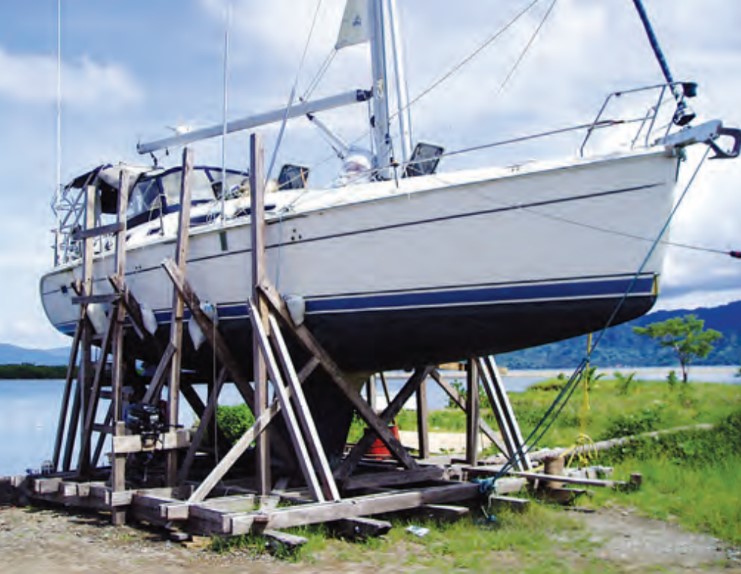
A week or so later, a rare break in the trade winds that make Vanua Levu a dangerous lee shore allowed Tuki, Rita, and Brian to make the 35-mile dash for Savusavu, where ferries and small planes call and limited hardware is available. Brian and Tuki built a cradle and hauled Viani ashore.
Fiji may not be a third-world country, but things don’t happen here in ways we are accustomed to. Instead of ordering lumber from a lumberyard, Tuki hiked his ancestral lands, selected the finest vesi wood trees, felled them, shaped them into beams with a chainsaw, and had them hauled across the coastal mountain range to where Viani waited at Nakama Creek.
A jungle haulout
When we sailed back into Nakama Creek four months later, we found Brian and Tuki bustling about Viani, sitting high and dry in a cradle that looked strong enough to hold the QE II. We had missed the action but were regaled with stories of how the cradle was dragged by brute force up the gravel boat ramp to sit just high enough to have king tides lapping up under her shattered rudder — a haulout coordinated and executed in typical jungle style and with typical jungle success.
Things were looking up and spirits were high. Viani’s keel had been straightened and patched, her rudder prosthesis was nearly complete, and the wiring and plumbing puzzles were being solved. Dealing with the askew propeller shaft would have to wait until Viani rested once again in the briny blue and the hull resumed its proper shape.
The question was how to get Viani wet again. How, exactly, could they push 13 tons of boat and cradle down a stony incline? They had not used rollers during the haulout and it would be impossible to install them now without lifting Viani with a crane. So Tuki visited his church (no, not to pray) while Brian puttered off to Hussein’s Hardware to buy a whole fleet of mini hydraulic jacks.
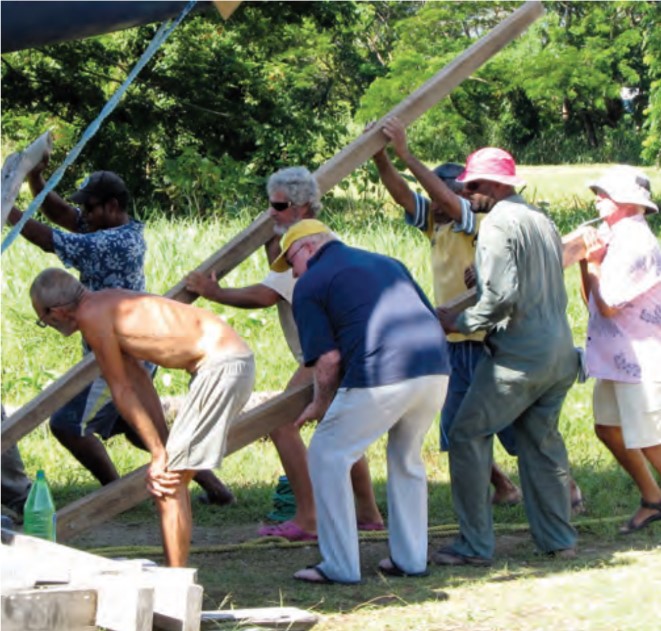
Then began the slow process of jacking up sections of the cradle and inserting under it the borrowed 2-inch Schedule 40 steel pipes that normally support the ceiling of Tuki’s church. As the weeks went by, the cradle snuggled deeper into the ground made soft by the summer rains. Even with rollers, Viani stubbornly refused to move. Brian, amazingly, seemed unfazed and sat puffing on a cigarette and contemplating the failure du jour before ambling off to make tea so he and Tuki could engineer a new plan.
One day, after a crowd of men failed to move Viani even an inch using jacks and levers, Tuki got an idea. He gathered up all the coconut-palm trunks lying around the site and laid them end to end in a row from the upland end of Viani’s cradle to a hardwood post the team had cemented into the ground roughly 70 feet inland. A hydraulic jack inserted into the row of palm trunks was able to push the cradle, and Viani began to move downhill, albeit glacially, toward the sea — another great example of jungle engineering that, though wobbly, actually worked.
On April Fool’s Day, Brian sent this email message:
Hi All . . . Well we are there at long last; floating along-side the wharf and still in the cradle which is lashed to the yacht . . . We eventually called on the services of the 13-ton powerboat with twin engines. No, the pulling power was not enough, so he took a running jump with about 20 feet of slack. No, that did not work either but we did break some ropes. He increased speed before taking up the slack (and then the rope stretch) to 7 knots and we did move a foot or two. Interesting watching the powerboat doing 7 knots forward, being stopped by the non-moving load, and then being pulled quite quickly backward by the rope stretch taking up. After this initial movement it was easy . . . just a couple more running jumps and we were free.
I pushed the cradle containing the yacht to the wharf with the dinghy and we started looking around for a cup of tea until we noticed the bilge pump was working. Yuck. Turned out that one hose was leaking (would you believe the big washing machine/dryer outlet?) and the seacock, although turned off, was not operating . . . Tuki smacked a bung in fast from the outside of the hull, so we are now a dry boat again . . . Then we had a cup of tea!
. . . That, I hope, completes the end of the 9-month salvage attempt which started after Cyclone Tomas (16 March 2010) took Viani ashore at Viani Bay.
A false start
Alas, Viani’s salvage was not complete. While fixing what now seemed to be minor issues, Brian optimistically set sail two weeks later inside Savusavu Bay. All went well until the rudder fell off and disappeared into the deep. A rescue operation was launched to tow Viani back to Nakama Creek. Two months went by while Brian organized the purchase of a replacement rudder that, when all the costs were added up, doubled his investment in Viani. Inexplicably, U.S. officials held up the shipment due to security concerns. Typically, although it had been consigned to Savusavu as air freight, the rudder eventually arrived by sea.
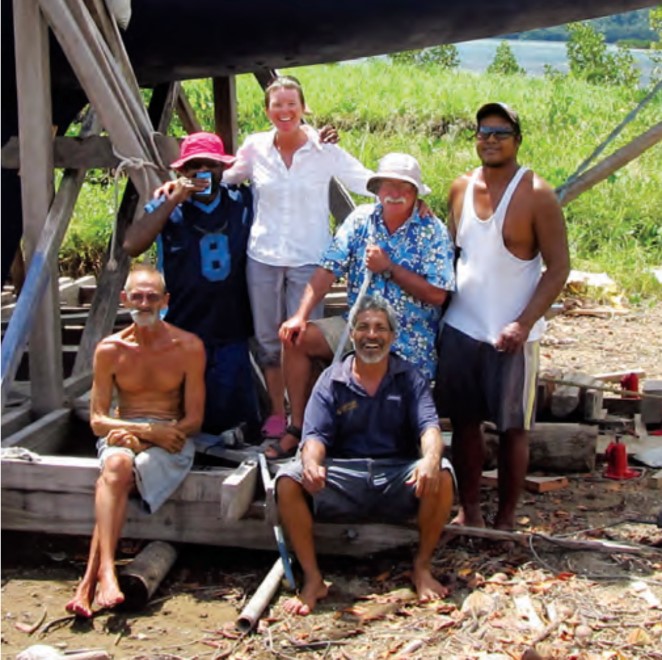
Extracting the stub of the old shattered rudder stock and installing the very buoyant replacement rudder while Viani was afloat (and still slowly sinking) stretched the creativity of the team. At last, she was afloat and mobile once again. During the interim period, there had been plenty of other projects to keep Team Viani busy. Ever cheerful, Brian wrote:
GPS — it was actually inset into the deck . . . wires cut, of course, and broken inside the unit — however Michael of Bebi Electronics here managed to do some micro-soldering for me and it is all go; connected up to the chart plotter/autopilot/radar. All of this stuff now talks to itself (including wind speed and direction, depth, and boat speed) so I can have the radar image on the chart plotter screen and vice versa. Maybe I do not have to leave the chart table to go sailing (???) . . . Interface Google Earth and maybe I don’t even have to leave the wharf to see the world!!!
A real boatyard
Things seemed to be looking up when the 150-mile passage to Vuda Point Marina in Lautoka went smoothly and Viani was lifted and set gently into a proper boatyard for what Brian hoped would be final repairs. Of particular concern was the area where the keel joined the hull. He needed to eliminate persistent leaks. As expected with a boatyard vacation, a thousand additional things occupied the team that once again included the affable and tolerant Rita.
Launch day in the boatyard was tense. As soon as the travel lift set Viani in the water, she began to leak, so she was hauled ashore once more. Diagnosis: insufficient reinforcement where the keel stub joins the hull. During the re-launching, the previous repairs had opened up and, when she was set down again, the keel depressed an inch up into the bottom of the hull. A lesser man might have thrown in the towel at this point but, instead, a now grim Brian emailed Hunter Marine for engineering advice. Hunter suggested surgery from the outside of the hull to allow access to the inner supports where structural repairs might be made.
Tuki and Brian completed the repairs as recommended, applying reinforcements to the inside and outside of the hull. Once Brian pronounced the surgery successful, they closed the wound, sealed it with epoxy, applied antifouling paint, and Viani was launched once more. A quick 18-mile test sail downwind to Musket Cove confirmed a dry bilge and allowed for a small celebration. Rejuvenated and unfazed by a growing list of additional issues, Brian and crew brought Viani back to Vanua Levu, even stopping in a few choice anchorages to allow for a bit of relaxation after 17 months of struggle.
Back in Savusavu, Brian began to prepare Viani for her first long passage from Fiji to Tonga. While there, he sold his trusty old Kyogle.
A fateful passage
Viani’s departure was delayed by late-winter blustery weather and friends’ concerns, but finally Brian pointed Viani east toward Niuatoputapu, rolled out sail, and disappeared over the horizon, elated to be at sea. Even under normal trade-wind conditions, this is a hard passage into large ocean swells, but conditions deteriorated even further and Viani took a beating. Quite suddenly, Brian heard the bilge pumps working and investigated. Water was pouring into Viani and the pumps were overwhelmed. Extra pumps he activated could not keep up with the flooding. Still 125 miles from Niuatoputapu, Brian altered course for Niua Fo’ou, about 40 miles downwind.
Niua Fo’ou has no protected anchorage but it was the nearest land and would have to do. After anchoring on the narrow shelf on the lee side of the island just off the supply-ship wharf, Brian snorkeled to survey the damage. He could not believe what he saw: extensive cracking around Viani’s keel and the same keel wobble that had plagued them from the onset of the salvage.
Knowing the damage was permanent and irreparable, Brian considered his options. He could not safely go to sea again in Viani and there was no harbor, crane, or even a remote chance of repair at Niua Fo’ou. He could either let her sink where she was or drive her ashore. He put Viani on the beach and donated her and all her gear to the local population.
Instantly, Brian became the guest of the Tongan government. Many of his possessions, such as his camera, were held pending an “official” investigation. The Tongans were good hosts though, housing him, homeless as he was, in an apartment normally reserved for the king when he visits.
Word of Viani’s demise leaked out, though details were few. The cyberwaves were abuzz with worried emails begging information. His good mate Curley Carswell, at anchor in Vava’u 200 miles away, prepared to rescue him by sea. Before Curley and crew could depart, however, the kindly Tongans decided to leave the copilot of the weekly flight to Niua Fo’ou behind so Brian could take his place and be flown out to Neiafu in the Vava’u group.
In Vava’u, Brian was quickly enveloped by the warm welcome of friends. Larry and Sheri at the Ark Gallery gave him a clean berth aboard a borrowed yacht, good cheer, and space to recover from the shock of being marooned and boat-less. Through this turmoil, Brian was remarkably cheerful and writing reassuring emails, despite the painful loss of his home, most of his possessions, and his dream.
It was now time for Jack, “commodore” of the local yacht club that was now defunct due to a fire that leveled the Mermaid Café, to step in. His boat, Antares, a Pearson Vanguard, had been his refuge and vacation home for more than 20 years but now sat deteriorating at her mooring in Vava’u. He was home in California when he heard of Brian’s disaster and kindly offered to sell Antares at a price Brian could afford.
Some might say that Brian just bought himself another nightmare, but Antares, though old and in need of care, is a strong, cyclone-tested boat.
So here the story ends . . . or begins, depending upon your point of view. Brian is once again afloat, the ever- present mug of tea and cigarette in hand, knees crossed and deep in thought as he plans his next escapade with Rita and Tuki, one dream lost but another just found.
Philip DiNuovo and Leslie Linkkila came to cruising and boat ownership as adults and quickly developed a passion for small-boat travel. In 2003, they quit their professional jobs and left the Pacific Northwest behind and are now in the South Pacific. Follow them in their ongoing travels at http://sv-carina.org.
Thank you to Sailrite Enterprises, Inc., for providing free access to back issues of Good Old Boat through intellectual property rights. Sailrite.com