Electric substitute for a mechanical pump
Issue 93 : Nov/Dec 2013
Our 46-year-old Allied Seabreeze, Secret Water, is a wonderful sailing boat. Nonetheless, reliable auxiliary power is a high priority. Originally built with a Gray Marine gasoline engine, she was re-powered in the early 1980s with a diesel . . . not your typical marine diesel, but an odd duck, a Lehman 4D50. Actually, it’s a marinized Peugeot. While we were doubtful about it at first, this engine has proven, with a mere 2,100 hours on the clock, to be a reliable workhorse. Perhaps not kitten-quiet like most of the newer breed, but it gets the job done.
The first sign of trouble was that the routine bilge-water pumping finished with a little shot of red that left a sheen on the water. Gasp! I had a fuel leak. I carefully inspected her original Monel fuel tank. No problem. Then the port side of the engine. Secondary filter: OK. High pressure pump: OK. Return lines: OK.
Over to the starboard side. Shutoff valve, primary filter, fuel lines: all OK. The last thing I set my eyes on was the low-pressure lift pump. Aha! Fuel had evidently been leaking from the diaphragm. After 30 years, fatigue had taken its toll.
The lift pump is actuated by a push rod riding on a crankshaft cam, a simple and proven mechanism. The motion cycles the diaphragm up and down and little check valves direct the fuel. It was time to rebuild the pump.
Parts are available for the engine, but a rebuild kit for the pump is not. For a ridiculous price, I could get a complete assembly, but I’d rather channel my boating dollars to other trinkets.
Auto-parts store solution
I knew it was standard practice to replace similar pumps on Atomic 4 gasoline engines with electric pumps. I also know of several modern diesel engines that rely on electric pumps. So why not my old Lehman?
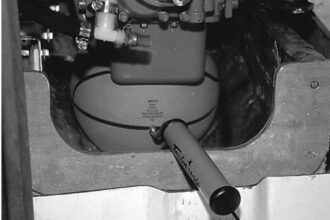
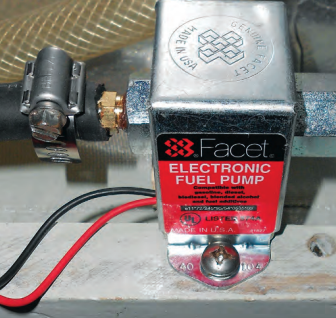
A little Internet research led me to the folks at Facet/Purolator, who turned out to be most helpful. They recommended their model with the smallest output pressure and lowest capacity. Since our fuel tank is slung under the cockpit sole, no lifting is involved. We actually have a slight head of pressure, so it doesn’t take much effort to deliver the fuel.
Installation was pretty straightforward. I bypassed the original pump and reworked the fuel lines to connect to the new one. It draws electrical power from the key switch.
Bleeding the system was a cinch. I no longer had to pump the little hand lever on the original pump. Clear fuel flowed out of the bleed ports within seconds, rather than minutes.
The moment of truth arrived . . . and after sitting “cold iron” for two weeks, the old 4-holer leapt to life. I let her run at half throttle for 20 minutes and she never missed a beat.
I’m aware of some installations where an electric pump is installed in parallel with the mechanical pump. It is switched so it can be used intermittently to make the bleeding process easier. I’ve also heard of installing one in line with the mechanical pump. I feel that arrangement has some serious drawbacks. If you install the electric pump after the mechanical pump, it would draw the fuel, but a failed diaphragm in the old pump could allow air to enter the system and would be difficult to detect. If the electric pump were installed before the mechanical one, it would pressurize the latter. If the diaphragm then failed, a significant leak could result or, worse, the fuel could possibly travel down the pushrod and contaminate the crankcase oil.
With my refit, I feel I have kept an aging, low-hour, dependable diesel engine in service. The entire cost was less than $100 for the pump, tinned wire, barb fittings, hoses, and clamps. No charge for the skinned knuckle. We should be good to go for another season and more.
Art and Sandy Hall, and their not-so-inclined-to-sail Pekingese, Kitri, can be found sailing Secret Water, their Allied Seabreeze 35, on Penobscot Bay, Maine. Occasionally, they’ll push way Down East for some solitude. A significant enjoyment while cruising is exploring “eel ruts” in their Peapod dinghy that is set up with two rowing stations. Life is good.
Thank you to Sailrite Enterprises, Inc., for providing free access to back issues of Good Old Boat through intellectual property rights. Sailrite.com