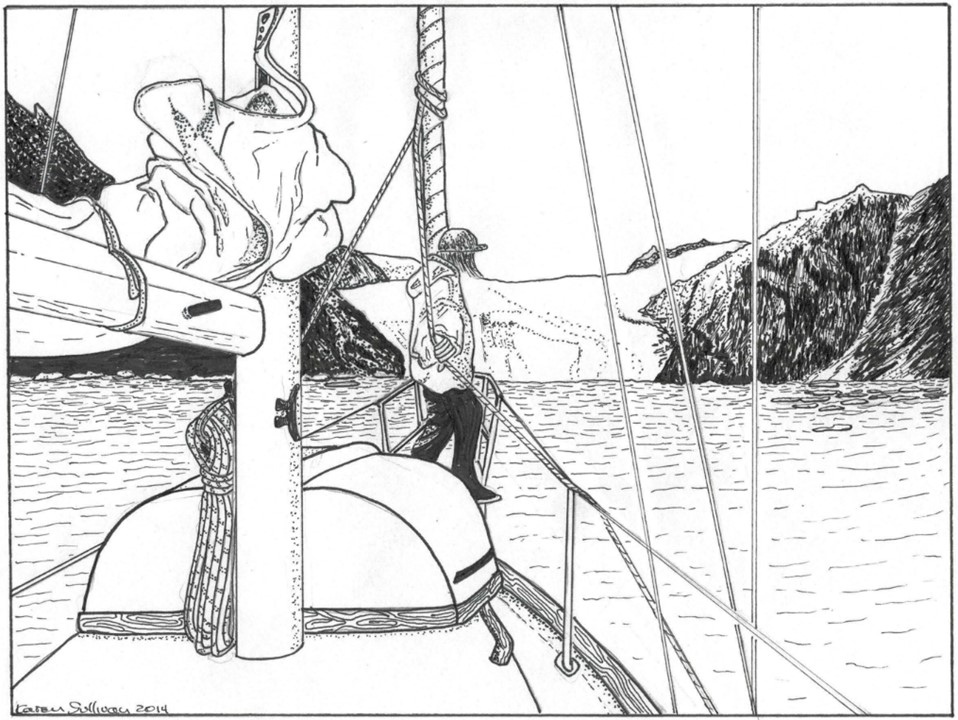
The rich rewards of sailing solo
Issue 98: Sept/Oct 2014
Over the years I’ve learned that, without quiet contemplative time on the water, I suffer as if from lack of freedom. The mind of a sailor seems to require a lot more open habitat than other minds. Perhaps it’s because we already have the means to escape, or maybe it’s why we acquire and cherish our good old boats in the first place.
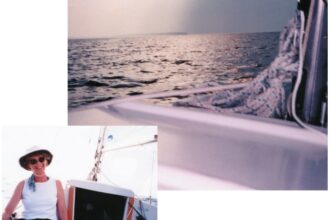
I sailed solo for a few years on Minstrel, a Pacific Seacraft Dana 24, in Alaska, Canada, and Puget Sound. My sailing companions at the time were more like guests than crew and, at sea, I found myself in a different frame of mind watching out for their safety and well-being. For that reason, I generally preferred to sail alone. When solo, there was an almost animal alertness to my days and nights. I wanted to experience the physical and psychological challenges of getting “lost” in a watery maze of islands, channels, and tide rips. So in 2006, I sailed the Inside Passage in the company of my dog and several dozen humpback whales.
Those glacier-topped Alaskan peaks delighted and humbled me. Weather changes and drifting icebergs kept me watchful. Ironically, it was the brooding loneliness of the place, with big tides that sigh around dark rocks, that kept me in a constant state of cheerful wonder. After a few weeks alone, I felt deliciously unhinged and stopped worrying about confined behavior in civilized towns, such as the need to refrain from bursting into song whenever a melody popped into my head. I would sing to clouds, shout into squalls, and hail passing birds as if they might answer back.
Emerging into a strong westerly from Zimovia Strait one day, I reefed the mainsail, then doused it because the wind died, then raised it again, reefing it when the wind came back strong — all within two hours. The weather radio alerted me to a 40-knot gale approaching. Grey squalls came and went and I furled and unfurled the jib to suit the wind. When it wasn’t raining hard, a fine mist blew. The wind boxed the compass, 360 degrees in a couple of hours. I considered sheltering in a cove on the north side of a large peninsula, but it had a rocky, kelp-filled entrance that would be a lee shore in a squall. Then the sky settled down and the wind became steady and fair, 25 knots out of the north. We were flying along so well, I decided to keep sailing a bit longer.
Imagination runs wild
The misty weather was perfect for hallucinating. About three miles to windward in between fog patches appeared a small round-sided island with leaning, wind-sculpted spruce trees and a row of dark rocks on its side. It was unremarkable except to my conversation-starved mind that hadn’t spoken to another human being in a while. I saw not an island but the lateen sails, heavy wooden hull, and gun ports of a Spanish galleon. Ahoy! A ship! Friendly? No! It’s headed this way! Madre de Dios! Have they seen me? Look at those guns! Can I outrun them? Yes! Cram on the stuns’ls, the royals, the t’gallants, and look lively, you scurvy swabbie!
For just a moment, I really was back in the 1500s and Juan de Fuca’s ship was chasing me. I even felt a little vertigo. Maybe this was one of those “thin places” where strange things can happen. Grasping the helm, I leaned slightly forward. I’d like to fall into another time, just to see what happens. “Close your eyes,” I told myself. “Try it. If you fall, you’ll leave the present and land on the deck of that galleon in 1560.” Could it happen? Could I come back? Slightly startled, I clung to the tiller, relieved to be hallucinating in my own century. But the “ship” was still there in the mist, so I tweaked the sails to squeeze out every inch of speed, finally outrunning the island.
I reached Port Townsend in September, thinking that Minstrel would be my boat forever, that no man could ever lure me onto his boat. I’d cruise in company with someone first before I’d give her up. There was no one with whom I felt comfortable sailing and I didn’t want to sail on some boat that didn’t measure up to my Dana. A steady stream of guys came down the dock to check out the chick with the boat. Apparently word had gotten around that I’d sailed down from Alaska, so slip B-18 was like nautical catnip. I enjoyed talking with them, but my conviction never wavered. Then I met Jim and encountered an improbable circumstance: he had an identical boat, similar plans, and a fearless willingness to try anything. Not to mention being witty, handsome, charming …
From single to double
While I was prepared to continue sailing solo, the idea of not being able to keep a proper watch offshore was a concern. Jim and I tried a few shakedown cruises and realized we wanted to sail together on the same boat. After much soul-searching, I sold Minstrel and we now sail our Dana 24, Sockdolager. I rather enjoy an oceanic sunrise where afterward I can go below, say to Jim, “Your watch,” and get a good nap in before breakfast. A nap with both eyes closed and no worries about ships approaching unseen.
But I’m glad I had that solo time. Sailing alone in wilderness gave me unique privacy in which to recalibrate my pace in an information-flooded world, in a meaning-challenged time.
A series of articles that begins in this issue will discuss making a boat safer and more efficient for single-handing. It starts on the following pages with setting up the boat — and the sailor — for singlehanded sailing. Docking will follow in the November 2014 issue, sail changes in the January 2015 issue, and anchoring in the March and May 2015 issues.
Thank you to Sailrite Enterprises, Inc., for providing free access to back issues of Good Old Boat through intellectual property rights. Sailrite.com