After buying back his boat, he brought her back again
Issue 94 : Jan/Feb 2014
The legendary singlehanded sailor looked me in the eye, paused for dramatic effect, and said, “Ray, buy this boat. You will not regret it.” When the great sea mystic, Bernard Moitessier, gave me that wise advice 30 years ago, I heeded his counsel. And just as he predicted, there have been no regrets. In fact, I am as happy with my little vessel now as I was three decades ago.
Here is a good test for the honesty of that claim: I have never seen another 30-footer I would swap for my beloved Aventura. Her combination of strength, beauty, speed, and seakindly motion are all one could ask for in a pocket cruiser. In more than 20,000 miles, most of them singlehanded, she has never failed me or even worried me.
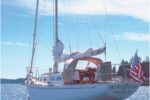
Aventura is a 1978 Golden Gate 30. She’s a full-keel sloop of moderate displacement designed by Chuck Burns. Sisterships were built under the brand names of Farallon 29, Bodega 30, and Bay Island 30. Back in 1983 when I was researching them, I was told she was a Cadillac boat at a Chevrolet price. But these boats had been built during the oil crisis of the late 1970s when the price of resin skyrocketed along with that of petroleum. This greatly reduced profit margins and many builders went out of business, selling their molds to others.
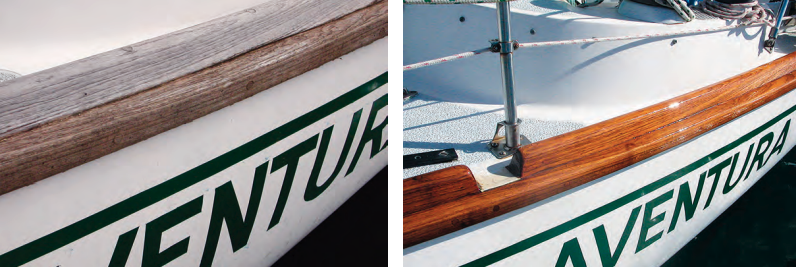
Now, even though I have just praised my boat as though she were the Goddess of Rum, I failed to mention that when I bought her she was a bit . . . cosmetically challenged. Her teak had deteriorated to the color of pewter. But if she had been a varnish-perfect princess, I would never have been able to afford her. However, her deteriorated teak didn’t alarm me because I had a sanding brigade available at my disposal.
And what an 80-grit gang they were! Because I am that rarest of cruisers — a sailor who supports his vagabond ways by juggling bowling balls — my friends are a bit . . . eccentric. There’s Dana who juggles torches with a live chicken standing on his head, Babycakes Babs the tap-dancing cowgirl, and Tommy the roller-skating accordionist. Because of the leisure time that graces the lifestyle of someone with “no visible means of financial support,” my friends were all willing to spend a few hours sanding in exchange for beer, sandwiches, and other enticements.
Since 18 of my loony friends showed up to help me, we only had to sand about 4 feet each. In one hilarious afternoon, we discovered some stunningly beautiful teak under that dull gray camouflage. Over the next few weeks, I did the finish sanding and laid on 10 coats of high-gloss varnish. My sweet little sloop now gleamed like a new bride’s smile. She looked exquisite.
And she remained that way for nearly two decades as I happily wandered the wide waters in her. Together we did a year-long cruise to Mexico and Hawaii and back to San Francisco in 1985. Next, in 1990, I competed in the Singlehanded Transpac (California to Hawaii) and then sailed her back to San Francisco, also alone. In 1992, I gave up my beautiful Victorian rent-controlled apartment in San Francisco and adopted the cruising life full time.
Sold to “the kids”
But early in the year 2000, a combination of extremely difficult family and personal circumstances made it necessary for me to sell Aventura. For someone who had meshed so effortlessly into the sea-gypsy life, this was Bad News. But there was also some Good News because my impeccable boat was purchased by a
wonderful couple.
I thought of them as “the kids” at the time, because he was only 19 and she was barely 20. But even though their chronological years defined them as youngsters, their nautical miles and knowledge surely qualified them as salty old dogs. Claude had already circumnavigated. And he didn’t do it as a teen aboard a family boat; he made the rounding with a couple of buddies who were only in their early 20s. Julie, his sweetheart at the time and wife now, was born in Paris but spent her entire life growing up aboard her parents’ French cruising boat. The two met in Tahiti during Claude’s circumnavigation and vowed to get a boat of their own after he completed his voyage.
They had spent months unsuccessfully wandering the want ads and docks of South Florida searching for the boat of their dreams, so they were feeling pretty dejected as they walked toward Aventura. The instant they saw her, they knew their luck had changed and they bought her within 48 hours.
It was a heart-rending experience for me to cast off the docklines for the young couple and watch my beloved sloop sail without me for the first time in 17 years. As I tossed the final line aboard, I told “the kids” to contact me first if they ever had to sell her.
Reunion
A couple of years later, the totally unexpected email popped up on my laptop. Claude’s dad had bought a large surplus vessel from the South African navy and wanted to convert it to an expedition ship. The young cruisers were going to dedicate themselves to that project and needed to sell Aventura. They wanted to know if I would be interested in buying her back for the same price that they had paid me for her.
To make my decision astonishingly easy, they informed me they had done some serious upgrades to her. That was an understatement. They had swapped out the old Volvo for a brand-new Yanmar diesel. They had added radar, a wind generator, refrigeration, new standing rigging, and other gear I could never afford on a bowling ball tosser’s salary.
Although this was already a very generous offer, they made it even more alluring by mentioning that my once and future sloop was in a boatyard in Carriacou, down near Grenada. I had always wanted to sail the fabled West Indies and now I wouldn’t have to beat into the trade winds for weeks to get there.
The only downside to this storybook reunion was the fact that, while dedicating themselves to upgrading the equipment aboard Aventura, Claude and Julia weren’t able to maintain her cosmetic beauty as I had always done. And, since she was now way down island, I couldn’t afford to fly in even a few members of my long-ago sanding brigade . . . those who were not presently incarcerated.
Singlehanded sanding
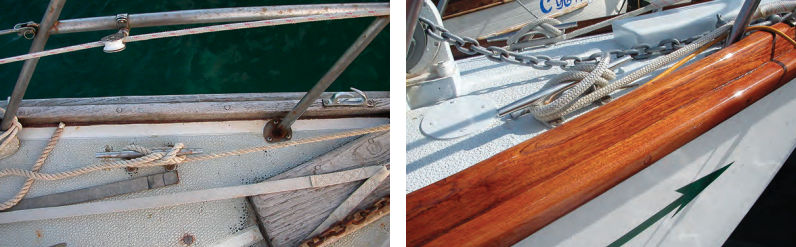
By doing it alone, I made much slower progress, but this also gave me far more time to savor the transformation. Three areas begged for my attention. The terminally gray teak was the primary project. Then I had to discover whether there actually was “stainless” steel under what currently appeared to be “rust-more” steel. And finally, the white fiberglass had oxidized to the point at which it was hard to determine where it ended and the gray non-skid began.
A cruising friend loaned me a palm sander. After a few days spent enjoying its labor-saving efficiency, I wanted to build a little shrine to the palm sander and make daily sawdust offerings. This is one great tool. I also eased my sandpaper burden by cutting down the number of teak objects I used to varnish. Many of these were little in size but large in nuisance. The bases under winches and beneath turning blocks are good examples of pain-in-the-palm items that I now covered with Pettit Easypoxy Mist Gray paint. It goes on easily, is readily available, and is very durable.
There is a phase when the teak becomes a pale salmon color so gorgeous I didn’t want to apply the varnish. Unfortunately, that stage lasts about as long as a campaign promise, so I laid on 10 coats of West Marine Admiral’s Varnish. Between each application, I sanded with 220-grit; except for the last two coats, which got the deluxe 400-grit treatment.
A boat-keeper’s tricks
To convert my stainless steel from rust-more to shine-more, I used basic Brasso. It is the only metal polish widely available in Panama. When applying it with a clean rag was not sufficient, I switched up to green scrub pads. On the really tough rusty spots I used toothbrush-sized metal brushes.
To resurrect the hidden beauty of the non-skid I used Easypoxy Mist Gray marine enamel. A barbecue brush does an excellent job of prepping the surface. I used masking tape on the long linear surfaces and would then freehand in the rounded corners. Cutting the brush bristles down until they are only about an inch long helps keep the paint from building up between the high spots in the non-skid.
A final trick that deserves mention in my boat-keeping arsenal is the use of acetone on the lifelines. In my early days of owning Aventura, I experimented with many techniques for removing the grime that seems magnetically attracted to white lifeline covers. I finally hit upon acetone as the miracle gunk remover. Other boaters on the docks cautioned me that it was too harsh and would soon eat up the white coating. Well, brothers and sisters, I am here to testify that for more than 25 years now this has not occurred. My lifelines remain clean and white.
In closing, I’d like to address the commonly held belief that sailors can either go cruising or they can devote themselves to keeping their boats looking beautiful. In my experience, this is simply not true. I have been out here in the fleet for a very long time and have discovered many cruisers who maintain their boats superbly and yet rack up the miles, the ports, and the adventures. To me, being cocooned in a beautiful boat is well worth the extra effort.
Ray Jason is the author of Tales of a Sea Gypsy. He and Aventura recently completed a fun voyage from Key West to Mayan, Mexico, then Belize, the Rio Dulce, and back to Bocas del Toro, Panama, where he is usually anchored out by his lonesome working on his “other writing.” Visit www.theseagypsyphilosopher.blogspot.com for a sample.
Thank you to Sailrite Enterprises, Inc., for providing free access to back issues of Good Old Boat through intellectual property rights. Sailrite.com