Designing by eye gives way to numbers

Issue 94 : Jan/Feb 2014
We have discussed at length in recent issues the design formulas used to compare boats of different designs and reach conclusions regarding their relative performance. Indeed, the average sailor might be as obsessed with numbers as the average baseball fan. However, this was not always the case.
Like architecture and engineering, yacht design evolved in the late 19th century from “rule of thumb” design to “scientific” design. Great strides were taking place in the 1880s in structural engineering, with the development of the steel-framed skyscraper and the suspension bridge, and in mechanical engineering, with the development of faster trains and locomotives and larger steamships and passenger liners. To ensure they would perform as expected, these structures, trains, and ships had to be “designed” before they were built.
The idea of designing a yacht before it was built was an equally innovative concept, especially in North America where the self-taught rule-of-thumb yacht designer held sway for many years. This changed in the America’s Cup racing of 1881 when the first “scientifically designed” America’s Cup defender, Mischief, beat the last “modeled” challenger, Atalanta, and the scientifically trained yacht designer gained supremacy. Before that, the profession of yacht designer did not even exist.
A model method
Prior to 1881, the great majority of yachts in North America weren’t “designed” as we now use the term. There were no lines drawings showing plan, elevation, and sections with waterlines and buttocks. There was no calculation of displacement or centers of effort and buoyancy, let alone block or prismatic coefficients. Yachts at that time were “modeled,” usually by the builder. The hull shape was literally carved out of a block of wood formed by several “lifts” or layers screwed together. The carving was done to scale, of course, 3⁄8, 1⁄2, 3⁄4, or 1 inch to the foot, depending on the size of the finished boat.
Since one side of the yacht is the mirror image of the other, a half model was used, although there was no consensus as to which side, port or starboard, should be modeled. Once the desired shape was achieved to the modeler’s satisfaction, the lifts were disassembled and the waterlines traced off. Beam measurements at each waterline were taken at several sections and transferred full-size to the lofting floor. Full-sized frames were cut and erected and planking followed. Before cutting the frames, the builders set up the stem, backbone, and sternpost. Because the model was used primarily to cut the frames and backbone, this “builder’s model” was almost always undersized by the thickness of the planking and often did not include appendages, such as a keel or rudder.
As the frames were being set up and planked, it was not uncommon for changes to be made, especially in the ends, to create easier runs or to facilitate planking. By launch time, there was no guarantee that the hull as built was an accurate representation of the initial model. For that reason, no one really knows what the true hull shape of the original America was, since the models of her that exist are not the same. Another complication with using models is that it was difficult to make quantitative assessments of subtle changes to subsequent designs, since everything was intuitive and done by eye.
After the boat was finished and launched, inside ballast was added as needed to get her down to her waterline and achieve proper trim. The spars and rig were installed and, after she was sailed, alterations were made in mast position or sail configuration to achieve proper balance. Once the builder had modeled and launched several boats, he would have a pretty good rule-of-thumb knowledge of what worked best. As long as he didn’t depart too far from his base design, each boat was slightly less of a guess than his previous one.
Skeptics of this process would do well to remember that some of the finest yachts in the history of sailing were modeled, not designed, including the schooner America. The finest yacht “designers” in North America prior to 1881 were of this school, including George Steers, who modeled America, and David Kirby, who modeled the 1876 America’s Cup defender, Madeleine. Other leaders in the field were the great sandbagger modelers and builders Bob Fish and Pat McGiehan and the Canadian modeler Alexander Cuthbert.
These early yacht designers were actually builders. They used the model to sell the concept of the design to the potential customer but they made their money in the building and sale of the boat, not usually the design.
Science enters the field
Across the pond in Scotland, things were proceeding in a slightly different direction. There, future yacht designers of the 19th century — like George Lennox Watson and William Fife III — were receiving design training in shipyards building iron and steel high-speed passenger steamers and warships. These vessels were designed before they were built as they had to meet performance expectations in speed, stability, and cargo and passenger-carrying capability. In their spare time, these men applied their design knowledge to yachts. It was not long before the theories and methods of scientific yacht design were published in book form, first by Philip R. Marett and then, more notably, by Dixon Kemp, another Englishman.
Also in Great Britain, slightly prior to this time period, the Royal Institution of Naval Architects was formed. One of the founding members was young Scottish engineer and naval architect John Scott Russell, one of whose earliest papers was on the wave-line theory of hull shapes (see sidebar on page 19). At this time, sail propulsion in passenger vessels was rapidly giving way to steam and, due to the limited horsepower of the early marine steam engines, it was imperative to have a hull form with minimum resistance. The American clipper ship builder and designer John W. Griffiths developed a similar theory and may well have been influenced by Russell’s work.
It is quite possible that the work of Russell and Griffiths influenced George Steers when he designed America. It’s interesting to note that when America voyaged to England to generate prize money for John Cox Stevens and his New York Yacht Club (NYYC) syndicate, the only one-on-one match race they could arrange was against Scottish railroad engineer Robert Stephenson and his slightly smaller yacht, Titania, designed by . . . John Scott Russell. Titania was designed to the wave-line theory but was artificially narrowed to be better optimized to the British tonnage rules then in effect that severely penalized beam. So, in Russell’s eyes, America better embodied his wave-line theory than his own Titania design, especially considering that America handily beat the smaller challenger.
Americans adopt science
As a boy, A. Cary “Archie” Smith saw America being built in 1851. He later apprenticed with Bob Fish building sandbaggers, where he received excellent training in conventional modeling and boatbuilding. He then embarked on what he considered to be a more stable and potentially lucrative career as a marine artist, specializing in “portraits” of the yachts of wealthy NYYC members. Two of his paintings still grace the library of the New York Yacht Club on 44th Street in Manhattan. He also kept his hand in as the club’s measurer.
In those days, the NYYC calculated ratings and handicaps with the Cubic Content Rule that required measuring the hull and calculating its volume, or cubic content. This rule only exacerbated the tendency to build low-freeboard, shoal-draft, lightweight centerboard sloops and schooners.
About this time, Bob Center, a good friend of Smith’s and an amateur designer in his own right, returned after spending some time in England. He brought home copies of the British texts by Marett and Kemp on the methods of scientific yacht design: methods for developing the lines plan on paper and of calculating displacement and centers of buoyancy and effort before the boat was actually built. Together, using as an example Mosquito, a British cutter published in Marett’s book, Smith and Center designed the cutter Vindex, a marked departure from the American “skimming dish” designs of the time. Then, in 1879, Smith designed the iron cutter Mischief, the “Iron Pot,” for the Englishman Joseph Busk, who was living in New York and was a member of the NYYC. Mischief is believed to be only the second iron yacht ever built in the U.S. and, like Vindex, one of the earliest in the U.S. to be completely designed on paper before she was built.
North of the border
In 1870s Canada, as in the U.S., yachts were being modeled and built by local builders. The most successful of these builders was a Scottish immigrant named Alexander Cuthbert who had become a very proficient helmsman racing other people’s boats on the Great Lakes for prize money. It wasn’t long before he established his own yard in Cobourg on Lake Ontario and was modeling his own designs. He had early success in 1872 with Annie Cuthbert, named after his wife.
Annie Cuthbert was owned by a syndicate sailing out of Hamilton, Ontario. Cuthbert’s work is often compared to that of McGiehan in New Jersey, since both were designing the “American model” of wide-beam shoal-draft centerboarders of the “flat iron” model. The top yacht on the Great Lakes at that time was the McGiehan-modeled Cora sailing out of the Detroit Yacht Club. So it was with a good deal of pride and one-upmanship that Annie Cuthbert, sailed by Cuthbert himself, handily beat Cora at the Put-in-Bay Fisher Cup Regatta on Lake Erie that year.
The success of Annie Cuthbert and other Cuthbert designs led directly to Cuthbert’s Countess of Dufferin — at more than 100 feet in length the largest design he ever attempted and the largest yacht built on Lake Ontario at the time. Built initially to take part in the U.S. Centennial Regatta in Philadelphia in 1876, she became the third challenger for what was now becoming known as the America’s Cup. However, like any number of subsequent challengers, the Countess was badly underfunded, poorly tuned, and totally unprepared. She was quickly defeated by the schooner Madeleine, a modeled hull by Long Island builder David Kirby.
America’s Cup fever
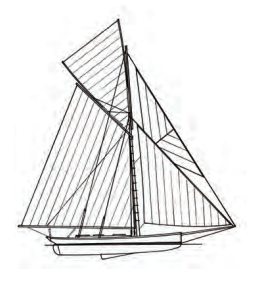
Like a lot of yachtsmen after him, amateur and professional, Cuthbert was bitten with America’s Cup fever and, after returning to the Great Lakes to lick his wounds, he challenged for a rematch in 1881. Thus we return to Archie Smith and Mischief. Since, for the first time, the challenge was going to be in smaller (70-foot) sloops, rather than the larger schooners, there was a bit of a panic to find a defender, as the NYYC at the time was a little short of sloops. David Kirby, whose Madeleine had so successfully defended the Cup during the previous Cuthbert challenge, was asked to model and build a new defender for a NYYC syndicate. This he did, and the new boat, Pocahontas, would be the first boat built specifically to defend the Cup.
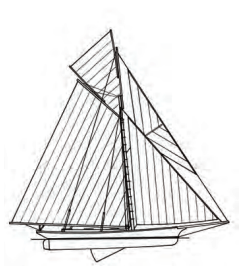
Built, as was her predecessor, from a carved model, Pocahontas was definitely “old school.” There was a selection series and, to everyone’s surprise, Mischief, the little Iron Pot, emerged as the best defender. However, the Cuthbert-modeled Atalanta was well behind schedule and not yet finished and even more badly prepared than his Countess of Dufferin. The racing was anticlimactic, with Mischief easily beating the ill-prepared and badly sailed Atalanta. However, what seemed to outrage the American defenders as much as the Canadians’ lack of preparedness was the fact they were challenging not with British cutters but with what the defenders considered to be Canadian-built typical American sloops.
Thus the 1881 America’s Cup was the first to be sailed by a scientifically designed defender and the last to be challenged by a modeled challenger. The new methods were replacing the old. Cuthbert continued to model and build yachts the old way until his death in 1890, and Archie Smith had already hung out his shingle as the first independent yacht designer in North America, the first of a new breed using the methods of scientific design. Smith went on to establish an enviable design career specializing in large schooner yachts. He also designed some very successful high-speed Long Island Sound passenger ferries that operated very economically into the 20th century.
In 1881, after Mischief beat Atalanta, yacht design became less intuitive and more analytical, and that trend has continued. However, in this age of computer-aided design and 3-D modeling, the model has taken center stage again, even if it is only virtual, and the programs generate far more numbers than the early scientific designers could ever contemplate.
Now when we talk about designing by the numbers and start comparing different design coefficients, remember that it was not always so. This sport we all enjoy has an intriguing history full of unique individuals with fascinating stories, each of whom has contributed something worthwhile to this sport. In that respect, I can’t think of another sport quite like it.
Rob Mazza,a Good Old Boat contributing editor, spent much of his professional life designing good sailboats that are mostly now old. He is an avid student of yachting history.
Thank you to Sailrite Enterprises, Inc., for providing free access to back issues of Good Old Boat through intellectual property rights. Sailrite.com