All agree this boat has character
Issue 95 : Mar/Apr 2014
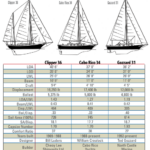
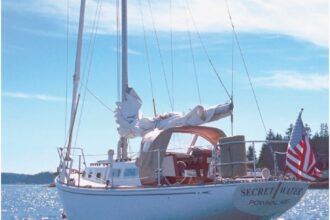
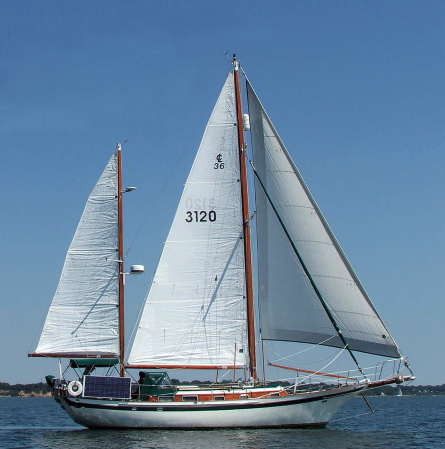
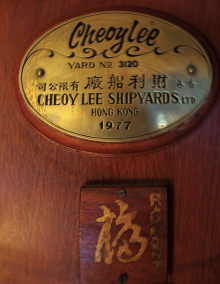
A beautifully maintained classic sailboat is sure to attract attention, even among non-sailors. The graceful hull lines and the fine details, in this case of a Cheoy Lee Clipper 36, vintage 1977, are there for all to admire. It’s not a stretch to say this boat exemplifies what’s meant by “shipshape and Bristol fashion.”
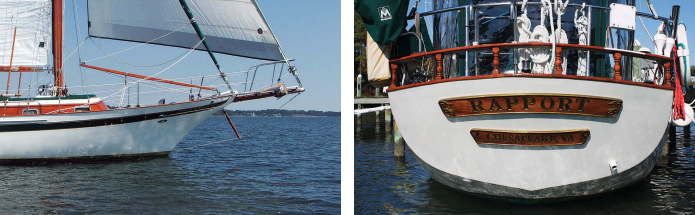
On the transom board, the name Rapport glows in traditional gold leaf against a background of high-gloss varnish. Is it Rapport, as in harmony and accord, or because rapporter suggests “to bring back”? She could fit either description as she did indeed need a rescue, and her owners have accomplished an extraordinary renovation.
Ron Koris and Gwyn Nethaway proved to be the right team to take on this needs-work boat. They are sailors first and foremost, and that’s necessary for incentive. “There’s nothing quite like a sailboat moving through the water smoothly and quietly with only the wind for power,” says Gwyn. “You just can’t duplicate that feeling in any other way. And on a brisk day, well then, you still can’t duplicate it. It’s just a kick!” Indeed, it is.
Many sailors come to the joy of sailing by simply growing into it — if it was summertime, it was family sailing time. For Ron, things were a bit delayed. Though his dad had talked long and often about someday doing some long-distance sailing, he never actually made the time for it. Ron remembered the dream and eventually latched onto it. “I started sailing in college,” he says, “and it didn’t take long for me to get hooked.” One college professor was especially helpful. He had a motto: “Anything less than a hurricane, we sail!” For the students, that meant good training and great sailing.
Gwyn’s childhood home was in northern Michigan, but she didn’t sail there. She stayed in the Midwest through the years of college and veterinary school and, soon after graduation, relocated to Virginia. As an equine veterinarian, she wanted her own practice in a place that’s known for its horses. It was actually business that brought Ron and Gwyn together. Ron’s company handled pharmaceuticals and he was an independent distributor to the medical community. Horses, of course, need pharmaceuticals too.
Sailing as a couple
Sailing hadn’t been part of Gwyn’s original plan, but since she didn’t like the idea of Ron sailing alone every weekend, she was determined to sail too. Her introduction to the boat will be familiar to many: no pre-sail warning, no mention of tilting, or heeling, or any other angle word. Gwyn was seated on the low side, enjoying a lovely sail and chatting about the absence of mechanical sounds when she realized how close she was, face to wave. She sat up very quickly and as upright as her petite frame would allow. Not one to be easily frightened, she recovered and truly did not look back. By the time Ron and Gwyn were married, their sailing style centered on cruising the southern Chesapeake in a 27-foot Catalina named Music.
Gwyn still looks forward to those days when the only sounds are those of wind and water: “What a great way to travel!” she says. “But . . . I did not fall in love with kedging into or out of a slip!” As bad luck would have it, the marina had assigned Music to a slip that was not deep enough for her at low tide. Leaving the slip sometimes required Gwyn to call on her horsemanship skills. She would lasso the nearest piling, winch the boat as far forward as possible, then move on to the next piling. The return sometime later might require a similar effort.
From the city of Chesapeake, Ron’s general business territory at the time, it was a short ride to a number of bay tributaries and marinas. Music was docked at Yankee Point Marina on Myer Creek near the Rappahannock River bridge. The marina annually hosted the Hospice Turkey Shoot Regatta for classic boats. Ron and Gwyn volunteered at this well-known fundraiser for years, fixing breakfast for upward of 500 people.
While Gwyn worked on sailing skills, Ron learned a special kind of horseback riding known as field competitions, in which horse and rider are put through a series of tests around a marked course. Because these competitions are often strenuous, a veterinarian is posted at various points along the way. As each horse arrives at a checkpoint, it is examined head to hoof to make sure it can continue the run. Gwyn rode in many competitions, too, and often served as judge and veterinarian.
Sailing, though, filled the greater part of their free time. One day, somebody said something about a larger boat.
Bigger-boat syndrome
As most cruising sailors know, once raised, the notion of a bigger boat does not easily disappear. Once voiced, it must be dealt with. So one Sunday, Ron, Gwyn, and a yacht broker went to see a little pea-green boat. Actually, it was a 30-foot white something or other they were to look at — lovely but Gwyn thought it small. Ron recalls Gwyn staring past the 30-footer, her attention focused on a boat at the next dock. It needed work; she could see that. The varnish was gone. The instruments were probably old and useless. Pea-green mildew covered everything.
“Why wouldn’t I want this boat?” Gwyn thought. “This boat has character!”
Pointing to it, she asked the broker, “What’s that?”
“Oh no,” thought Ron. “Please don’t look at that one!”
“Well . . .” said the broker. “That one’s not in very good shape; you probably don’t want that. Now this boat has . . .”
“I want to look at that boat,” said Gwyn, a bit louder than before. Ron hemmed, the broker hawed, and Gwyn prevailed. Once she opened the companionway hatch and saw all the beautiful interior woodwork, there was no looking elsewhere. On the plus side, the hull was fiberglass. Ron was already juggling dollars. “If we can buy it at a low enough price, we’ll have the money to pay for fixing it. I’ll buy it and fix it.” He added one proviso: “I never want to hear one word of complaint about the dollars that will be poured into the hole that is that boat!”
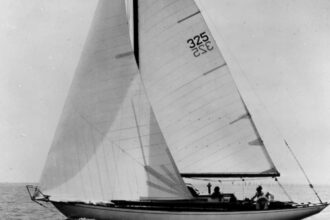
Apparently, Gwyn agreed. The deal was done — the couple became the proud owners of a Cheoy Lee Clipper 36 designed by Bill Luders, who also drew the Naval Academy’s 44-foot yawls, among other recognized classics.
Despite his initial concerns, Ron was pleased with this unexpected purchase. Curiously, the boat was not meant to fit an imminent cruising plan nor to satisfy an immediate desire to live aboard. But circumstances were falling into place to enable one or both to occur within a few years.
The liveaboard option
The economic slowdown of the early 1990s that forced lifestyle changes for many people affected the local horse economy. Gwyn opted to sell the practice and retire. This prompted a move from the city of Chesapeake to the area around the Rappahannock River. Ron was still thinking “house” when Gwyn suggested they try living on the boat instead. “I guess the idea kind of grew on me over time,” she says, while making little motions with her hands. “It just makes sense. I can take care of it; I can manage this much space. If I don’t use something, I’ll just get rid of it.”
With living aboard in their future, they looked at houses, but not to buy. Instead, they rented a place where they could live and also work on boat projects because, before they could move aboard their “new” boat, they would have to fix her up.
A progression of priorities
A practical worker, Ron started a list of projects. By the middle of page two (on legal-size paper yet) he realized he should approach the list from a different angle.
Ron decided to focus first on what needed to be done so they could sail the boat the next summer. That list filled half of a standard letter-size page . . . doable. Working through the winter should enable them to sail in the spring and summer. This was a much better incentive than looking toward the end of a four-year plan. Work some, sail some, work some, sail more, and so on until the work is done.
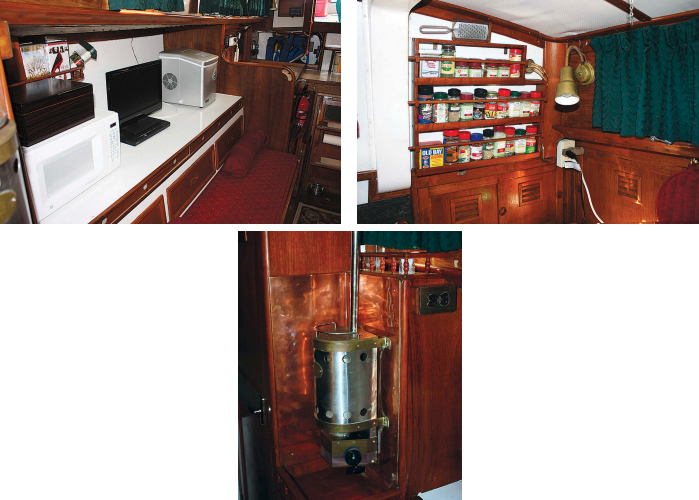
First on the list was a most ambitious project to remove all the interior wood pieces and strip, sand, and revarnish them. Not an easy task in any circumstances, it would have been nearly impossible to do while living aboard. As each piece came out, Gwyn coded it for later reassembly into the master puzzle. The interior wood was then finished with traditional Schooner varnish.
“I got a new propane cookstove for our first after-boat-purchase Christmas,” boasts Gwyn, though of course it was really a together gift. As they are both avid cooks, they normally take weekly turns at Rapport’s galley or grill, turning out unique combinations of foods and flavorings.
“And I got an anchor windlass too,” says Gwyn. “That might have been for a birthday.”
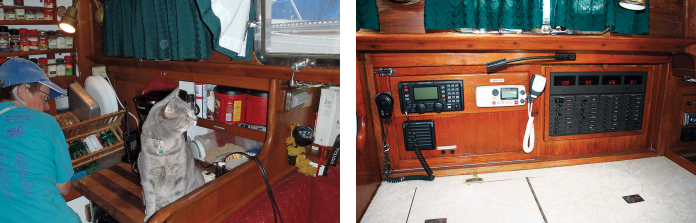
The electric panel is new. “The original was nearly impossible to see,” Ron says. He made the new panel, but asked the yard to do the wiring. They also had new stainless-steel ports fitted and Ron replaced all the through-hull fittings with new ones made of composite material. They also have a new Force 10 propane heater.
“Don’t forget the new interior cushions,” says Gwyn, “and the new headliner.” In addition, all the water lines on the boat have been replaced. The head has a new toilet, a new sink, and a Lectra/San system.
“The boat has a deck-stepped mast,” says Ron. “At some point, I noticed that the base under the mast was looking a little concave. At first, we couldn’t lift the floorboards to check this, but when we did, we saw that the compression post was just sitting on a pan in the shower, and it had finally bowed the pan. I had to cut a hole in the pan and use a jack to raise the post up. I cut a 4-inch piece of PVC pipe and filled it with epoxy. The compression post now sits on top of that base.”
They sandblasted the keel, which is iron covered with fiberglass. The blasting took off the fiberglass along with the corrosion, so Ron re-glassed it, put on a barrier coat, and repainted it. While working on that project, Ron found and fixed a hole in a fuel tank. “I was glad I found that early on,” he says. Many listed projects sprouted spin-off work in that way.
“We were really lucky with the masts,” Ron says. “They’re wooden, and leaving them on the boat for years of outside storage could have spelled disaster. But the previous owner had removed them and stored them indoors. I had to replace only one spreader — even that was $200 of Sitka spruce. Oops . . . money talk!”
The main halyard was an immediate problem too. It was wire — standard when the boat was new, but not desirable today. And Gwyn had to stand on the cowl vents to reach the winch. The new halyard runs back to the cockpit. All the standing and running rigging has been replaced.
“And,” says Gwyn, “we got new sails.”
“This is the first ketch I’ve sailed,” Ron explains. “I asked Jerry Latell of Ullman Sails in Deltaville for his recommendations. As a result, we have a fully battened main and a 110 jib. It has worked out perfectly. It’s so easy to balance the boat.”
Cosmetic touches
Hull painting finally reached “to-do” status in 1999, three years after they bought the boat. “When planning for supplies,” Ron says, “I realized what a job it is to paint this boat. With a Cheoy Lee, you don’t just buy one big can of white Awlgrip. That works for most of the hull, but then there’s the colored stripe and boot top.” Rapport’s are green. And applying the gold leaf for the name and scroll design requires a special skill as well as a special coating. Then there are the cabin sides, finished with Honey Teak from Signature Paints in Florida and, finally, bottom paint.
Re-chroming can create problems during a refit, so Gwyn was very careful to record all the pieces she sent away. They came back one item short, but not because something was lost. Gwyn had accidentally sent a stainless-steel item. The chroming company kindly forwarded the odd piece to the stainless-steel polishers and a delayed communication kept it out of Gwyn’s return package. Good news and good service — and no extra charge!
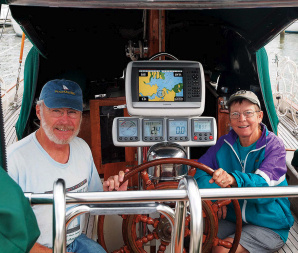
In the cockpit, they moved the engine display from the bottom of the cockpit to the back of the cabin bulkhead and moved the sailing instruments from there to a new pedestal guard. They also installed a Garmin chart plotter, HD Radar, and AIS together with a Raymarine Smart Pilot for wind, depth, and speed.
“All the things we’ve added have been good for their purpose,” Gwyn said when asked about a favorite upgrade. “But the Bimini enclosure was a really great idea. In winter, we can turn heat on below and in a short time the heat rising from the interior combines with the sun streaming into the enclosure to make the space really comfortable. We can enjoy so much more light and outdoor time.”
As for Rapport’s engine, today a Perkins 4-108 hums happily in place, installed while Gwyn and Ron enjoyed a delightful winter vacation in Charleston, South Carolina. That, however, is another story.
What’s next for Rapport?
“More cruising,” says Ron. “First the usual places — the Intracoastal, Bahamas, Caribbean — then maybe the European canals and Greece.”
“We both enjoy the travel aspects of cruising as much as the actual sailing time,” says Gwyn. “We like to meander at sailboat speed, exploring the rivers and creeks and waterside towns. The ICW is not a ditch to us . . . it’s our route to neat people and places.”
Zora Aiken and her husband, David, are the authors of several books about boating and camping and recently finished their seventh children’s book illustrated by David. Their movable studio, office, and home is Atelier, a good old, now antique, 1963 35-foot Chris-Craft sloop.
Thank you to Sailrite Enterprises, Inc., for providing free access to back issues of Good Old Boat through intellectual property rights. Sailrite.com