. . . and realizing that “perfect” is the enemy of sailing
Issue 99 : Nov/Dec 2014
I once helped a friend who was looking for an apartment. We found one I thought was especially cool and in a convenient location. She rejected it because it was one block away from the most exclusive area of town and she considered that too far away. Her explanation, stated emphatically, was: “I have standards.”
We all have standards. The question is, what are they and how do they affect our lives? In working on my boat, I found myself going beyond the old saying, “The perfect is the enemy of the good,” and gravitating toward standards that are neither perfect nor good.
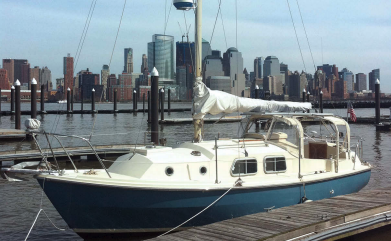
Several years ago, I was living aboard the 1970s British sailboat I have long owned. It needed work and I dove in. One project led to another . . . that led to another . . . and so on.
It’s so easy to think, “As long as I have this section of the cabin apart, I might as well fix this and change that.” Before I knew it, I had moved off the boat, removed every piece of metal and wood, sanded the boat down to bare fiberglass, repainted it, redesigned all manner of things, and begun the long process of putting it all back together.
In the course of this work, my standards changed. At first, I tweaked each item until I heard myself say, “That’s perfect,” and felt the glow of satisfaction. As time went by, and I longed to move back aboard, my standard devolved to hearing myself say, “That’s good enough.” The object of my attention may not have been perfect, but it would do.
As more time evaporated, my standard morphed to, “It’s better than it was.” I wondered if I was descending into the realm of rationalization. Maybe the item wasn’t even good enough, but at least I had improved it some. At least it kept me from coming apart as my boat was coming together.
Later, as I became more physically and mentally exhausted by the project, I heard myself say one day, “I can always change it later.” While it may seem as though I had reached the depth of despair, this was a strangely liberating standard. I realized I didn’t have to fix everything on the boat immediately. In fact, improvising a temporary solution and living with it for a time became an effective test drive. Sometimes, the test drive was so effective that the temporary became permanent, and I was OK with that.
For example, it’s amazing what one can do with some thin line and trucker’s hitches. At one point, I was feeling too lazy to install all the hardware needed to properly lock my two companionway hatches and two cockpit lockers. From below, I wedged a dowel against the main companionway hatch to secure it. Also from below, I used a line to secure the aft cabin companionway hatch and the cockpit locker lids.
This meant I had to exit the boat through the forehatch. I secured a line to its underside and ran that line up to the deck through the chain pipe. After climbing out, I made the line fast to the forward cleat and hid it under some loose anchor chain.
I missed seeing all those beautiful brass padlocks, but decided I could cope. I considered my system foolproof: it would either fool a fool, or prove I was one. In any event, I could still “change it later.”
Over time, I developed a refined version of the “I can always change it later” standard. I would ask myself, “If I were at sea and had to fix this problem right here, right now, by myself, with what I have on hand, what would I do?”
This often revealed the simplest, quickest, most reliable solution, or at least a healthy place to begin my analysis. I could still “change it later,” but it helped to start with the simple and consider whether to complicate it, rather than the other way around.
This process of accepting changes in standards may be anathema to the perfectionists among us. I actually consider myself to be one of them, when I have that luxury. But when I don’t, I am grateful for two of the wisest words in the English language: “Oh well.” The “oh well standard” does more to get the job done and protect my mental health than any other.
Like my friend, I do have standards. The difference is that my boat is happily back on the water — while my friend is still looking for the perfect apartment. Now, if I could just remember how to unlock my boat.
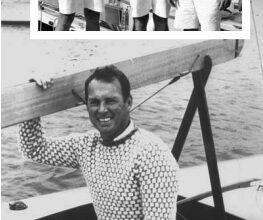
Roger Martin restored his first boat in 1964, a 1950s Wood Pussy daysailer he still owns. He has owned his 26-foot 1972 Westerly Chieftain since 1979. Bucket is now on loan to his son Justin in New York. Roger lives in eastern Virginia.
Thank you to Sailrite Enterprises, Inc., for providing free access to back issues of Good Old Boat through intellectual property rights. Sailrite.com