The long road to separation of keel from hull
Issue 102 : May/Jun 2015
In a previous article (“How Sailboat Rudders Evolved,” January 2015), we looked at the evolution of the rudder on sailing yachts from its position hung from the aft edge of a full-length keel, through the attachment to a fixed leading-edge skeg, to the all-movable balanced rudder that is now seen on all racing yachts and most production cruisers. These developments in rudder design and execution were directly tied to the evolution of the “keel” from being primarily an integral longitudinal appendage under the hull to becoming the separate bolt-on vertical appendage we see today.
This dramatic change in profile is linked to the two primary and complementary purposes of the modern keel: stability and lift. The modern keel provides righting moment to the boat when heeled, to prevent capsize when close-hauled, and also provides hydrodynamic lift to prevent side slipping or excessive leeway when sailing upwind. That is to say, the development of the modern keel is tied directly to the improvement in upwind performance and, in that respect, is also tied directly to the improvements in mast, sails, and rigging that took place at the same time the keel was evolving. Both of these developments, but primarily the development of sails, masts, and rigging, benefited from the rapid development in aerodynamic theory pioneered with the advent of flight and publicized through the work of authors, such as Manfred Curry, in the 1920s and 30s.
In the beginning, all ballast in sailing vessels was carried internally. Usually in the form of cobblestones, it was placed aboard sailing ships when they had no cargo to deliver, in which condition the ship was said to be “in ballast.” When a ship took cargo on board, a lot of this ballast was removed and was often used to pave the streets leading to the port.
Yachting was becoming a popular sport in the mid-19th century, and early yachts also carried ballast in the form of stones that were usually placed below the cabin sole in the bilge. As the sport became more competitive, sailors learned that higher-density materials, such as pig iron and lead ingots, were far more effective than stone and, since the ballast had become a semi-permanent fixture in the boat, the denser materials were well worth their additional cost. I say “semi-permanent” since the ballast was often removed to reduce the strain on the hull when the boat was hauled and stored on land.
We have already discussed the 19th-century contest for design supremacy between the British cutter and the American sloop (November 2012). The narrow-beam “plank-on-edge” cutter relied on its deep draft, heavy displacement, and high ballast/displacement ratio to achieve the righting moment to carry the large unmeasured sail plans of the day. This high concentration of ballast in the form of iron or lead was placed as low in the bilge as possible to lower the center of gravity of the vessel and thus increase its heeled righting arm. Since these narrow-beam cutters relied almost entirely on the low center of gravity to generate righting moment, they sailed at very high heel angles when sailing upwind in any sort of breeze.
The wide-beam, shoal-draft “skimming dish” American sloop (or schooner), which was almost always a center-boarder, relied primarily on wide beam to achieve sailing stability. Although a good deal of ballast was still placed in the bilge to get the boat down to her lines and to achieve proper trim, neither the amount of ballast nor its location was considered the primary source of sailing stability.
Removable ballast proved to be a liability for a number of these vessels. The capsize of the 141-foot centerboard schooner Mohawk at her mooring off the New York Yacht Club at Staten Island in 1876 was the most notable example. She capsized while raising sail in a squall, resulting in the death of her owner and his wife, who were trapped below under tons of shifting ballast and cabin furniture.
External ballast
It should come as no surprise that the English cutter first pioneered the use of external, rather than internal, ballast to further lower the center of gravity of the vessel. This external ballast, in the form of lead or iron plate, was simply bolted to the existing keel timber, which is the lowest portion of the hull and forms the structural backbone of the vessel. Very soon, the external ballast was “let into” the keel timber to become structurally and visually integral with the existing wooden keel. The shape of the keel had not materially changed, but for the first time it housed an increasingly large percentage of the ballast. As cutters became narrower and narrower, the ballast portion of displacement crept up to 70 percent, and the amount that was external to the hull also increased.
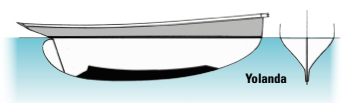
External ballast started appearing in the U.S. in the late 1870s; the 1879 Roosevelt Schuyler-designed and -owned moderate cutter Yolanda is an excellent example. The first yacht built on Lake Ontario with external ballast was the Gooderham-owned Watson-designed Aileen, built in Toronto in 1882. The second cutter on the lake with external ballast was Whistlewing, designed and owned by Æmilius Jarvis and built in 1885.
The battle between cutter and sloop for international design supremacy had been somewhat settled with the racing dominance of the G.L. Watson-designed Madge in 1881, and the rivalry soon disappeared with the adoption of the Seawanhaka Rule in the United States in 1886 and the similar Waterline Length and Sail Area rule in England the same year. The two national types merged into what is now called the “compromise” sloop with moderate beam and draft and the by then well-accepted external ballast, sometimes with a centerboard traveling through the lead casting.
It wasn’t long before the full keel superseded the centerboard, and the beamy 1887 Edward Burgess-designed Papoose quickly set the standard for early Seawanhaka Rule boats of moderate size. Papoose established the parameters for the popular 40-foot class but, with her plumb stem, did not take advantage of the waterline measurement under the new rule. That would have to wait until Nathanael Herreshoff re-entered the yacht design world.
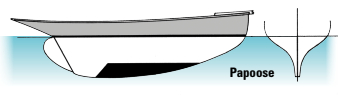
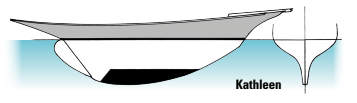
Nathanael Herreshoff and his brother John had already established the Herreshoff Manufacturing Company in Bristol, Rhode Island. By 1874, they were almost entirely devoted to the building of high-speed steam launches. Nathanael had shown himself to be an innovative and creative sailboat designer with the building of the first catamaran Amaryllis in 1876 and the sloop Shadow in 1871. Shadow was the only boat to win a race against the British cutter Madge in her dominance of Long Island Sound racing in 1881. However, in 1891 Nathanael returned to the design and building of racing sailing yachts and, in a single year, changed the entire direction of the sport with two distinctly different designs, Gloriana and Dilemma.
New rules herald the introduction of new designers; the adoption of the Seawanhaka rule in 1886 led to the rise of Edward Burgess, William Gardner, and most notably Nathanael Herreshoff. Following the untimely death of Burgess in 1891, and with the design of Gloriana the same year, the yacht design mantle passed to Herreshoff.
Gloriana, with her waterline forward dramatically snubbed to reduce her rating, was the first boat to truly “exploit” the new Seawanhaka Rule.
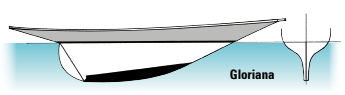
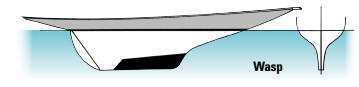
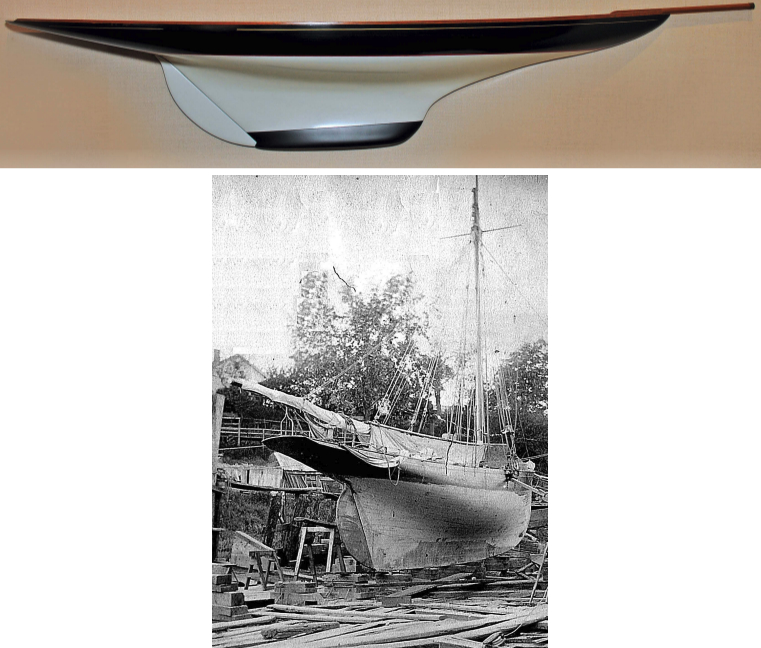
The following year, 1892, when Herreshoff designed Wasp, the keel became more like an appendage with its own leading edge distinguishable from the sweeping centerline curve of the hull. Herreshoff would retain this profile for the rest of his design career, as evidenced by the two-time America’s Cup winner, Defender, in 1895, and the famous New York 30 of 1905. With Defender, however, Herreshoff further lowered the center of gravity of his external ballast by creating what was then known as the “bulb” keel, a distinct swelling of the ballast thickness. In these Herreshoff designs — with their sharper turn of the bilge and distinct leading edge and swelling of the ballast thickness — the keel was becoming a distinct entity designed to supply hydrodynamic lift as well as sailing stability.
Fin keels
In 1891, the same year as Gloriana, Herreshoff set a new direction in yacht design when he launched Dilemma with his version of the fin keel. He was not the first designer to think of this concept, but he was certainly the first to make it work.
The fin-keeler further exploited the Seawanhaka Rule by shortening the LWL even more than on Gloriana. It took full advantage of light displacement in a rule that took no account of displacement in the rating. By separating the rudder from the trailing edge of the keel and greatly shortening the chord length of the keel, Herreshoff reduced wetted surface significantly. By cuttting away the trailing edge, he increased the aspect ratio of the keel and its efficiency. Since this was well before the development of aerodynamics, it’s doubtful that he was aware of that, but he may well have known it intuitively. The greatest advantage of the fin keel was to greatly lower the center of gravity of the ballast by suspending a torpedo-shaped cast-lead bulb from the bottom of a bronze plate. This allowed a light-displacement sailboat to achieve maximum stability with the minimum weight of ballast.
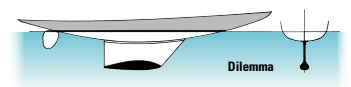
The Herreshoff-designed-and-built 40-foot 20 Rater fin-keeler Niagara went to England in 1895, where she dominated racing among the more traditional designs. Niagara’s reputation was so great that members of Chicago’s Lincoln Park Yacht Club had such confidence in her potential that they challenged the Royal Canadian Yacht Club to a series of match races with a copy of Niagara named Vencedor. In this much-publicized and well-attended series of races in Toledo in 1896, the Fife-designed Canada beat Vencedor in two straight races, starting a series of challenges for what would become the Canada’s Cup.
Two large Boston fin-keelers, Jubilee and Pilgrim, were built to defend the America’s Cup in 1893, but lost the selection trials to Herreshoff’s centerboarder, Vigilant, the first of his six successful America’s Cup defenders. This was said to prove the ineffectiveness of the fin keels in large yachts, but it probably spoke more to the inefficiencies of the flat-plate keel as a lifting surface at a time when the understanding of wing theory was still a number of years in the future.
The backlash against the fin-keeler was so great that new rating rules soon appeared to penalize them. They did this by introducing a “skin girth” measurement in a new Girth Rule. By measuring the actual length of curvature from the waterline to the tip of the bulb and adding this length to the rating, they hoped to penalize these yachts out of existence. When that didn’t work, they later added a “girth difference” factor: the difference between the skin girth against the hull and the “chain girth” formed by stretching a chain from the sheer down to the bottom of the keel. This did not entirely work either. The fin-keeler was not effectively regulated out of existence until after Herreshoff introduced what would become known as the Universal Rule, which was adopted in North America in 1906 and, for the first time, used displacement in the denominator. The same approach was undertaken in Europe that year with the adoption of the International Rule, which retained the girth-difference measurement and other features to eliminate the fin-keeler. It would be another 60 years before separation of rudder and keel would again become popular, during the latter years of the CCA Rule.
The Seawanhaka Rule had its limitations, but that period in the mid-1890s, at the height of the rule, is generally considered the Golden Age of Yachting with the building of some of the greatest yachts in history. G.L. Watson’s Royal Yacht Britannia, designed for the Prince of Wales in 1893, is often cited as the finest of the breed. Even the J-Class yachts of the 1930s departed little from the ideal she established. This was, of course, the goal of the rule.
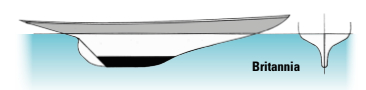
The use of lead external ballast in racing yachts built prior to 1914 assured that few of them would survive World War I. The high demand for lead during the war resulted in a “ballast for bullets” program that deprived most of these pre-war boats of their cast lead ballast. Four years spent drying out on land left them in very poor shape and a high percentage never made it back into the water after the end of the war.
Universal and International Rules
The Universal Rule is famous for producing what W.P. Stephens called an “alphabet soup” of level-rated racing classes. The gigantic J-boats of the 1930s America’s Cup are now the best known. There were smaller classes, though. The R and P classes are the best known on Lake Ontario. Soon after the introduction of the Universal Rule in 1906, R-boat keels were very short in chord length and had fairly high aspect ratios for their time. The distinction between keel and hull was also much more precise, as seen in the 1915 John Alden design and in Swamba, the first R-Boat on Lake Ontario, designed by George Owen for Æmilius Jarvis in 1910. However, as more and more loopholes were plugged in the rule and restrictions applied, the boats designed to the Universal Rule became more conservative and the keels longer and less well defined.
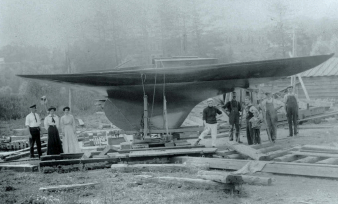
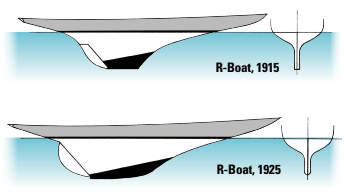
The introduction of new design rules successfully curtailed what was considered an undesirable direction in yacht design embodied in the fin-keeler, and the continual plugging of perceived loopholes and the elimination of extremes with the imposition of limits within the rule eventually produced designs that didn’t differ much from each other. Boats designed to the Universal Rule in its final incarnation left little room for major design innovation. Once the waterline length had been decided, most other dimensions fell into place accordingly.
Rob Mazza is a Good Old Boat contributing editor. He began his career as a yacht designer at C&C Yachts and has held a lifelong fascination for the history of sailing yachts, their designers, their builders, and their owners.
In Part 2 of this series, in the July issue, we’ll look at the influence of the International Rule on the keel development of 6-Metres and how a young yacht designer by the name of Olin Stephens II applied what he learned in the design of successful 6-Metres to the design of equally successful ocean racers under the CCA Rule in the 1930s. We’ll also see how other designers in the 1960s finally achieved what Herreshoff had foreseen in the 1890s: the separation of the keel and rudder.
Thank you to Sailrite Enterprises, Inc., for providing free access to back issues of Good Old Boat through intellectual property rights. Sailrite.com