A non-splicer has it all sewn up
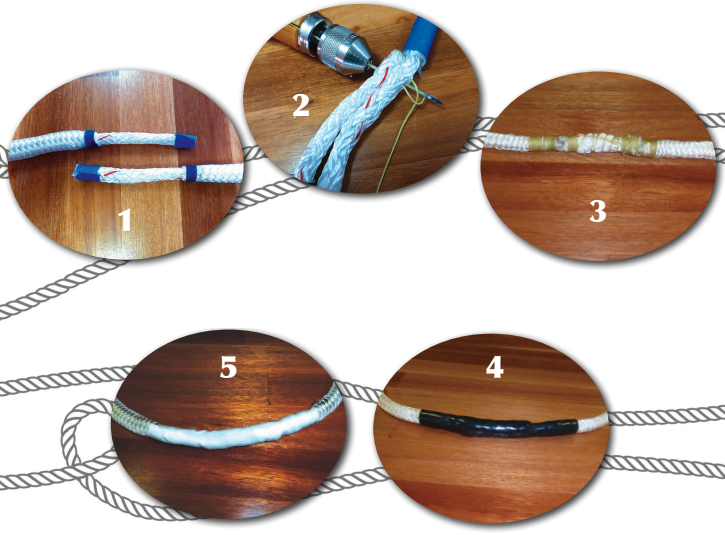
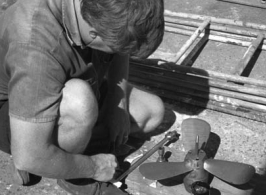
2. He sewed the two core pieces together with two runs (i.e., up and back).
3. He whipped the ends and middle tightly.
4. Ferman discovered that covering the connection with 1⁄2-inch heat-shrink tubing resulted in a stiff section of line.
5. Wrapping with silicone Stretch & Seal tape gave him the more flexible result he needed for use with his furler.
Issue 103 : Jul/Aug 2015
For all of us out there happily sailing about with Hood Seafurl LD headsail-furling systems that have a continuous-loop furling line, the day will (maybe has!) come when it’s necessary to replace that line. It happened to me on Wind-Borne, my 1985 Hunter 28.5.
Easy, you say. Nope. Oh sure, it’s easy to buy the perfect line for the furler, but can you splice a multi-braid line? While on your boat? Well, that’s what it takes. To make matters worse, the connection cannot be much larger in diameter than the line itself.
But there’s good news here. In my research, I learned that line can be sewn, yes sewn, together instead of being spliced. I read the few sources I could find and decided to test the idea. I purchased several feet of the required 7⁄16-inch multi-strand braided line and got to work experimenting. I’ll save you the failures and jump ahead to what worked.
You can see the results in the last two photos. The black heat-shrink tubing was rather stiff (4), but you need the line to be flexible. I obtained this additional flexibility by using white silicone Stretch & Seal tape (5). We’ll see how this tape holds up in use and weather.
I performed a couple of tests. Pulling against the connection with all my strength, I could not break it. Pulling it while standing in a loop with my 165 pounds didn’t seem to faze it a bit.
It’ll be great to have my furler back to its former self!
Ferman Wardell began sailing an 11-foot Styrofoam Snark on a 30-acre lake in North Carolina. He later owned a 12-foot Scorpion, a San Juan 21, and now his good old Wind-Borne, a 1985 Hunter 28.5 that he cruises and races on Lake Norman near Charlotte, North Carolina. He has sailed extensively in the Caribbean and recently received his U.S. Coast Guard Merchant Mariner Captain’s Credential. Ferman enjoys doing boat maintenance, repairs, and “improvements.”
Thank you to Sailrite Enterprises, Inc., for providing free access to back issues of Good Old Boat through intellectual property rights. Sailrite.com