. . . is an ongoing work of artists
Issue 102 : May/Jun 2015
Sailors may have many reasons to switch boats, but upsize and update would probably apply to most. Our boat-buying history didn’t follow an orderly path. Having bought two new cruising sailboats — the first a 28-footer and the second a 27 — we first downsized and later backdated by choosing a used 35-footer as number three. Although this third boat seemed well-suited to our cruising plans, we soon exchanged her for another used and older still 35.
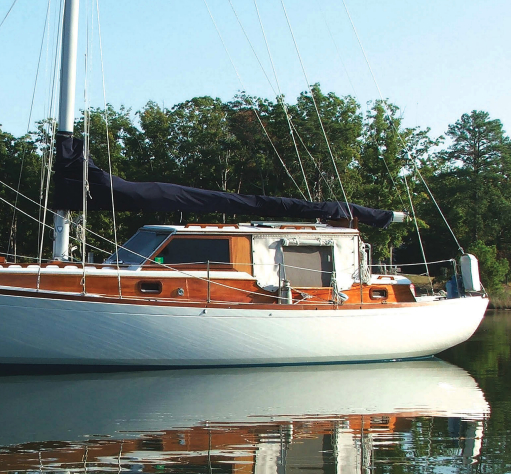
That one, finally, was the keeper. The year was 1978, the boat a 1963 Chris-Craft Sail Yacht (or Motor Sailer, depending on which brochure was given to the original owner). In 2013, at age 50, she became our official antique.
When your broker is a friend, you trust his hunches. About this boat, he’d said, “It’s a good deal. If you find you don’t like it, you can always slap on some paint and sell it. Then you can start looking again.”
That plan never appealed to the person who, at the time, was doing the paint-slapping, but once we got past the apparent cosmetic drawbacks, the boat did have a lot of appeal.
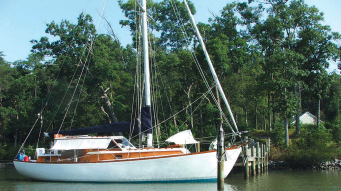
She had a top designer in Olin Stephens and an experienced builder in Chris-Craft (although we cannot count the number of times we’ve heard, “I didn’t know Chris-Craft made sailboats!”). Once the brightwork on her mahogany cabin was restored, she’d look like a woodie, but her hull was fiberglass and built to early “tank” standards. (A later version of the Sail Yacht 35, the Chris-Craft Caribbean, is all fiberglass.)
Perhaps most important from our perspective was the center-cockpit design. With the well-separated two-cabin layout this creates and a phenomenal amount of storage space, this boat was ideal for two workaboards. Besides all that, she was the perfect fit, in size and character, for the brass trawler lamp we’d purchased years before, when our cruising boat was an 18-foot daysailer we took camp-cruising on Lake Michigan.
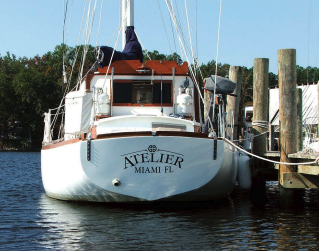
A surprisingly apt name
Most cruising sailors modify their boat to suit their travel plans and liveaboard style. We added one more variable with our desire for separate work spaces. When we left Chicago in the fall of 1973 for a year that became a lifestyle, we quit the busyness of commercial art studios, but we didn’t quit the business of graphic design, illustration, and copywriting. We continued to do some of that work as we traveled. We both paint, too, not just bulkheads and boat bottoms but hang-on-the-wall pictures. That was the reason for the boat’s name. We understood Atelier to mean “artist’s studio,” until we met a Frenchman who wondered why we wanted to call our boat “workshop.” In any case, we soon added editorial writing to the workshop’s mix.
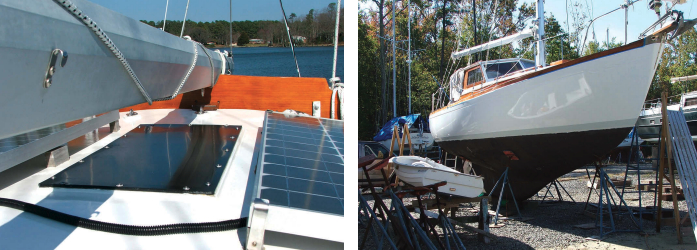
We’d already completed two Great Loop trips, but ours followed the Mississippi all the way to New Orleans, as the Tennessee-Tombigbee Waterway was not yet open. With the Keys as a home base for a few winters, we’d meandered around and across Florida. Wherever we would cruise next, we planned to travel from anchorage to anchorage with few marina stops, so dockside power would be available only occasionally. Solar panels were a great idea later, but initially, we removed all unnecessary items that required excess electricity. We weren’t specifically trying to embrace a minimalist philosophy, but we did believe in the familiar, if pessimistic premise, that if something could go wrong, it would. Removing the causes of potential problems was the simplest way to avoid tempting Murphy.
We didn’t write a restoration or refit plan, but the actual work started as soon as we finished the paperwork. It was October in Annapolis, so we had very little time to do just enough to take the boat south. “Enough” proved to be a quick sandblast of the bottom followed by a tedious filling and fairing and recoating of the hull before adding the necessary coats of anti-fouling paint. We repainted the cabin exterior, too, not because we liked the painted look, but in an attempt to save whatever wood was salvageable under a fairly fresh coat of paint that had apparently been applied to cover the evidence of peeling varnish, mildew, and naked weathered wood. Stripping and varnishing the mahogany cabin sides would have to wait.
Once out of the Annapolis yard, we hurried to Florida by alternating Intracoastal Waterway motoring with outside sailing, then crossed to the Bahamas for the first of many winters there. The first trip, always, is the
most memorable, and so it was for us. Beyond the beautiful surroundings, it gave us a bunch of ideas on how best to adapt the boat as a movable home and workplace.
Changes for cruising
When we first saw Atelier’s windshield, we agreed it would have to go — real sailboats do not have windshields. But it was mid-November when we left Annapolis and, as we sailed down Chesapeake Bay against all that crisp-now-biting-cold air, the windshield took on new meaning. Amazingly, we did not need foul weather gear. By North Carolina, the windshield was not nearly as objectionable as its first impression had suggested. By South Carolina, it was gaining silent admiration. By Georgia, it was removed from the removal list. The windshield could stay, but now the giant yellow Bimini would have to go. And so it did, in stages.
We would move into a boatyard for a month or two each year to finish a project or two. Not surprisingly, one of the first such projects involved the Bimini. We wanted to close in the center cockpit, at least partway. Not only would we be sheltered from sun and rain, but the enclosed area would make fall sailing so much more comfortable. We’d joined the snowbird migrations by this time, heading south to Florida and the Bahamas for the winters and north to the Chesapeake or New York for the summers.
With the windshield as the starting point, we built a hardtop over the forward half of the cockpit, later finishing it to cover the entire space, including the helm station. We added a bulkhead aft to form an almost complete wheelhouse. The remaining side areas could be closed in with fabric panels that had plastic ports or with full-panel screens, depending on the climate. These panels can be rolled up in place or easily removed when not in use.
Sail-handling was upgraded, also in stages, with Pro-Furl’s jib-furling, lazy-jacks, and a boom gallows, an especially good addition to a center-cockpit boat, where it’s hard to reach the boom to safely furl and tie the sail. Later, a tabernacle joined the rigging alterations. (Our first lesson regarding DIY mast-lowering: don’t do it near a naval air station. Low-flying helicopters create wind and waves on even the calmest of days.)
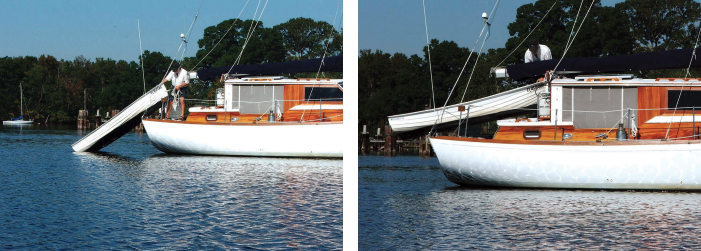
Dinghy handling got much easier with another change. After years of fighting with an assortment of dinghies and no good place to carry one, we replaced the original backstay with a split backstay. Our dinghy can now be raised up over the transom and pulled forward between the two stays. It comes to rest atop the aft cabin and is secured snugly to a cleat on the boom gallows. The two stays prevent it from swinging to either side when we’re sailing.
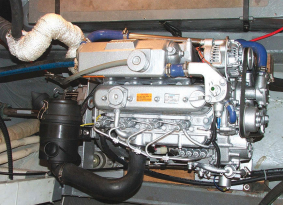
As for auxiliary power, we’d bought the boat with its original 60-horsepower gas engine, which almost killed the purchase for David; it was too big and would burn too much gas. To its credit, however, the engine soon taught us about our new boat’s sailing capabilities. At the start of our November trip south, in the pre-Sea Tow era, the starter broke off the engine about mid-Chesapeake, forcing a night sail to Norfolk and a tacking exercise up a side channel not known to be especially wide or deep.
We kept that engine for another season or two and then installed the first of two new engines, a 36-horse-power Volvo diesel. We were aware of some disapproval of the brand, the subject of many love-it or hate-it discussions. But ours proved OK by us, lasting 25 years, even though it was raw-water cooled. A second diesel, a 37-horsepower Kubota, is now in place, this one with freshwater cooling.
Changes for living aboard
Since owning the Chris-Craft, we’ve seen a few sister ships and heard about enough others to know that most, if not all, owners of this model modify their boats extensively. The original interior could best be described as non-traditional, due in large part to the center-cockpit layout, which forces a different kind of forward cabin. Fortunately, the boat’s heavy hull construction enabled extensive alteration.
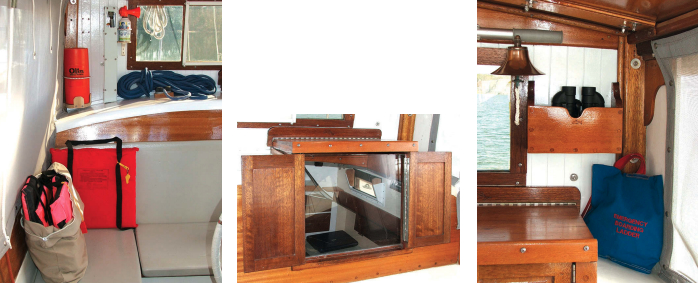
Center cockpit – Because our center cockpit is farther forward than that of similar boats, it carries the full beam of the hull, making it the most spacious area on the boat. For us, it is the main saloon. Though the wheelhouse was initially conceived as a way to extend fall cruising time, the changes made for cruising added liveaboard comfort as well, with one more advantage for summertime. The wheelhouse provides a way to attach a narrow awning on each side of the cockpit, to create shade and lower the daytime temperature inside by a few degrees. The awnings connect to the wheelhouse with a boltrope at the top. Lines at the bottom tie out to the lifelines.
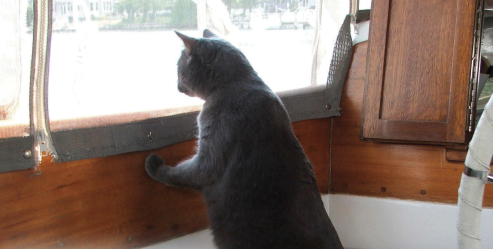
The cockpit/wheelhouse/saloon can also sleep two, when we need extra bunks or when we’re looking for a stray breeze on a steamy summer night. It is the site of popcorn or pizza parties, music sessions, holiday dinners, and endless talk fests. On special days, it’s a good place to watch fireworks or listen to an outdoor concert. And, every day, it’s the perfect spot to catch the sunset or moonrise with the crew or the cat, or both.
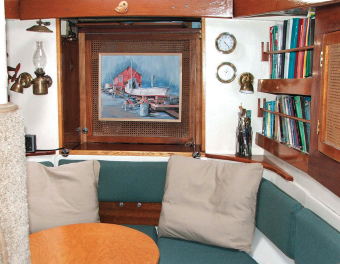
Forward cabin – As originally designed, our boat could sleep six. Because the center-cockpit design leaves less room forward, the boat has no V-berth, eliminating two of a sailboat’s usual bunks. If the owner had wanted to take five more people out for a cruise, four would sleep in the forward cabin, upper/lower bunk-bed style. The upper bunks were hinged to swing up and out of the way when not in use. We had no need for six berths and replaced the uppers with storage lockers and bookshelves.
The cabin also sported a huge dropleaf table that, when dropped, left little room for the knees of persons perched on the settees. To replace the original table and leave more room in the cabin, David made a small oval table, a good size for dinners for two or snacks for more. A larger finished-plywood panel stows against the overhead, ready to attach to the oval table when we want the larger surface.
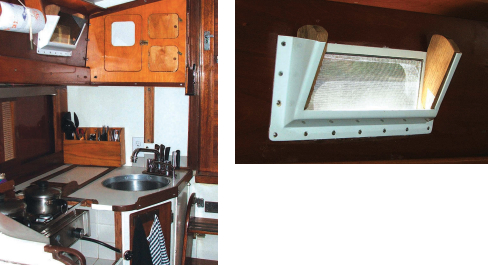
Galley – The original galley had an upright bar-sized icebox. Its front-door access opened into the center of the cabin, guaranteeing a loud and messy spill if anyone was foolish enough to open it when sailing on a starboard tack. We chose to “repurpose” some storage areas and build in a top-loading ice chest that could later accommodate a refrigeration unit. (The galley photo in the boat’s brochure actually shows a top-opening ice chest. Our galley was probably a custom installation.)
The stove was a standard-for-the-time two-burner alcohol type, aligned lengthwise with the hull on the starboard side behind the sink. Reaching it was awkward. Fortunately, when the stand-up icebox was removed, it left a perfect vacancy to be filled by a gimbaled two-burner propane stovetop and a good-sized storage bin for pots and pans beneath.
Head – The boat brochure boasted two heads. Both were electric on our boat. With an alternator that could hardly keep up with lights and radio, these did not seem practical for our cruising plans. A generator had been in place to run off the engine (separate from the standard alternator), but it had long ago ceased to function. Eventually, the electric heads departed, one at a Nassau dock, the second in a Florida boatyard.
Through the years, a number of heads have been in and out, some removed because they just plain quit, others because we were always looking for a better solution. We finally settled on a LaVac toilet and a LectraSan treatment system, which probably makes the head compartment the highest-tech place on the boat.
Aft cabin – The original aft cabin had two single berths with a seat between them. The berths were long, reaching their designed length by extending underneath the cockpit seats, so occupants slept with their heads next to the bulkhead that separates the cabin from the lazarette. That’s not particularly unusual, but this boat added the questionable amenity of a toilet not so discreetly placed under that center seat. To make better use of the aft cabin, we remodeled. The starboard bunk grew in width to become a double. The port bunk gave way to a large storage locker accessed by front-opening doors, leaving the top available for use as a hinged-top desk. As noted earlier, the toilet left the boat.
Changes for working aboard
Forward cabin – Most 35-foot sailboats don’t have space for a dedicated work area, unless the owner is willing to sacrifice the V-berth. We’ve seen full workshops and art or hobby studios in former V-berths, but our boat had no such space. Instead, the forward cabin is David’s studio. The daily conversion to work area is easy. He removes the drawing board from its storage space against the overhead and places it atop the oval dining table. A length of 2 x 4 glued on one edge to the underside of the drawing board keeps the board at a proper angle for drawing or painting.
A small V-section forward of the seating area was intended for sail storage. Instead, we stowed our two extra sails in the cavernous cockpit seat lockers, leaving the V-space open for David’s supplies.
Aft cabin – The sleeping cabin converts to a versatile workstation. The portside locker hides everything needed to turn the cabin into a mini office or an art studio, keeping all the supplies contained but still reasonably accessible.
The hinged desktop covering the locker serves multiple purposes. “Desk” is the obvious one, when the laptop sits on top of the opened-out desktop and the writer sits on the center seat. At other times, the seat supports a tabletop easel and the desktop in the closed position serves as a taboret, holding the paints, palette, brushes, water jar, and anything else the artist needs. Still other times, the sometime desk is the surface upon which mats are cut to frame watercolor paintings.
Cockpit/wheelhouse/saloon – Add “gallery” to the center cockpit’s cruising and liveaboard descriptions. With no alteration required, the center cockpit serves as a gallery when people come aboard to look at our paintings. It has convenient seating, and it has the best space on board to provide an appropriate distance between the viewer and the viewed.
What next?
Given our extended time frame, the major work on the boat has long been finished. Although hull painting, alas, is not exactly permanent, much of the other maintenance can be handled by timely touch-ups with only an occasional do-over. A typical haulout is limited to a short stay for the requisite bottom paint; we don’t miss the annual boatyard condo living. We still find small projects to do at anchor or dockside, a holdover perhaps from years of writing for the original DIY Boat Owner magazine. We’re still pleased when strangers admire the boat and ask about her history.
After so many years, the question of “What next?” is a strange thought. The flippant response returns a question: “Why a next?” or “What’s wrong with status quo?” But even when we try to be serious, no good answer has thus far surfaced. We’ve lived on board too long to imagine being away from the water, so that remains a priority. Cruises may be planned in days or weeks rather than months, but they are still planned. We have so many years of memories that make us smile. For now, “next” is just looking forward to more of the same.
Zora Aiken and her husband, David, are the authors of several books about boating and camping. Their seventh children’s book, Chesapeake Play Day, written by both and illustrated by David, was published in April. Atelier, a 1963 35-foot Chris-Craft sloop, is their movable studio, office, and home. See David’s work at davidaikenart.com.
Thank you to Sailrite Enterprises, Inc., for providing free access to back issues of Good Old Boat through intellectual property rights. Sailrite.com