A quick trailerable that does the small things right
Issue 104 : Sept/Oct 2015
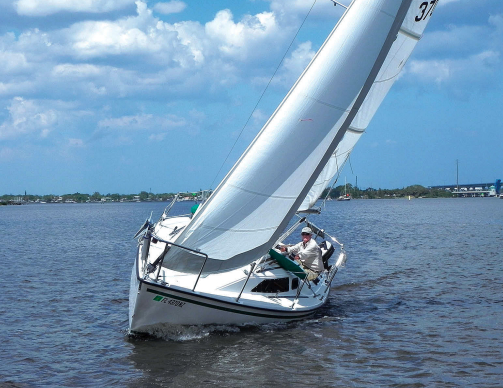
R K. “Kim” Hogan, a retired airline captain, and his wife, Karen, have been sailing their 1996 Precision 23, Willow, on the St. Lucie River, just off the Intracoastal Waterway near Palm City, Florida, since May 2011. A longtime resident of Florida’s Treasure Coast, Kim daysails and races Willow singlehanded for the most part. He apologized for not being able to show me the Precision’s performance at its best, which is when the wind gets up to 12 knots, but we had a great sail on a wide place in the river nonetheless.
Kim owned a West Wight Potter 19 before he bought the Precision 23 from racing-sailboat designer, Paul Lindenberg. Willow was Paul’s personal boat and he had modified her to suit his own performance needs. Kim has carried on that tradition and enjoys sailing with fresh sails and putting the rail down. He keeps Willow on a dry-storage rack when not out sailing and maintains her in sparkling condition.
Design and construction
Brothers Richard and Bill Porter founded Precision Boat Works of Palmetto, Florida, in 1978. Precision continues to produce small sailboats of 15 to 23 feet and has outlasted dozens of other builders of boats in this size range. The largest boats the company has built are the Precision 27, the Precision 28, and the Colgate 26. Richard and Bill pride themselves on building fine small boats that are sold through a nationwide dealer network. Precision also builds molds for other boatbuilders.
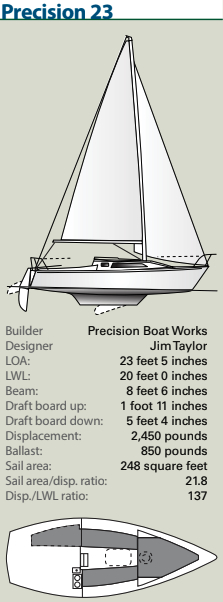
The Precision 23 is not inexpensive; the 2015 base price is $36,985. While many used 23-foot boats can be bought for less than $5,000, the Precision 23 appeals to the sailor who wants a well-designed and well-constructed boat. It is certainly both. Award-winning naval architect Jim Taylor designed the Precision 23, and it has been in production since 1986 with 600 sold to date.
The Precision 23 is not revolutionary. Its claim to fame is in doing all the small things right. This it does with few exceptions. It is well thought out and practical, which results in a boat that is comfortable and handles well. The sheer has a nice sweep to it while the ends seem just right for the boat’s size. The transom-hung retractable rudder is appropriate, as the shoal-draft fixed keel with centerboard draws less than 2 feet with the board up. The long narrow keel contains 850 pounds of internal lead ballast and, with the wide 8-foot 6-inch beam, keeps the Precision 23 stiff and tracking well. The centerboard provides extra lift to windward, yet reduces drag downwind when retracted. The keel arrangement eliminates the centerboard trunk from the cabin, making it remarkably roomy. Also, a fiberglass beam in the overhead supports the deck-stepped mast and removes the need for a space-limiting compression post.
The hull is solid fiberglass hand-laid with vinylester and polyester resins throughout, with 3⁄8-inch PVC foam core where it sits on trailer bunks. The deck is cored with the same foam. The transom is reinforced with plywood where the outboard motor and rudder are mounted. The hull-to-deck joint is an outward-turning flange glued with 3M 5200 and temporary #10-32 bolts that are removed after the adhesive cures. The flange is capped with a rubrail. A structural furniture base/liner is employed in the cabin.
On deck
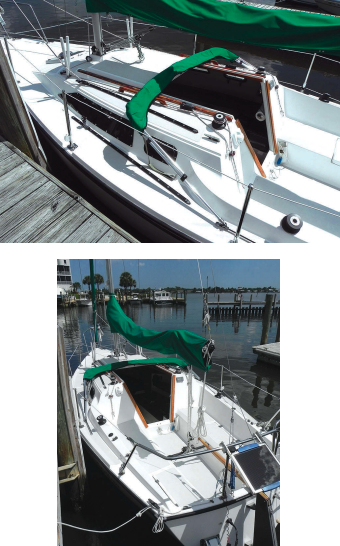
One feature that makes a big first impression is the large cockpit. The seats are more than 7 feet long, with nice backs, chamfered front edges, and a “just right” bracing distance between them. While plenty long for napping, they are a bit narrow, earning them a PNI rating (Penticoff Napability Index) of 4 out of 5. Wider cushions would help.
Twin drains at the aft end of the cockpit remove water quickly but — this is a warning to those who store their boats outside — the cockpit should be covered and the drains kept free of debris, as the bridge deck is quite low and could easily be topped by heavy snow melt or a hard rain.
The laminated tiller is attractive, as are the teak companionway slides and handrails on the cabin trunk. Excellent molded-in non-skid and a molded-in toerail add to on-deck security. Stainless-steel bow and stern pulpits are standard and the lifelines are at a realistic height. The sidedecks are wide enough to allow easy access forward for handling sails or the anchor that is stowed in a bow locker.
Cleats and other hardware are first-rate — no plastic is used. For ventilation, there is a forward hatch above the V-berth and two opening portlights. Two fixed ports let light into the saloon but the real cabin ventilator is the extra-large companionway hatch. It is exceptionally wide and slides well forward, creating a very roomy standing space that makes entering the cabin easy. Three synthetic dropboards close off the companionway. Kim has modified the top board with a port and screen. On newer boats, Precision has done away with teak on deck, replacing it with HDPE synthetic wood to cut down on maintenance.
The two halyard winches mounted on either side of the companionway, coupled with rope clutches, are standard, but the coaming-mounted winches for the genoa and spinnaker sheets were optional before 2000. A large sail locker under the starboard cockpit seat opens to the interior, while an open-sided fuel-tank locker is to port. An outboard-engine mount and a stainless-steel swim ladder are standard on the Precision 23.
Rig
The Precision 23 has a seven-eighths fractional sloop rig. The shrouds, uppers and lowers, are fastened to beefy chainplates that penetrate the deck inboard of the sidedecks, allowing for very tight sheeting angles. Tracks for the jib are standard while genoa tracks are optional. Kim has full-length battens in his three-year-old Mack Sails mainsail. His jib and 155 percent genoa are also fairly new but the storm jib and asymmetrical spinnaker are original to Willow.
A stock Precision 23 has a split in the backstay to clear the tiller. The mainsheet is normally attached to the end of the boom and the backstay split plate. From photos I’ve seen, it appears the cam cleat end is mounted on the boom. I’ve never much liked this arrangement, and apparently neither did Paul Lindenberg, as Willow’s mainsheet is close to the helmsman’s hand on a small traveler mounted between the cockpit seats forward of the tiller. Kim constantly uses the traveler to fine-tune mainsail trim. Paul also modified the backstay so he could adjust it with a block-and-cam-cleat arrangement. Roller furling on the headsails is another addition that aids the singlehanded sailor.
Cabin
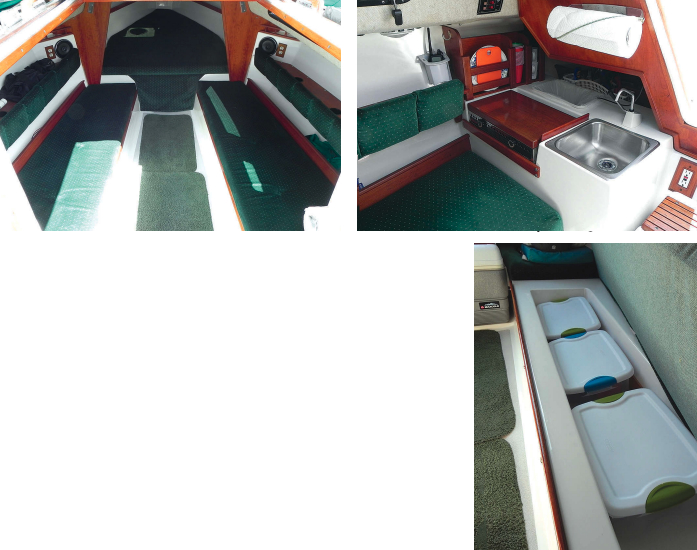
Entering the cabin via the large low companionway is a piece of cake. There is one step — onto the teak step on the 48-quart cooler — and then the sole, which has the same non-skid as the deck. The cabin, with its abundant teak trim and panels, is very roomy for a 23-foot trailerable boat. Although it’s advertised as having four berths (V-berth, two settees, and a quarter berth to port), Kim thinks it’s comfy for one. Two would be very cozy. The other two would have to be children, even though the berths are long enough for adults. As with many trailer-sailers, the extra berths are good places for gear and supplies, but there is plenty of storage space below each of the settees and beneath the V-berth.
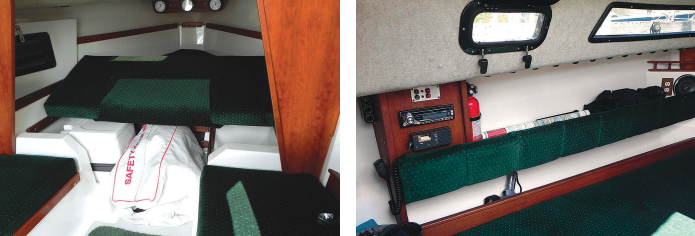
Models built between 1986 and 1995 had no opening ports, just solid full-length deadlights. Boats from 1995 to 1999 had two opening ports, and since 2000 Precision has fitted six Lewmar opening ports with screens. With two opening ports in the saloon, plus the opening forehatch and large open companionway, it was fine on a sunny, 90-degree Florida afternoon.
The cloth-covered settees are comfortable with appropriate backrests and fiddled shelves behind them. A wooden pedestal table with fiddled edges can be mounted in a socket in the cabin sole. A small galley with a sink, a 5-gallon water tank, a stove, and a trash container resides to starboard aft while an electronics area is to port.
Kim has upgraded the lighting to LED bulbs. A portable toilet is situated under the V-berth to port. Using it requires the removal of a large cushion but there’s no good place to put it. The overhead is a white fuzzy fabric and the finish on the cabin sides is the gelcoat of the inner liner. I saw no exposed rough fiberglass.
Under sail
In light winds with occasional strong puffs, the sail on the St. Lucie River was a pleasant exploration of the Precision’s handling. As we sailed close to the wind, I found the tiller pressure to be a tad on the heavy side, but there was no undue weather helm. Willow pointed quite high and came about quickly enough, though not dinghy quick, to show the Precision 23 has the weight to carry through a tack in light air. The long stub keel keeps her going straight.
In lighter winds, Kim does not lower the centerboard, as the keel provides plenty of lift without the drag of the board. In the puffs, there was not much need to dump sail; with good form stability and plenty of ballast she’s quite stiff. Heeling did not change how she handled and she was stable sailing downwind. On a reach, she accelerated quickly in the puffs, as she should with her generous sail area/displacement ratio of 21.8.
The seating was comfortable and the visibility forward quite good. I felt no need to leave the seat near the tiller to find a better view or more comfortable spot. I did find the modified mainsheet a little close to the end of the tiller, and getting around the tiller during a tack was a bit cumbersome. A tiller-mounted autopilot frees Kim to do chores while singlehanding.
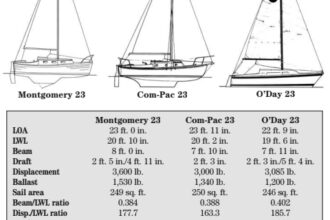
Under power, there was a small but not uncomfortable amount of helm pressure from prop wash against the rudder. In all, we had a great time. I can see why a person would be tempted to race the Precision 23. It’s simple, stable, predictable without being stodgy — and fast. Its PHRF number is 228 in most fleets. A Compac 23 is around 260, and an O’Day 23 is between 237 and 273.
Conclusion
If you are moving down in boat length, no longer cruising, lost your crew and singlehanding, or just tired of the cost of big-boat maintenance and fees, the Precision 23 is a proper little yacht that may be what you are looking for. While certainly capable of a pocket cruise on a weekend, perhaps even much farther, its real forte is just simple sailing fun. Shoal draft will get you into the quiet coves and make for easy trailering from any decent ramp.
The quality of the design and build leave you little to fix up or modify. Good boats command good resale prices, and you’ll be paying a bit more for the Precision 23 than most other boats in this size range. But you’ll not be disappointed. Prices range from a 1988 listed for $5,000 to a 2008 at $24,900. The highest asking price online was $27,000 for a 2006 model — and of course you can buy a brand new one, but that’s not a good old boat . . . yet!
Allen Penticoff, a Good Old Boat contributing editor, is a freelance writer, sailor, and longtime aviator. He has trailer-sailed on every Great Lake and on many inland waters and has had keelboat adventures on fresh and salt water. He presently owns an American 14.5, a MacGregor 26D, and a 1955 Beister 42-foot steel cutter that he’s restoring.
Thank you to Sailrite Enterprises, Inc., for providing free access to back issues of Good Old Boat through intellectual property rights. Sailrite.com