Turn any flat surface into a workbench
Issue 105 : Nov/Dec 2015
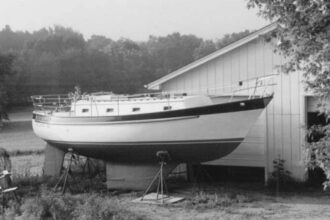
What happens if you find yourself on a sailboat and need a vise for holding either wood or metal while you work on it? I have long admired those boats, generally much larger than my 26-foot Paceship, that had an actual workbench. One major feature of a good workbench is a decent vise.
Owners of small boats have to make do, sometimes the old-fashioned way, by bracing the work piece with a knee while sawing, drilling, or hammering. However, there’s a better way.
On a trip to one of the big-box stores, I found a number of vises for sale, some at reasonable prices. Most had a footprint that could easily fit on a 2 x 8 board.
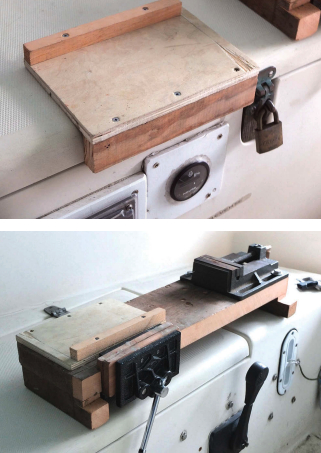
With a little work and some lag screws, I secured a woodworking vise on the side of a 2 x 8 and a metalworking vise, designed to go under a drill press, to the other end of the board. If I was to going to bang on it with a hammer, it should be able to take some abuse. I added wooden jaws to the woodworking vise to limit damage to work pieces.
The base needed feet to accommodate the woodworking vise that’s mounted on the bottom of the board. I trimmed the feet so any plank in the woodworking vise would also rest on the tops of the feet for additional security. For large work pieces, the base can be clamped to something more secure, such as the table in the cabin or on deck.
The area of the board clear of the vises comes in handy when I need to hammer a grommet into a sail.
While I was at it, I also made a bench hook, which is very helpful when cutting square to a line. It lives on the portable vise, stowed out of the way when not needed.
The board is 2 feet long and the entire workbench fits in a space about 2 feet by 10 inches wide by 6 inches high. It has some weight, but weight is a virtue with vises.
Thank you to Sailrite Enterprises, Inc., for providing free access to back issues of Good Old Boat through intellectual property rights. Sailrite.com