Exercise that gets you somewhere on the water
Issue 104 : Sept/Oct 2015
For many of us, our very first boat was a rowboat — in my case an old and leaky one — so every outing is a trip down memory lane. But rowing is a rewarding activity that can be learned at any time of life.
Oars
If you look closely at oars used with hard dinghies, you’ll find that their blades are often not solid wood but three pieces glued together (laminated). Oars made this way don’t have the life expectancy of the more expensive solid oars cut from a single piece of wood. The higher cost of one-piece oars is due to the waste involved. While the shaft of a laminated oar can usually be made from 2- x 2-inch lumber, one-piece oars are made from more expensive 2- x 6-inch boards, and what is cut away is wasted.
Once you have decided on the type of oar construction you want, length is the next consideration. The rule of thumb is that the length of an oar should be at least 1.5 times the beam of the dinghy. For a 4-foot beam, an oar should be at least 6 feet long. A few rowers (usually those who grew up rowing racing sculls) prefer to row with the grips of the oars overlapped. In that case, add 6 inches to the above figures. A dinghy with very high freeboard will also need slightly longer oars. An important point to consider is that the oars should be stowable inside the tender. For this reason, some long oars are made in sections.
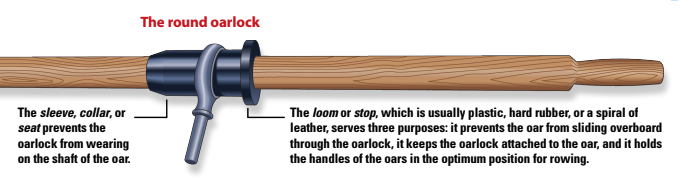
Oarlocks (or rowlocks)
Many types of oarlocks, or rowlocks, are available. For children and rowing novices, the U-shaped, or “horn” oarlock, with a pin through the oarlock and the oar, sometimes called the North River Horn Oarlock, is the most common and the easiest to use. (The term “horn” is usually applied to U-shaped oarlocks that resemble the horns of a bull). The pin keeps the oar and oarlock together and holds the oar’s blade vertical. However, a blade that is always vertical is not ideal, especially when rowing into a wind or chop and having the ability to reduce wind resistance by feathering the blade makes rowing easier.
Rowing technique
Even when you have the ideal dinghy and the best of oars and oarlocks, your success at rowing all comes down to technique. (See Don’s “The Gentle Art of Rowing,” May 2003 –Eds.) Good rowing technique requires that you use as many muscle groups as possible, not just your arms. Not much practice is required for oars with pinned oarlocks, but it takes a little while to master rowing with unpinned oarlocks that allow the oar to be rotated or feathered.
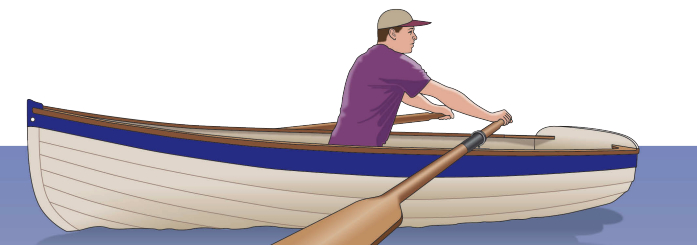
To row while feathering your oars, grab the handles of the oars with your wrists straight and the blades vertical. Lean well forward with your arms extended in front of you and put the oar blades in the water with their upper edges just at the surface. Keep your arms extended and pull on the oars by straightening up your body using your back muscles. Keep your hands level and push with your legs to prevent you from sliding off the seat. Near the end of the stroke, pull your arms up to your midriff to extend the length of the stroke. During this power stroke, the blades should not come out of the water or dip too far below the surface. This will happen if the blades are not vertical.
When you have completed the power stroke and begin the recovery, feather the oars by rotating your wrists downward so the blades are nearly parallel to the surface of the water. As well as reducing the wind resistance of the blades, feathering also prevents the oars from hitting the tops of waves (sometimes called “catching crabs”). Push the oar handles toward the stern of the boat and return to your starting position, leaning forward with your arms outstretched. Now rotate your wrists upward so the blades are at 90 degrees to the water, lower the oars into the water, and begin your next power stroke.
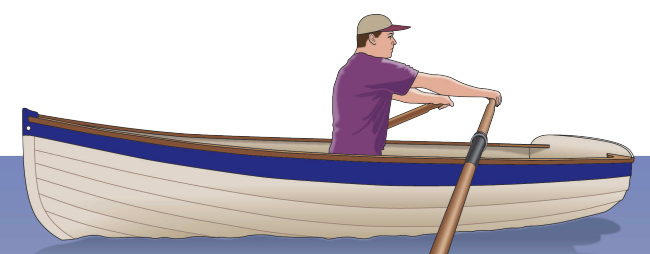
The rate of the rowing stroke is proportional to the oar length. The longer the oars, the slower the rate, because of the longer sweep made by the blades. A comfortable stroke rate that will have you rowing your dinghy at a good speed is 20 to 30 strokes per minute.
Don Launer, a Good Old Boat contributing editor for many years, is now in Fiddler’s Green (see page 16). Don, a master of virtuallly everything he attempted, built his two-masted schooner, Delphinus, from a bare hull, held a USCG captain’s license for more than 40 years, and wrote five books. His 101 articles through November 2011 are available as a collection from the Good Old Boat download website. Look under Archive eXtractions at www.audioseastories.com.
Thank you to Sailrite Enterprises, Inc., for providing free access to back issues of Good Old Boat through intellectual property rights. Sailrite.com