A downhaul is a singlehander’s foredeck crew
Issue 105 : Nov/Dec 2015
A friend of mine told me about an incident he witnessed in which the jib furler on a 54-foot sailboat jammed. “You haven’t laughed until you’ve been on a big boat in a rising wind with a jammed furler,” he said, grimacing with the memory of it. This was all academic to me until
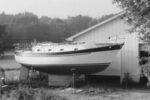
I got my next boat, Pelorus, a 26-foot Paceship with an old-fashioned hanked-on genoa. Because that was what I was used to on my previous and smaller boat, I thought the only difference would be that it was larger. However, I discovered that a larger sail can be a handful when it’s lowered. (Now that I think of it, it was a handful on my smaller boat as well.) Fortunately, the halyard led to the cockpit, so I could raise the sail without going forward.
I kept Pelorus on a mooring and routinely sailed off it and on to it. I have long considered that to be a minimum standard for seamanship. That, and not hitting anything. I’d gotten into the habit of dropping the headsail first, then sailing in under the mainsail, slowly and completely under control in any kind of wind, when picking up the mooring or dropping the hook.
Pelorus had a 135 percent deck sweeper for a genoa and, even though it was an old sail, I used it most of the time, preferring to reef the main first. If I was going to windward in winds above 15 knots, I dropped the big genoa and replaced it with the 115 percent headsail that was flatter and usually OK up to 30 knots. Thinking back on that, it was a lot of work. Also, it was hard to see under or around the big sail, especially as I usually sail singlehanded.
The 135 destroyed itself one day right after I had anchored in advance of a squall that ripped through. I was below at the time. The first gust was well over 35 knots. It took the unsecured sail halfway up the forestay, shredding it before I could get on deck to secure what was left. Fortunately, the 115, which was as old as the 135 but not so blown-out, worked pretty well during the rest of the summer except in the lightest wind, when I flew a drifter instead.
I was able to replace the blown-out 135 with a new 110 from Cruising Direct. At first, I thought that might be a little small but, surprisingly, the 110 worked just fine. It was slightly heavier than the sailmaker suggested for a sail of that size, but I wanted it to last. The extra weight made it so stiff that wrestling it into the sailbag was almost like folding plywood, but it had the virtue of keeping its shape well in light wind and it pointed closer to the wind.
By then I’d grown used to the hazards of handling the old sail, among them getting hit in the face by the clew while trying to pull the sail down on the foredeck . . . or standing on the foredeck with the bow dipping into the sea while hauling the sail down only to have the halyard jam and having to run aft to clear it. In a fine example of the perversity of inanimate objects, halyards have a knack for kinking into knots too big to pass through a jammer.
A blast from the past
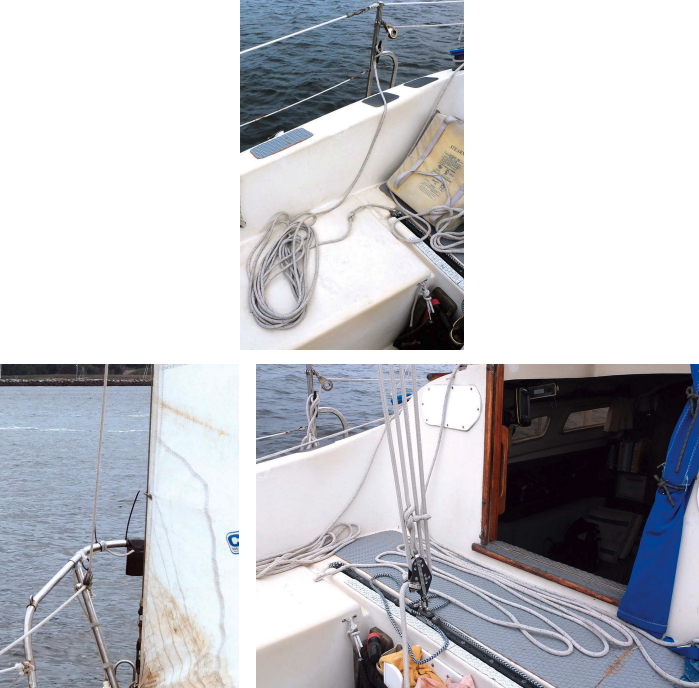
Eventually I had a thought: why not do what the old-time sailors did and rig a downhaul that I could use on whatever headsail I happened to be flying? At the next Annapolis boat show, I visited the Garhauer booth and bought four SB25 stanchion blocks. Their online catalog has them at $40 each, but I got a boat show discount.
The next time I went to my boat, I mounted a block on each stanchion, one on the bow pulpit, and a stanchion cleat next to the cockpit where I could reach it without going forward. I then ran enough 5⁄16-inch line to reach from the masthead, down the forestay to the first block, and aft to the cockpit, with a snap shackle at the working end. It works like a charm.
Now when I need to lower whatever happens to be flying from the jib halyard, I fake out the halyard in the cockpit, loosen the downhaul from its cleat, bring the boat directly into the wind as if tacking, then quickly throw the halyard off the winch and haul on the downhaul. Generally, the genoa falls on the foredeck right where I want it. If there isn’t enough sea room to go directly into the wind, I point up as high as I can and then lower the sail. Sometimes it falls partly in the water and gets wet, but so what?
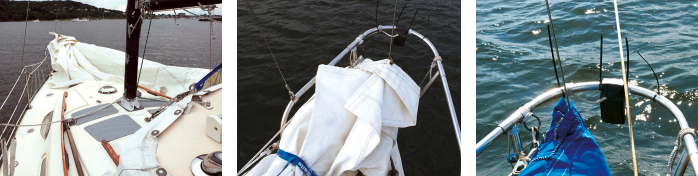
It takes very little effort to lower any headsail, including the drifter. Although I do have to keep some tension on the downhaul so it doesn’t slap against the sail, after four or five years I have so far detected no chafe on any sail.
Once the genoa is down, the boat slows immediately while remaining completely controllable. Fortunately, Pelorus has the virtue of sailing reasonably well under main alone, even in light air. I first secure the tiller to keep her going where I want her to, using either a tiller lock or the autopilot, then go forward with sail ties and secure the genoa in the usual way. Sometimes in very light wind while motorsailing, for instance, I’ll just let it remain as it fell on the foredeck. But no matter how hard it blows, the downhaul keeps the sail from heading up the stay.
Thank you to Sailrite Enterprises, Inc., for providing free access to back issues of Good Old Boat through intellectual property rights. Sailrite.com