A smart weatherly sailer and able cruiser
Issue 110 : Sept/Oct 2016
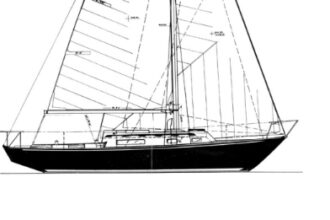
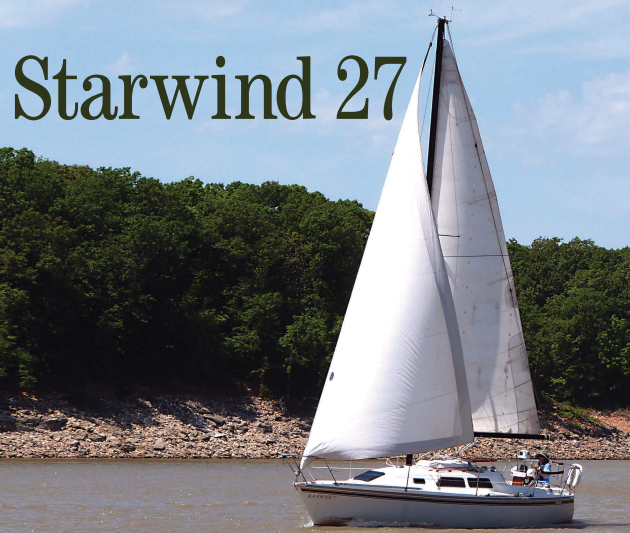
Asmall cruiser that has good accommodations, pleasing lines, and offers exhilarating sailing is worth a second look. Such is the case with the Jim Taylor-designed Starwind 27, so when Bruce and Sarah Miller invited my wife, Sandy, and me aboard their Starwind 27, Polaris, on Missouri’s Mark Twain Lake, we did not hesitate to accept.
Bruce was raised by his father, a Navy man, on a diet of boating. As a young man, he bought a part ownership in an Ericson 27 on the Columbia River, but when he met Sarah they decided a bigger boat was in order. The same partners purchased a Jason 35, Dromen, and sailed her out of Friday Harbor in the San Juan Islands. Bruce sold his share when he was transferred inland.
Years living away from the water, and the birth of their son Charlie, made sailing less of a priority, but when the family relocated to Missouri they bought a Catalina 22, Kenai, to sail on Mark Twain Lake. While that boat was fun to sail, it was a little small for their family, so they began to search for something with more accommodations. In late 2015, they found Polaris, and now Bruce, Sarah, and Charlie have plenty of space and a boat that likes to show her stuff.
History
Jim Taylor is noted for the fast and attractive designs that have come out of his office in Marblehead, Massachusetts, including the Taylor 42 Drumbeat, a veteran campaigner that is still winning races. Jim’s long association with Sabre Yachts resulted in a series of popular high-quality cruisers with pleasing lines and good performance. He has designed smaller boats as well, including several for Precision Boat Works. Jim designed the Starwind 27 in 1983 for Wellcraft, when the well-known powerboat builder made a brief foray into sailboat production.
In 1981, the Sarasota-based company began producing the Mutineer 15 and Buccaneer 18 designs at its Avon Park, Florida, facility, and planned to move into the larger boat market by introducing a line named Starwind. The Starwind 27 sold well in 1984 and into 1985. That’s when Wellcraft decided to end its sailboat experiment by selling the line to Rebel Industries. Production continued until Rebel closed its doors in 1987. It’s not easy to establish how many Starwind 27 hulls were produced but, judging from the number on the market at any time, it’s likely that it’s 300 or so.
Construction
Starwind 27 hulls are solid fiberglass. Decks are cored with balsa except in high-load areas such as attachment points for fittings. The hull-to-deck joint is shoebox-style, with the overlapping deck flange fastened to the hull with stainless-steel screws at approximately 3- to 4-inch centers. The adhesive used to seal the joint has proved to be generally durable and tight. A black neoprene band with a contrasting brown rub strip covers the joint on the exterior and protects the hull.
A fiberglass liner forms the interior, and substantial bulk-heads are bonded to the liner and to the underside of the deck to produce a stiff overall structure. That’s important, because there is no compression post under the deck-stepped mast. Removable teak panels to port and starboard in the fiberglass headliner allow access to wiring and through-bolted hardware.
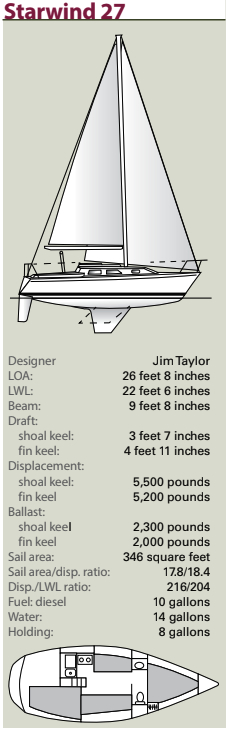
The boat was offered with a fin keel drawing 4 feet 11 inches or a shoal-draft keel drawing 3 feet 7 inches. The fin is a cast-lead foil, trapezoidal in shape with a swept-back leading edge and a swept-forward trailing edge. The shoal keel is likewise lead but with an end plate at the base to help with lift. Both versions are attached with stainless-steel keel bolts, washers, and nuts. The hull-to-keel joint is a common maintenance issue on keelboats and should be inspected at every haulout.
The partially balanced rudder is made of fiberglass over a stainless-steel armature. The rudder stock extends through the deck beneath the helm seat. The boat was offered with a choice of tiller or wheel steering.
Rig
The Starwind 27 has a deck-stepped black-finished aluminum mast with. single spreaders that are swept slightly aft. Single upper and single lower shrouds are secured to chainplates that are through-bolted to the same bulkhead that supports the mast and are fully visible for inspection. The split backstay is attached to chainplates port and starboard at the aft ends of the cockpit coamings.
As noted, there is no compression post. The stiff bulkhead structure located strategically below the mast step at the forward end of the saloon provides the needed support.
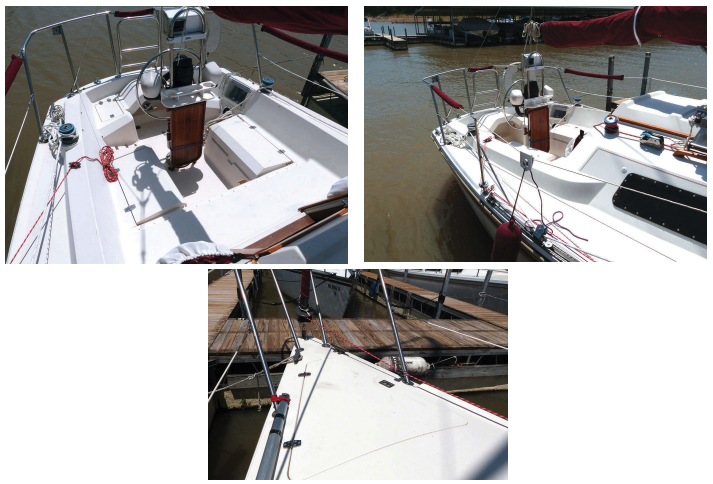
Lever-action cam stops at the forward end of the boom secure the lines for the mainsail jiffy reefing, which are rigged inside the boom, as is the outhaul. The Starwind 27 was originally fitted with a recessed traveler across the forward end of the cockpit seating at the bridge deck. Polaris has been modified and her traveler is mounted over the companionway. It no longer interferes with seating but is less convenient for a singlehander.
Lewmar #16 primary winches are mounted on the coamings adjacent to the helm where they are accessible for singlehanding. Halyards, the boom vang, and the mainsheet lead to Lewmar #6 winches on the cabintop. The winches on Polaris are not self-tailing, but they are fitted with Winchers (inexpensive rubber add-ons) that work well.
Stepping aboard
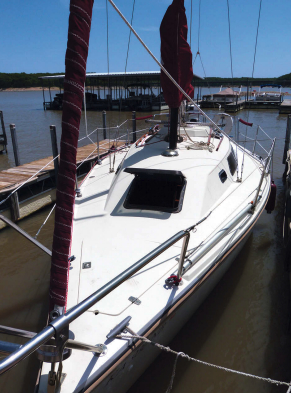
An effective non-skid finish and chainplates mounted inboard next to the cabin trunk allow crew to move with ease along the wide sidedecks, but the boat has no toerails. A T-shaped stainless-steel stem fitting is through-bolted on the bow. It does not incorporate an anchor roller, although a shallow anchor locker in the foredeck will hold a Danforth-type anchor and rode.
Mooring cleats are mounted just aft of the forward legs of the stainless-steel bow pulpit, but there are no chocks to provide leads for either docklines or a mooring line. This makes chafe protection for the lines doubly important — for the lines and for the deck edge.
Double lifelines attach to the aft legs of the bow pulpit and run aft to a pulpit on each quarter. A stainless-steel boarding ladder fills the gap between the pulpits when in its stowed position. Pelican hooks aft and retainers
at the aft-most stanchions allow the lifelines to be dropped for boarding at the dock.
A tinted-Lexan hatch is mounted on the forward end of the cabin trunk where it slopes to meet the foredeck. Teak grabrails are fitted along the sides of the cabintop but do not extend as far forward as the mast step. Crew working at the mast cannot brace their feet against them, and the footing can be precarious on the slightly rounded cabintop. A single solar vent is centered just forward of the mast.
The fiberglass companionway hatch slides in teak rails. The forward end of the hatch is sloped for drainage but there is no sea hood. Pie-pan vents are fitted between the hatch slides and grabrails on both sides.
Deck organizers route lines aft from the mast through rope clutches to the cabintop winches. Polaris has line-adjustable lead cars on the jibsheet T-tracks, but that was likely not standard when the boats were made.
The cockpit is 7 feet long, but the footwell is foreshortened by the wide bridge deck. On the wheel-steered model, the T-shaped footwell makes the side benches too short for stretching out and napping at anchor. Tiller-steered boats had teak fillers to cap the openings and lengthen the seats. The coamings provide some back support but would be more comfortable if a bit higher. Sloping sides on the contoured helm seat provide support when the boat is heeled.
There is a deep cockpit locker beneath the port seat and a shallow but functional locker under the starboard seat. A small icebox is located to starboard of the helm seat. The engine controls are in a covered panel to port of the helm.
Accommodations
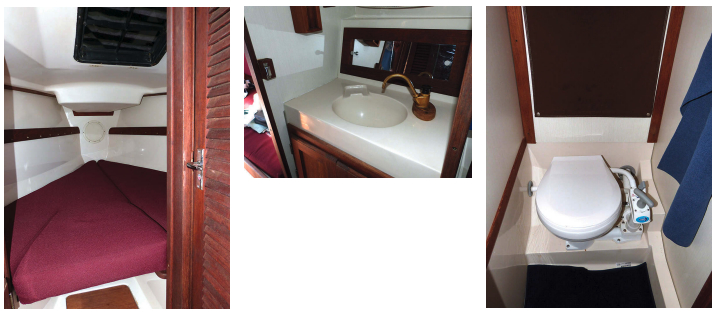
The Starwind 27’s 9-foot 8-inch beam assures fairly generous interior volume. The V-berth is 6 feet 6 inches long and it can serve as a double berth despite rather cramped toe room. Teak shelves along both sides provide modest storage for small items, and there is locker storage under the berth. The small drop in the fiberglass headliner beneath the anchor well does not intrude into the space. The forward hatch provides light and ventilation, and 12-volt reading lamps to port and starboard create a cozy glow after dark.
The head compartment spans the width of the boat between the V-berth and the saloon — the vanity sink and cabinet to port, the marine toilet to starboard. Folding teak doors close off the starboard compartment for privacy while allowing passage to the V-berth. Ventilation comes from a very small opening port on each side and the solar vent forward of the mast.
The saloon has a warm appearance due to the teak bulkhead forward, teak backs and shelving above both settees, and teak battens applied to the liner above the settees. A large folding table stows vertically against the forward bulkhead to starboard. When it’s deployed and fully opened, supported on three folding legs that snap solidly into place, it accommodates four diners comfortably. The sole is a flat teak-and-holly insert in the fiberglass pan. While two fixed portlights on each side provide good light in the saloon, there is little provision for ventilation other than the vents alongside the companionway hatch. When that hatch and the head compartment door are closed, airflow will be minimal.
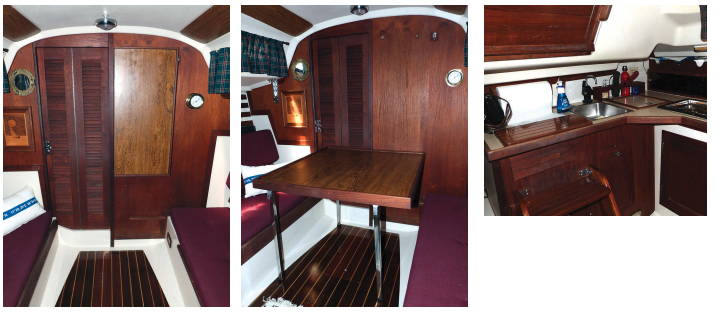
The galley is aft in an L shape that begins at the base of the companionway and wraps around to port. A two-burner alcohol cooktop with a cutting board cover is fitted on the outboard leg and an icebox and sink are in the small counter on the aft leg. A hand pump at the sink draws from a 14-gallon freshwater tank. Headroom in the galley under the companionway hatch slide is about 6 feet. Elsewhere it’s a good 4 inches less.
A 6-foot 6-inch quarter berth is situated to starboard, aft of the saloon. It can serve as a cramped double if necessary, but it has no ventilation. Many owners use this space for storage.
Under power
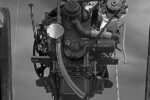
The Starwind 27 has a Yanmar 1GM10 single-cylinder diesel engine rated at 8 horsepower. Like many one-lung diesels, it can be started with a hand crank if battery power fails. Service access is reasonable. Panels at the companionway ladder and at both sides can be removed by turning retaining toggles with a screwdriver. The fuel tank holds 10 gallons.
The engine does vibrate, as do most one-cylinder engines, but it is fairly quiet. It will drive the boat at hull speed in flat water but may be a bit challenged when the wind is up. No noticeable correction is needed on the helm in forward gear. Shifting into reverse produced a slight but noticeable lag before the folding prop on Polaris engaged, but that is to be expected. There is mild but controllable prop walk to port in reverse.
The inboard engine was an option on Starwinds and many on the market today are powered by outboards.
Under sail
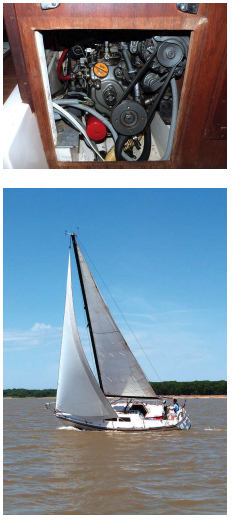
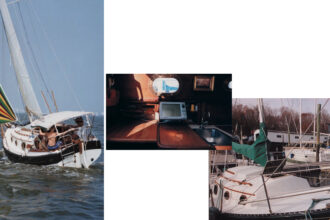
Our chase boat for the under-sail photography session was Kevin Ballard’s Newport 28, Desiree, which was a review boat in the May 2009 issue. A wind of 10-12 knots was creating a slight chop on Mark Twain Lake when Bruce took off sailing Polaris singlehanded. As he put the boat through her paces on all points of sail to give us the best photo opportunity, she seemed to be very quick and responsive. When we finally stepped aboard for our test sail, I was eager to confirm that impression.
I have sailed quite a few boats in this size range and have seen varying degrees of performance. Polaris is among the fastest I’ve seen. As soon as we trimmed in the sails she romped off on a reach, accelerating quickly and tracking nicely with just the right amount of weather helm. The low drag of the folding prop likely helped the acceleration.
When we brought her up to close-hauled, she would point very easily to 30 degrees apparent with no perceptible drop in speed. We took her through a series of tacks and the helm response was quick and precise. Polaris is the fin-keel model, and she pivoted on her axis with little hesitation.
After we bore away to a reach and then to a broad reach, the boat powered up and built up speed. We were using a GPS to judge speed over the ground and we registered over 6 knots most of the time, with occasional readings of 6.7 to 6.8 knots. I could sense the rudder well with just a light touch on the wheel, and it made me wonder how the tiller version would feel.
Singlehanding the jib was fairly easy, as the primary winches are alongside the helm. On Polaris, because the traveler has been moved to the cabintop, the help of a second crew is needed to manage the mainsail properly.
This boat should do well in a PHRF fleet. The base rating of 184 for the inboard-engine model is much lower than the O’Day 27 at 204 and the Cal 27-2 at 207, and very close to the inboard C&C 27 at 180. Polaris will rate somewhat lower with her folding prop. The Starwind 27 will give many larger boats a run for their money.
Prices and availability
A search online found six Starwind 27s currently on the market. The average price was $12,200 over a range from $8,000 to $18,500 — one of the higher-priced boats came with its own over- the-road trailer. Some of the variation is no doubt due to lower asking prices for outboard-powered boats.
Tom Wells is a contributing editor with Good Old Boat. He and his wife, Sandy, have been sailing together since the 1970s. They recently retired and have cast off the docklines to embark on full-time adventures aboard their 1979 Tartan 37, Higher Porpoise, starting in Florida this winter.
Thank you to Sailrite Enterprises, Inc., for providing free access to back issues of Good Old Boat through intellectual property rights. Sailrite.com