The best decision was to call for help
Issue 110 : Sept/Oct 2016
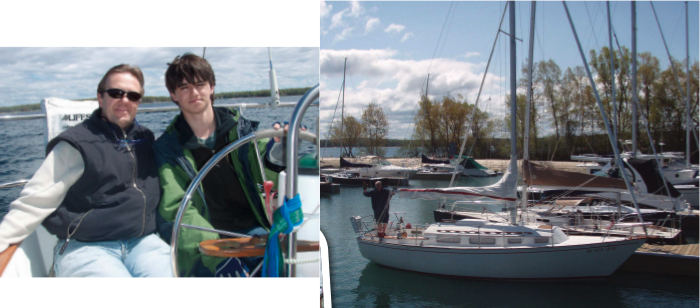
Having plied the Great Lakes on sailboats for more than 30 years, I was thrilled when my brother Jim informed me that he was getting his first boat. The thought of having his family at the yacht club, and of sharing my passion with them on their own starter boat, pleased me. I don’t know which one of us was more excited about bringing a new boat into the family. I had sailed my old trusted friend, a 1981 Cape Dory 27, for 23 years and my head was spinning with anticipation at the prospect of sorting out and learning to sail a strange new craft.
I was ecstatic about my brother’s choice, a 1977 Sabre 28. Even her name, Cabaret was acceptable. I knew this boat would serve him well and carry his family safely on the unpredictable Great Lakes.
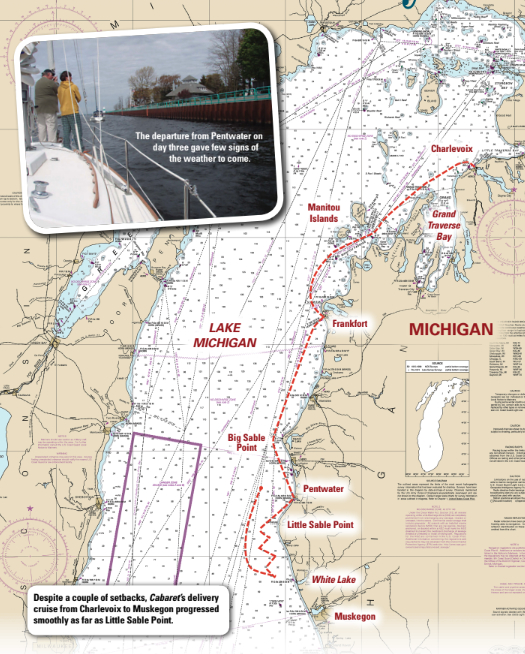
In only a matter of days we would put that thought to the test. Cabaret was in Charlevoix, Michigan, and we had to bring her to her new home in Muskegon, almost 180 miles to the south on Lake Michigan’s eastern shore.
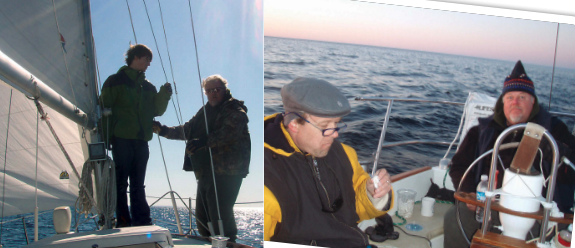
Our crew for the delivery was my brother, his son Nick, and me. Our plan for the trip was an aggressive one. We had three days over the Memorial Day weekend to hand steer Cabaret (she had no autopilot) 178 miles in three legs of up to 60 miles between ports. We would have to give up our normal sleep habits and use a navy-type watch schedule, but we were up to the task.
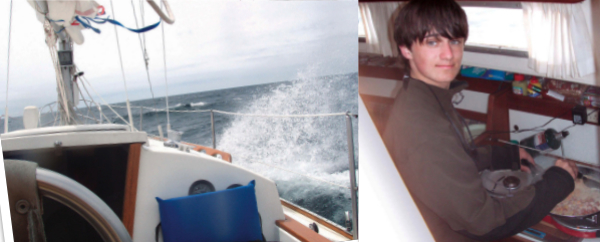
In our family, we call ourselves the Dilbert Navy. My experience and demeanor earned me the title of Admiral Smartmouth. My brother with the master’s degree is Captain Brainiac. My nephew goes by Leftenant Bilgerat, and that name stuck around the club. This bright-eyed, capable, and eager 16-year-old is an accomplished foredeck man on a Tripp 33. His fellow racers affectionately address him as Bilge or The Rat.
A fair start
The first leg of the delivery was the longest, 60 miles from Charlevoix to Frankfort, passing by Little and Grand Traverse Bays with a night navigation through the treacherous Manitou Islands. We left port on a sunny but chilly afternoon. Daytime temperatures were in the 40s, dipping down into the 30s at night. Multi layers and ski clothing were the norm. The lake temperature was only 38 degrees; serious sailing on Lake Michigan in May and not for the faint of heart. If you fall in, it’s simple: within 30 minutes, you’ll be dead.
The wind was right and we started our family adventure under full main and jib. Cabaret was a true gazelle of the sea and could point well with her crisp new jib and full-battened main. As with most Great Lakes cruises, the storybook sailing lasted only a short time before we had to fire up the iron genny. The two-cylinder Volvo Penta diesel purred like a sewing machine.
A damper
We’d been under way about an hour and were miles offshore when I looked below to see the bilge cover afloat, along with some of our gear. I told Captain Brainiac and his eyes grew as big as saucers.
“Let’s not panic,” I told the crew. “Let’s pump her out and gauge the rate of flow. Most likely, the stuffing box needs an adjustment and we will be just fine. When we put in to Frankfort, we’ll find the culprit and fix it.”
We pumped the bilge dry every 30 minutes. As night fell, we settled into a routine of motorsailing and pumping with two crewmen on deck and one off watch resting for 2 hours. The outline of the Manitous looked menacing in the dark of night. While the cold seeped into our bones, a billion bright stars shone in high definition and warmed our spirits.
We made Frankfort at 4 a.m. without any further drama and slept for 3 hours, all we were allotted before the bilge cover was again afloat. Up at 7 a.m., we had a full breakfast ashore before commencing our attack on the pesky leak. It was indeed the stuffing box, and the Bilgerat’s bean-pole frame made him the perfect candidate for worming around the diesel auxiliary to fix it — under Admiral Smartmouth’s expert direction.
Back in our foul weather gear and multi- layered ski clothing, we left Frankfort midday to start leg two to Pentwater. Despite our heavy gloves, all of us complained of cold hands. If it weren’t for the bite of the arctic chill in the air, it would have been a glorious day at sea.
Motorsailing all the way to make the best time, we arrived in Pentwater at 10 p.m., looking forward to a good night’s sleep. Leg three would be the shortest and, if all went well, we’d arrive at our home port on Sunday . . . if all went well.
The gamble
Because Lake Michigan weather is so unpredictable, anyone who sails here long enough will eventually experience the fury of its storms. Aboard a C&C 40 in the 1985 Chicago-Mac race, we were surfing down 30-foot waves at 17 knots under spinaker when we broached. In the early ’90s, seven boats from our club sailing in a group were caught in a blow north of Sturgeon Bay and I witnessed lightning strike three nearby boats. Two seasons ago, I was sailing my Cape Dory 27 from Port Sheldon to Muskegon when a squall line bore down toward us like a giant angry black rolling pin and hammered us with winds over 50 knots for 25 minutes. That line squall set my high-water mark for Great Lakes terror.
We left Pentwater Harbor at noon to find the wind in the high teens and on the nose. Seas were predicted to be 3 to 5 feet, promising a long, wet, and cold day. I interpreted a forecast for a 30 percent chance of scattered thundershowers at midnight or later as a 70 percent chance of not running into any thundershowers, a gamble we were willing to take. We figured we’d be home in Muskegon, about 40 miles away, in 6 or 7 hours, plenty early for a hot shower and dinner.
First, we had to round Little Sable Point, which forms the top shoulder of Michigan. The waves get real goofy here; I have seen them crashing into each other from all directions. Our plan was to punch our way out to sea to give a wide berth to the shoals that extend from shore. After an hour at sea with the Little Sable Point Lighthouse in sight, our trusty diesel’s rpm began to oscillate. Given the rough conditions, I figured this was a sign of an air bubble in the fuel line or tank sludge being sucked up and clogging the fuel filter. It could not have happened at a worse time. We had not yet clawed far enough offshore to give me peace of mind. I was nervous. Then the engine quit and would not restart.
A fateful decision
We had a decision to make. Do we play it safe and sail back to Pentwater, throwing off the schedule, or do we raise the sails and carry on? Like schoolboys on Tom Sawyer’s river raft looking for adventure, we made the decision to sail on. After all, we were on a sailboat and could sail to White Lake, where friends at Crosswinds Marina could help us get in.
White Lake was 11 miles short of our Muskegon goal, but we estimated that we could reach it around midnight. We all knew we were committing to a very long day at sea, but we of Dilbert’s Navy were special forces, not regular navy.
We had been beating to windward for 11 hours, the lights marking the entrance channel to White Lake were in view, and our last tack had put us on a course that would take us easily to the harbor when, without warning, the wind ramped up to 25 knots.
With every stitch of sail set, Cabaret was overpowered. We had to get that main down immediately. A glance to the west showed lightning in the darkening sky; our 70 percent gamble on the weather was not paying off. I carefully explained to Brainiac and Bilgerat the danger of what they had to do: go forward without missing a foot placement or handhold and pull down the main. With life jackets on, they scrambled forward and waited for me to shear the wind so they could grab 2 feet of the sail at a time. Without a motor, I had to steer carefully in these high winds so as not to backwind the jib and careen the boat in a wild carnival spin. I was proud of the crew for a perfect takedown in tough conditions and I said so when they arrived safely back in the cockpit. Then, before we had time to even rig a jackline or to jury-rig safety harnesses out of docklines, the wind ramped up to 35 knots.
Round one
Thoughts of safe harbor left our minds. I informed the crew that we had to pull in the jib until it was the size of a postage stamp. I cautioned them to be careful not to jam the roller furler, but careful turned out to be no match for the wind. The jib jammed with a terrible overlap, leaving it at the mercy of the wind.
Then Thor’s hammer dropped. The dark storm clouds were nearly on top of us. I urged the crew to stay calm
and to stay with the boat under any circumstances. My brother looked at me, “What do we do now?” I responded with two choices, both of them bad.
We could set Cabaret on starboard tack toward the beach and wreck her on the shore, or we could set her on port tack and sail into the mouth of the dragon. Jim said he really didn’t want to wreck the boat. We turned to port tack. The wind speed had climbed, hovering somewhere over 50 knots.
I kept thinking how terrifying the experience must be for my crew, neither of whom had ever experienced anything like this. I again and again urged Jim and Nick to hang on at all costs. With the wheel locked to port and the exposed part of the wrapped jib driving us forward, Cabaret was, amazingly, mostly hove-to, which to me seemed like a blessing of sorts. All we could do was hang on. After about 30 minutes, the storm released its grip. I turned to Jim and said that we might just have beaten this thing. He said he didn’t think so, that round two was coming.
Round two
No sooner were the words out of his mouth than all hell broke loose. We could not yell above the roar of the wind. Miraculously, the jammed jib kept us driving forward as I steered for our lives. The rain and spray stung the left side of my face like it was ripping flesh away. My windward eye was closed against the pain, my leeward eye was a mere slit. The scene was surreal. (We later learned that the wind during this time had blown more than 70 knots.)
Fighting this second phase for about 45 minutes we were blown onto our side twice. The whole time, the Bilgerat was wedged backside down in the cockpit as low as he could get. We all had death grips on anything solid. Twice, the 38-degree water washed over us, completely submerging The Rat — the coldest Jacuzzi he had ever experienced.
My biggest fears were of a rollover or of all three of us being washed overboard. The main appeared to have been stripped of sail ties and ripped in half. The sails slatted so hard their edges began to fray. A batten took off like it was shot from a crossbow. The Windex was blown off the top of the mast. Bilge said he saw the mast bend like a pretzel. Whether or not we survived this, I imagined the stainless-steel rails we clung to would forever bear the impressions of our fingers.
During the final 15 minutes of the storm’s second punch, I believed this blow was going to consume us. All I could do was steer and pray, steer and pray. I made peace with the thought of dying out here, but was saddened by the idea of friends and family losing all three of us at one time. Jim’s and Nick’s bodies would be recovered but my life jacket was at my side. From the moment the hammer dropped, I had feared relinquishing the wheel long enough to put it on.
After another full hour the wind and rain began to abate. The huge seas remained. At one point, I saw a dark line at least 12 feet above my head and knew it was a black wave about to slide under us. I remember saying to the guys that it was a damn good thing it was so dark out there, because seeing this in daylight would scare the crap out of them. They were not amused at my attempt at humor.
We were now rocketing due north at what must have been 8 knots, 9 when surfing. I steered like a madman, intent on avoiding a broach. To my amazement, the Little Sable Lighthouse was coming into view. A 90-minute storm had set us back the entire distance we’d covered during our 11-hour beat south. At this rate, we would blow into the teeth of the Manitous.
The towel
I decided it was time to call in the cavalry. In the decades I’ve been sailing, I have always been able to figure my way out of these terror-at-sea episodes, but with no motor and our sails blown out I had to admit this storm had beaten me. I asked Bilgerat to carefully make his way down below, to switch on a cabin light, and to hail the Coast Guard with a clear, “Mayday, mayday, mayday.”
My nephew picked up the mic and got the first part of the call out clearly. The Coasties responded right away, but Nick politely excused himself, went to the sink where he was violently sick, then resumed his conversation. He had to break away two more times before he could transmit our full message. I had never witnessed anything like that. My teenage nephew grew from a boy to a man before my eyes. I promoted him to
Tough Sea Monkey on the spot.
We were disappointed to learn that it would be an hour and a half before the Coast Guard could reach us. We were all wet and cold. My brother could not stop shaking, slurred his speech, and was now seasick. I realized he was pre-hypothermic and could go into shock. Bilge found a dry mummy bag in the mess below and the two of us worked to wrap it around his dad. Five minutes later, we were happy to hear Jim say he had stopped shaking. His condition hadn’t stopped him from giving the Coast Guard periodic updates of our postion from the handheld GPS.
Our tremendous relief at finally seeing the Coasties’ large orange RIB was shortlived — they told us the boat didn’t have enough power to tow us in safely. Although they assured us they would stay with us until their big cruiser arrived from Grand Haven, that wouldn’t be for another hour and a half. Our hearts sank.
An eternity later, at about 4 a.m., the big cruiser came out of the south, but bearing bad news: its draft was too deep for it to tow us through the shallow Pentwater Channel. Just when I thought this nightmare was never
going to end, the Coast Guard radioed to say they would make one attempt to tow us with the smaller craft. Their plan was to race up to our stern quarter and toss a line to Cabaret. But, they warned, given the conditions, if they missed or we failed to catch the line, we’d have to wait until they figured out how to get us to safety.
The tow
I couldn’t leave the helm, so I turned to my nephew. “You know what to do,” I said. “ . . . and don’t miss that line.”
The rescue boat was soon off our quarter, first 2 feet away in the surging seas and then 15 feet. Suddenly, a heavy line struck midships and lay across the boom. What a beautiful sight! I watched Bilge choke down his fear as he set about dragging the heavy line aboard and securing it to the bow of our bucking seahorse.
Warning us for what would come next, the Coast Guard radioman advised us to hang on tight and try to keep the sailboat directly behind the RIB. Then, as soon as the 200-foot towline came taut, the coxwain hit the throttle. Cabaret surged out of the water like a breaching whale. We set off on a ride Disney would be proud of.
After about 12 miles, the towboat disappeared into a fog bank. A few minutes later we emerged from the fog — and there was Pentwater Harbor, waves crashing on the north pier and shooting water 30 feet into the air!
The takeaway
Only by the grace of God and the prayers of those on shore were we saved. Sailing on the Great Lakes is serious business and I made many mistakes on this delivery in terms of safety equipment, the weather, and poor decision making. I allowed our pursuit of adventure to compromise our safety. These are hard lessons to swallow after decades of experience.
If I had taken all the precautions listed below before departure, the outcome would likely have been far less dramatic.
- Inspect all through-hull fittings and the stuffing box.
- Change all fuel filters and carry spares on board.
- Test run the motor for at least 30 minutes after changing the fuel filter.
- Inspect the fuel tank for sludge and debris that could be sucked up by the fuel pump.
- Install jacklines prior to leaving the dock and stow safety harnesses and safety gear where they can be quickly accessed by the crew.
- Establish rules for wearing life jackets and safety harnesses, such as after dark and at all times in heavy weather.
- Take aboard extra batteries for all electronics, especially for a handheld GPS or a cellphone.
- Test or inspect all safety equipment, such as radios and flares.
- When sailing in an area where the weather can be severe, unpredictable, and fast-changing (such as Lake Michigan), pay attention to forecasts and always be prepared for the worst—even if that means cancelling a trip.
- Make sure people ashore know your route and schedule. Inform them of any changes to either.
Mark Myaard has sailed the Great Lakes for over 45 years. He’s enjoyed (and not enjoyed!) countless adventures sailing cross-lake and participating in long-distance races. Mark has owned and skippered a 1981 Cape Dory 27 for the last 31 years, and sails out of Muskegon, Michigan.
Thank you to Sailrite Enterprises, Inc., for providing free access to back issues of Good Old Boat through intellectual property rights. Sailrite.com