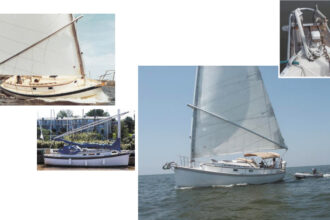
. . . evolve alongside a contemporary cousin
Issue 116: Sept/Oct 2017
The Viking 33 is one of a small number of boats designed for another builder by C&C Yachts after the company’s creation in 1969. Prior to 1969, the design firm of Cuthbertson & Cassian designed for a variety of builders, but after the formation of C&C, most of those outside allegiances disappeared. The rare North American exception was Ontario Yachts of Oakville, Ontario, with whose founder, Dick Kneulman, George Cuthbertson had always had a close relationship. Dick was already building the Cuthbertson & Cassian-designed Viking 28 and Viking 22 (Classic 22), and he also built George Cuthbertson’s only International 5.5 Metre design.
Equally interesting, when looking at the Viking 33 and its successor, the Viking 34, is the nature of model updates and why some, like the Viking 34, were given their own brand designation while others, like the C&C 35 Mk II, became a continuation of an already well-established brand. Indeed the modifications between the C&C 35 Mk I and Mk II were far more extensive than those between the Viking 33 and 34. So what logic, if any, determines when a model is “new” and when it is an “upgraded” successor? It can be a little obtuse.
The Mk II C&C 35 is a development of the Mk I hull form, but the C&C 35 Mk III is an entirely different boat, with no relation to the Mk II except in name. In the case of C&C, of course, mark designations allowed the use of the same brand names in later years, when there were so many C&C models on the market that numerical duplication became impossible to avoid. A number of builders solved this problem by going to three-digit length designations or even metric designations. So, using the C&C 35 of the same period as a counterpoint, rather than examining the performance potential of the Viking 33 compared to other like boats, I’m going to compare it to its own successor and explore some of the changes builders would make to “upgrade” a successful model to keep it in production longer.

Making a market
In production boatbuilding, the goal is to market a product that offers more features than are available on used boats. If a successful boat is in production long enough, its main competition for customers is often its own older version on the brokerage market at a considerably lower price. By refreshing an existing design every few years, builders were able to differentiate the new boats from the older boats and offer customers, new and old, the opportunity to buy a boat with upgraded features.
In C&C’s case, that upgrade usually had as much to do with performance improvements as with creature comforts. That was certainly so when a change was made in the rating rule under which the boats would be racing, as happened in the early 1970s when the Cruising Club of America (CCA) Rule was replaced by the new and very different International Offshore Rule (IOR). Performance upgrades to a given model included changes in keel and rudder designs, which were rapidly developing in offshore racing yachts in this time period, as well as adjustments that allowed boats to measure into the IOR level-rated 1/4 Ton, 1/2 Ton, 3/4 Ton, 1 Ton, and 2 Ton classes.
Close cousins
It’s clear from the drawings that the Viking 33 and the C&C 35 are very similar in size — they are only 4 inches different in LWL — and style — they are both obviously the work of the same design office. Both have the swept keels typical of C&C at the time but the Viking 33 is more extreme, reflecting a slight nod to a more race-oriented configuration than the 1969 C&C 35, while the 1971 Viking also has a less severe scimitar shape to its rudder, indicating a maturing or evolution of design thinking over the two years that separated these designs.
Despite their similar LWLs and the C&C 35 being heavier, 10,500 pounds compared to the 33 at 8,800 pounds, the C&C has a more typical displacement/length ratio of 225 compared to the competitively lower 196 for the more race-oriented Viking 33. However, due to the C&C’s larger sail area, their sail area/displacement ratios are almost equal: a generous 19.5 for the 33 and 19.2 for the 35.
In 1973, with the introduction of the IOR, both models were upgraded, and it’s interesting to compare the changes made between the 1971 CCA Rule Viking 33, the 1969 CCA Rule C&C 35, and their respective 1973 IOR successors.
Viking 33 to Viking 34
The Viking 33 was modified to incorporate lessons learned on the racecourse to improve her performance and also to meet the requirements of the new IOR 3/4 Ton class. Starting with the same hull, deck, and interior, the designers replaced the highly swept keel with the more vertical Peterson-style keel, which had been so successful on Ganbare that year, with deeper draft to achieve a higher aspect ratio and increase stability. At the same time, they gave the boat a more vertical rudder, also with a higher aspect ratio. It looks as though they may have even installed the new foils on the same keel sump and the same slight rudder skeg to keep hull modifications to a minimum. The rig went higher by almost 2 feet and the length of the boom (E) was slightly increased, adding sail area, while the aspect ratio of the foretriangle was further increased by a reduction in J (the base of the foretriangle). Eventually, a thinner double-spreader section with double lower shrouds replaced the original single spreader rig and its tripod shroud configuration.
Essentially all the major tooling stayed the same, but new “bolt-ons” were used to improve performance and achieve the 3/4 Ton rating. Logically, this model change should have been a Mk II upgrade, but Ontario Yachts stipulated a one-foot-higher designation, even though the length did not change at all.
C&C 35 Mk I to Mk II
By contrast, the C&C 35 Mk II received a new keel, new rudder, all-new rig, and more than 3,000 pounds of added displacement as well as substantial alterations to the original hull. Erich Bruckmann, who made the modifications in the C&C Custom Shop, always maintained that, rather than starting with an existing Mk I hull, as they did, it would have been better to have started from scratch with a whole new hull plug.
A 6-inch-higher sheer increased freeboard and necessitated an entire new deck and house, which was then designed to better match the newer boats in the C&C lineup. A redesign of the stern in way of the rudder, to earn a better rating under IOR, resulted in an almost 3-foot increase to the LWL over that of the Mk I. Other than the galley and quarter berth switching sides and the use of more extensive interior pans and liners, the interior was essentially the same.
So, here we have two early designs from C&C that evolved in production to meet new market requirements. One of them was introduced as a new model, while the other, with far more significant changes, was given the Mk II designation. Go figure.
Rob Mazza is a Good Old Boat contributing editor who, in his long career with C&C and in other design offices, designed many boats that are now good and old.
Thank you to Sailrite Enterprises, Inc., for providing free access to back issues of Good Old Boat through intellectual property rights. Sailrite.com