Wearing a life jacket is sensible — but nobody said it was easy
Issue 33 : Nov/Dec 2003
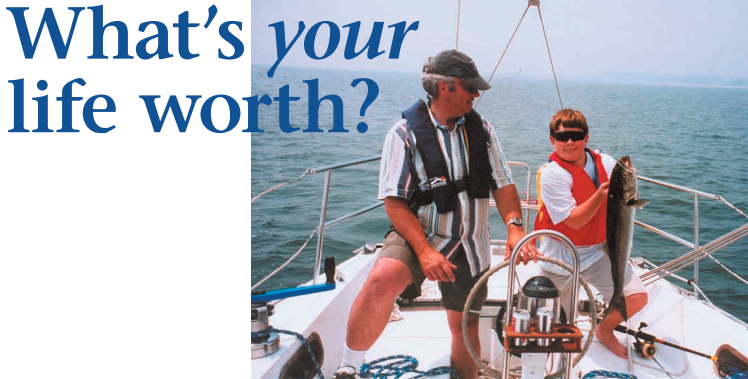
“Is my life worth $359?” I blurted out as I returned to the safety of the cockpit after putting an extra crank on the main halyard and tightening the outhaul. “No,” my wife replied unexpectedly and without hesitation, “but you’re worth a couple of million dead.”
I took the helm and was unusually quiet as I contemplated her answer. The seas were building; they averaged around 3 feet now. Occasionally a voluptuous 5-footer rolled under us. I love the water and saw no cause for concern.
Finally my wife broke the silence. “What are you talking about?” she asked, still unaccustomed to my habit of starting in the middle of a thought.
“Well, hon, I think this self-inflating life jacket with harness cost me about $189. I’d like to get one of those nifty tethers that retracts and has hooks that can be released under pressure. Bill sells them for $170. So, do you think my life is worth $359?”
Thinking back
The afternoon of May 24, 2002, was overcast. A southwest wind blew at about 15 knots. Seas were nominal at 1 foot. After six months on the hard, the boat was finally back in the water with numerous upgrades. Two buddies, neither with more experience than a few daysails, agreed to join me for a shakedown cruise. It was Friday. The weather was still cool. There were not many boats out.
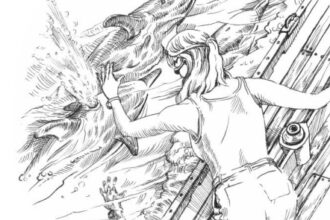
We were on an easy beam reach headed for Stratford Shoal when the straps holding the clew ring to the old genoa parted with a bang. I slid out onto the bowsprit, wrench in hand, to make the sail change. The clew of the torn foresail flogged noisily. I second-guessed my economic decision to buy a new mainsail rather than a foresail the previous winter. The seas were growing. The wind was gusting, taking the tops off the waves in fabulous bursts of white mist.
“You want to stop? Should I start the engine?” Danny called from the helm.
“No, no,” I answered, reasoning that I’d changed many a foresail while racing under far more adverse conditions than these. It crossed my mind that I should go below and get my life jacket. I thought about asking the friend sitting behind me on the bow to go below and get life jackets, but I reasoned that leaving and returning to the deck posed more risk than staying put. If I went overboard, I had no expectations that my guests would be able to come about and retrieve me.
Spray was making the deck wet now. The fabric of my pants gave way, exposing my thighs and knees. The testosterone flowed. My system was fully charged. This is the stuff life is about.
Flying umbrellas
Unknown to me, back at the club, a comedy was unfolding as old salts, already a drink or two into the evening, chased umbrellas that abruptly took flight in a sudden gust of wind. Just west of us several larger sailing vessels milled about. I admired their lines and dreamed. I kept steady at my task, sans safety equipment. Once the damaged sail was down and a smaller one replaced it, we continued on, blissfully unaware that a deadly tragedy was playing itself out nearby.
The next morning I read in the paper that a skilled skipper was missing, having been swept from the deck when a spinnaker pole failed. The coordinates given were just west of those entered in my log following my sojourn onto the bowsprit. I was certain that it had been his vessel I’d admired the evening before. Though wearing his life jacket at the start of the race, the missing captain had removed it at some point prior to the mishap. A shipmate dove into the water and grabbed him but was unable to hold him. Despite a competent crew and the flawless execution of man overboard procedures, a great guy was gone, a cherished life was lost.
For the last few years I’ve sporadically worn a self-inflating life jacket with a built-in harness. On Saturday, May 25, 2002, I made the commitment to don a life vest every time I’m on the water. I must say it’s a challenge. I’m the only member of my race crew who wears a life vest. To my dismay, I’ve noticed in the family pictures that the life vest accentuates my ample girth. Periodically the vest gets caught under the lifelines, rendering me something akin to a squealing pig wedged in a fence. Some days it’s just plain hot, and going downwind I perspire like an exploding fire hydrant.
Then the crème de la crème: we were at the dock flaking the mainsail when the manual-inflate tab dropped out and got caught in a sail tie. There was a moment when the crew heard the pin penetrate the CO2 cartridge. The entire marina stopped to watch my life vest inflate. Right side, left side, poof. My face flushed with embarrassment as the vest expanded around my neck. CO2 is cold when it expands, and I should have enjoyed a brief respite from the heat. Instead, I gave in to peer pressure and lost my temper.
“Sh*#, that just cost me eight bucks,” I said out of humiliation and tossed the vest into the cabin.
On further reflection
In the three days that passed before the next race, I thought about some of my less gallant nautical experiences. There was the time that, as 19-year-old college freshmen, we proudly showed off our Coast Guard seaman’s cards when renting a canoe. It was spring in Oklahoma, and the Illinois River was swollen and cold. Barely two hours after our proud display of credentials and boasts of many aquatic conquests, we found ourselves pinned between the shiny aluminum rental canoe and a fallen tree. The water was freezing. I tried to move, but my muscles only half-heartedly complied. The physical prowess I was accustomed to failed me. All I could see of my best friend was a mass of brown hair floating on the water next to me. Strangely, my first thought was, “What will I tell his mother?” I reached for the back of his orange life preserver, and my buddy abruptly popped to the surface.
Lessons learned in Captain Dunn’s East Jefferson High School nautical science class surely contributed to the saving of a life that day. We were wearing our life preservers. Until that moment, I believed myself to be invulnerable. I’d been warned about cold water but didn’t believe it could happen to me; I had never experienced its paralyzing effects until that moment
I started wearing seatbelts when a friend’s vocal career went on hold due to a broken jaw received when she hit the steering wheel of her car in a 25-mile-per-hour crash. Only geeks wore seatbelts in the ’70s, but — with firsthand knowledge of a senseless broken jaw — I reluctantly at first buckled up. Today it’s a habit.
Hope of survival
There is a high probability that if I leave the deck of my boat unexpectedly, I will find myself not only in the inhospitable marine environment but will also be injured or incapacitated in some way. A life jacket is the best and cheapest hope of survival.
A captain acquaintance described an incident in which a ferry wake unexpectedly tossed him from the deck of a friend’s twin-engine catamaran. Turbulence from the starboard prop tickled Dave’s right ear as the screw passed within inches. The trolling wire passed smoothly along his arm. Visualizing the nasty hooks of the umbrella rig at the end of the wire, Captain Dave started swimming. On board the boat, blissfully ignorant, the owner motored toward home, some 60 miles to the west. A perplexed mate tapped him on the shoulder.
“Where’s Dave?”
Thank you to Sailrite Enterprises, Inc., for providing free access to back issues of Good Old Boat through intellectual property rights. Sailrite.com