Give in and go with it when you’re chosen by a boat
Issue 33 : Nov/Dec 2003
It seems like every important event in my life starts with a phone call: jobs, births, deaths, want ads. This time it was long distance to Seattle.
Me: “Um, hi, I’m calling about your boat for sale.”
Seattle: “OK.”
Me: “What can you tell me about it?”
Seattle: (short pause) “Anything.”
Me: “Well, is she in good shape?”
Seattle: “Yes.”
Me: (Hmmm, man of few words.) “It says in the ad you’ve had her for 24 years. Where was she built?”
Seattle: “My house.”
Me: “OK, uh, how does she sail?”
Seattle: “Good.”
The conversation was fairly one-sided — something like a 20-to-1 word ratio, my favor — but gradually the boat took shape in my mind. Being pretty good at reading between the lines (even short ones), I discovered a man who had built his dream during his prime, only to see his wife lose interest. He never did though. I think that’s why he was reluctant to speak about his lost dream to a stranger over the phone.
The boat was in good shape: well made and seaworthy (I learned later that this man, perhaps harking back to his no-nonsense Finnish heritage, grossly understated most things about his boat). I asked every question I could think of and received mostly short, but accurate, answers. (“4,200 pounds of poured lead. Because I poured it.”)
After a series of quick terse answers, I began to feel — as a potential buyer — that I deserved a little more excitement on his part . . . perhaps even some multi-word sentences. I wanted him to extol the virtues of his boat to me. Maybe this one wasn’t such a good idea after all. But somehow I liked talking to this man — he certainly didn’t behave like a broker. And I felt sorry for him once I imagined him enduring phone calls from half-interested buyers, tire kickers, and dreamers.
I told him we’d like to see it (I think I de-emphasized the “we”) and after he paused (judging for worthiness?), I set up a time to drive the 150 miles across the Cascade Mountains to see it. After I got off the phone, I told my wife, Theresa, that maybe we could take a drive to Seattle next Saturday and maybe take a ferry ride and ohyeahandseeaboat. To my surprise, she said — after looking over the notes I had made while I was talking to the seller — that she sounded nice.
She? Ever since we’d been looking at boats (just for fun, of course), Theresa had never called one a “she.” I hope there are other men who have a wife like mine — not so set in her ways that she can’t still surprise you. I sensed something in her that felt encouraging. Maybe my (dare I say our?) nebulous dream of seeing new places by sailboat could someday become a reality.
Corporate ladder
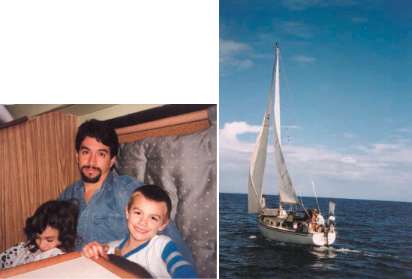
I had been climbing the corporate ladder and had reached a point at which there weren’t many rungs left. To me at the time, it looked like a pretty long way down. Mid-life crisis? I don’t think so. I was only 34, and everything was going great for me. But something was missing . . . my family. I was spending nine or 10 or 12 hours a day away from my 9-year-old daughter and 6-year-old son.
Maybe I was jealous that, as a homeschooler, my wife got to enjoy 24/7 with them (at the time she might not have been in total agreement). What would the cruising life be like, I wondered? Waking up in the morning and not having to leave home? Or leaving together in our home when the whim took us? I extended the dream to include being away from mortgage payments, advertising, peer pressure, The Simpsons. A small sailboat could do it. Just us, distilled down to a real family, traveling where we wanted, bringing our home with us, taking a bite out of life, with four mouths.
It was raining as we drove into Everett, just north of Seattle. Still early spring, this was not surprising. It was also cold and windy as we drove up to the yacht club parking lot to meet the owner. We found his truck, and introductions were made. He was short and trim, late 60s. He had eyes that seemed to have taken over emotion-central, since his mouth was not allowed to express strong emotions. When he saw the kids, his eyes gleamed, even sparkled. His kids, he said, were grown now, but they used to like to sail in Puget Sound. On his boat. His eyes sighed.
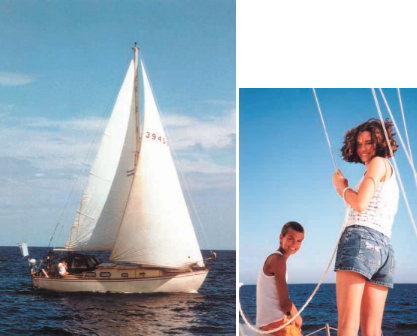
We followed him to the marina and began walking down the wet dock into a spitting cold rain. At each slip, I wondered if he was going to stop and say, “This is the boat,” or more likely for him, “Here.” Most of the boats we passed were average, some rougher. I hoped he would keep walking. Suddenly he turned and walked down a finger pier. On one side was an ugly sky-scraper powerboat and on the other — her. Her clean ivory hull had classic lines. Her rig looked capable and reassuring. The freshly painted cockpit was comforting. I swear she tugged at her docklines as we approached.
We were selected
“So you’re going to be the new owners, eh?” she seemed to say. “Where shall we go first?” She was partially covered by a tarp to keep the rain out of the cockpit, so it was difficult to see anything of her deck except that she was well taken care of. He stepped aboard and motioned us to follow. As I stepped aboard, she bowed to me. After he unlocked the companionway, I followed him in and waited for the rest of the family — I wanted to see their expressions when they first saw the inside. The kids were smiling and instantly picked out their own quarter berths and giggled inside their “caves.”
When Theresa stepped in, she looked around and got a strange look in her eye . . . like the one she gets after one of the kids gives her a flower. She later said that it felt as if she were home. This was surprising, given that the boat was decked out in 1970s burnt orange carpeting — something that normally would have caused an exit stampede.
I expected a cold wood-and-fiberglass vessel, but in contrast to the laconic nature of her builder, she seemed to speak to me. On opening a drawer or locker, I could hear her whisper, “Yes, the silverware goes here. Tools here. I’ve a place for everything you need. If there is no place, you don’t need it!”
Her whole inside seemed to be just waiting. The cushions were stacked neatly to avoid mildew, all of the locker doors were open, and a small dehumidifier purred on the floor. It was as though she had been put away in 1971 and was patiently waiting for the right circumstance to release her. I got the feeling that she thought we were it.
The negotiations were short (as I’m sure she knew they would be), and our dream became a reality perhaps as much because of Lindsay Christine as ourselves. She was the catalyst, the spark that ignited the fuse of the dream and propelled it to reality.
Thank you to Sailrite Enterprises, Inc., for providing free access to back issues of Good Old Boat through intellectual property rights. Sailrite.com