An anxious skipper learns to listen to others
Issue 54 : May/Jun 2007
When first conceived, the notion of an overnight sail seemed exciting. Sally and I had been coastal cruising for years, but we always planned our inlet-to-inlet passages between sunrise and sunset. We had spent many nights aboard but always on the hook or moored in a marina. All were great memories. Still, the longer I pondered the idea of standing watches in the red glow of the binnacle, the more obsessed I became.
“Even coastal cruisers should be competent night sailors,” I began my pitch to Sally. We were planning to repeat a cruise made the year before. For three lovely days we had sailed down the Intracoastal Waterway, motoring when we had to and anchoring each evening before sunset. On Day Four, we ran the Fort Pierce Inlet at dawn and sailed the 60 miles back to Port Canaveral, offshore.
According to my revised plan, this year we would run the inlet in the afternoon and make our passage to our home-port overnight, gaining valuable experience and having a grand adventure to boot.
“I don’t know,” protested Sally. “Let’s just do it like last year — we had such a good time.”
“Wait,” I added, “Simon is going with us this year.” John Simon, my dear friend and mentor in all things nautical, had, after much persuasion, agreed to join us. He’s a delivery skipper who has sailed the world over, and he was the missing piece of my plan. With a seasoned mariner aboard to teach us the nuances of night sailing and navigation, how could anyone say no?
Pleaded for days
“No,” said Sally, “You and Simon go by yourselves. It’s going to be a ‘guy-trip.’ ” My pleading went on for days. Anxious to share this new experience, I sincerely wanted to include her. At last my efforts paid off, and Sally reluctantly signed on.
Our cruise began perfectly with a stiff east wind and clear skies. Day Two was equally satisfying, ending with us moored at the Vero Beach Municipal Marina. The next day or, more importantly, the next night, the real adventure would begin.
I awakened early, eager to get under way. For Sally, certain she had been shanghaied into some “boys’ night out,” the morning was passing all too quickly. She disappeared while Simon and I made final preparations. I found her beneath a banyan tree, reading a paperback novel. When asked if she was excited about our “passage,” she wondered aloud about renting a car and driving home.
Departure time finally came. We reached the inlet early and discovered the outgoing tide was still an hour away. Sally suggested anchoring until slack tide, but driven more by “the plan” than sensible thought, I pushed on at an agonizingly slow pace.
Eventually we reached the sea buoy, hoisted the main, set the jib, silenced the diesel, and took up a broad reach on our course of 345 degrees. Perfect.
Afternoon passed quickly into twilight. It was time to switch on the running lights and set the watch. Sally had excused herself from any watch schedule. Simon and I had cooked up this little all-nighter, so we could steer the boat ourselves. She enjoyed the sunset, bid us good night, and retired to the V-berth with her novel.
Nobody sleepy
The first watch was Simon’s. I would sleep two hours, then switch. But neither of us was sleepy. So we set aside the ritual and vowed that when one felt tired, he would confess and go below for a nap.
The wind strengthened with nightfall, delivering 6 knots. A check of the GPS confirmed we were off Sebastian Inlet, a full two hours ahead of schedule. Encouraged by our early progress, Simon and I began discussing the possibility of reaching Port Canaveral before sunrise. I was calculating a revised time estimate when I noticed a buoy depicted on the chart near our position. Surely on this dark night we would see its red light flashing every four seconds. I returned topside with binoculars and began scanning the horizon. Nothing.
“We’ve had two hurricanes this past year,” Simon interjected, detecting my concern. “Yeah,” I said, “That buoy’s probably long gone.”
Our conversation turned to other topics, only to be interrupted by a Coast Guard radio broadcast warning that the lighted buoy at Bethel Shoal was extinguished. Bethel Shoal! Extinguished? That’s the buoy I was looking for. Should we slow down? Should we heave-to until dawn? Simon gave me the helm and went below. Squinting through his bifocals, he surveyed the chart, then the GPS. “We’ll hear it, Skipper, it’s a whistle buoy,” he said calmly. “Besides, we’re past it.”
The adrenaline ebbed, leaving me suddenly tired. “I’m gonna take that nap,” I said. “I’ll wake you in two hours,” replied Simon. I clipped off my harness, went below, and stretched out, realizing I had never tried to slumber while under way. Before I finished the thought I was sound asleep.
Wind went slack
“You’re really sawing some timber there, Skipper,” said Simon, prodding me awake. He told me the wind had slackened and clocked to the south, explaining that he had altered course to north-northeast, intending to turn back toward the coast later. I took it all in, still half asleep. Simon went below and was snoring in minutes.
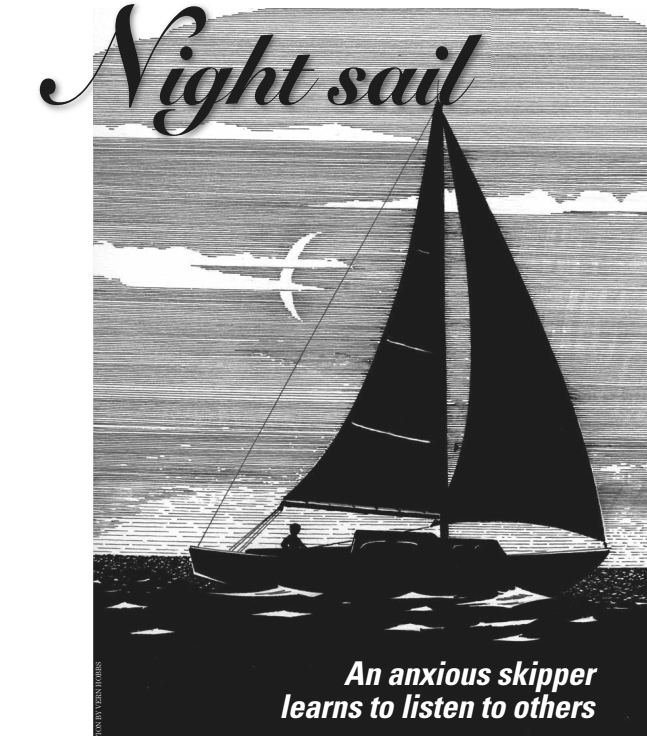
A thin crescent moon had risen. Our speed was down to 4 knots, and Simon’s new course was carrying us well offshore. There was a chill in the air and, although my two companions were only a shout away, I felt very much alone.
I held Simon’s course, understanding his plan, but realizing he felt none of my present anxiety about being this far offshore. The lights of the coast were disappearing in the deeper swells. “We’re no more than 5 or 6 miles off,” I told myself. Still, the dwindling lights dredged up misgivings and doubts. I had sailed beyond sight of land before, but in broad daylight. Why was darkness making it all so different, so foreboding, and so intimidating?
I deferred my anxiety. I would hold Simon’s course until the lights fell totally out of sight, then come about and steer toward the coast. The lights were gone a few minutes past three. Bringing the boat about, I felt my fear displaced with rising exhilaration. Perhaps it was the knowledge that I was turning toward land, or maybe it was simply the act of performing a task, rather than passively riding on the black ocean. Whatever the reason, I was relaxed now and even coveted my time alone in the cockpit. I selfishly decided to extend my watch until dawn.
Still a way to go
A thin strand of lights crept back over the horizon within an hour. Our speed fell to three knots. I wondered how far north we were, but reasoned that since I could not see the launch towers at Cape Canaveral there was no chance we had passed our destination.
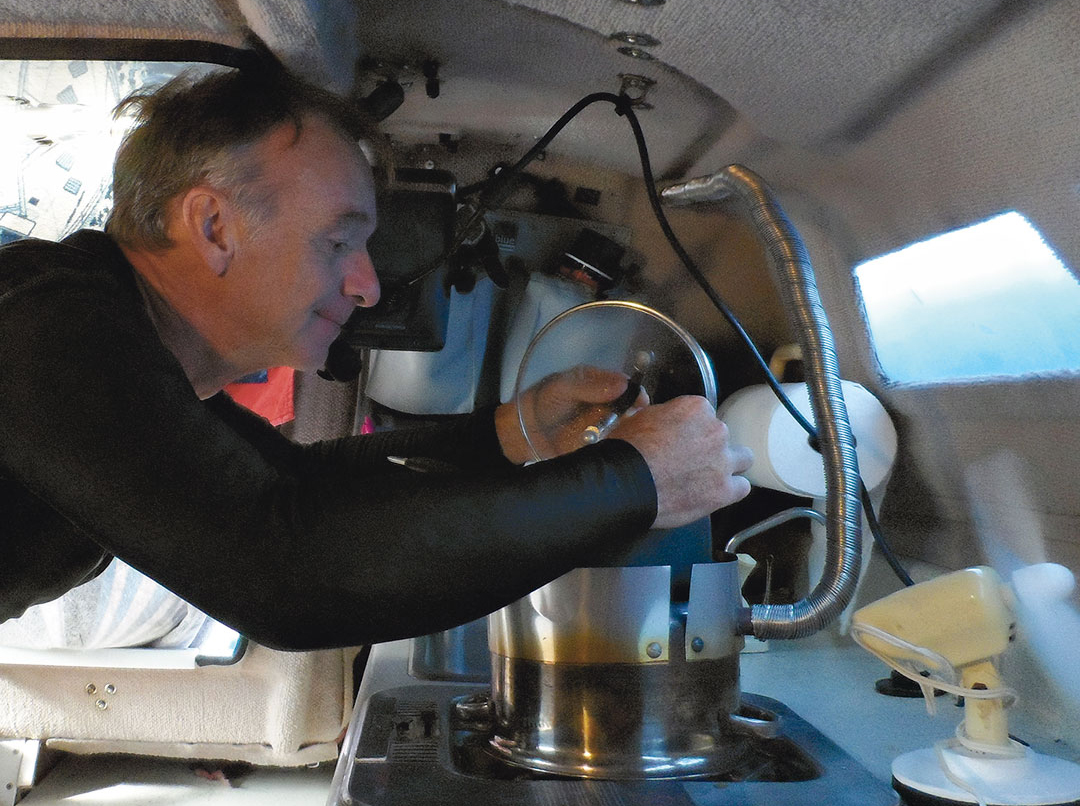
Dawn found us ghosting along still 10 miles south of Port Canaveral. The rising sun washed over us, vanquishing the chill and awakening my crewmates. Soon the teapot was whistling in the galley and, as our tiny ship came to life, I realized the moment was precisely as I had imagined it would be.
The wind died completely with the morning sun. I cranked the diesel and began steering toward the launch towers now prominent on the horizon. Struggling against fatigue, I began to mentally catalog the lessons of the night.
The boat had sailed as stiffly and reliably in darkness as she ever had by day. No surprise. The true discoveries were more personal. First, in spite of the fact that we experienced no trouble, listening to your crewmate and, more importantly, your lifemate, is best put ahead of blind ambition. Second, that living the better part of five decades doesn’t mean I’m too old to be a little afraid of the dark.
Thank you to Sailrite Enterprises, Inc., for providing free access to back issues of Good Old Boat through intellectual property rights. Sailrite.com