Let how you cruise be how you choose
Issue 94 : Jan/Feb 2014
Cruising in trailerable sailboats has its advantages. In the winter, you can get your boat from the frozen north to Florida at 60 mph in a couple of days. You can cruise on a great variety of inland or coastal waterways without making long voyages to get to them. You can store your boat in your backyard.
On the other hand, you are not likely to sail to Tahiti or to cross oceans in your trailerable cruiser. (Yes, it has been done, but it’s not common.)
I consider a trailerable cruising sailboat to be one that can be legally towed on U.S. highways and in which you can cruise for several days or more. Most trailerable sailboat cruising is done on coastal or inland waters, so I’m not including boats more suited to extensive bluewater cruising.
If a trailerable sailboat is in your future, which one is right for you? Start by focusing on how you will use the boat. By that, I mean how you will use the boat most often. Don’t get sidetracked by the idea that it might be nice to take cousin Herman, his wife, six kids, and two dogs on a cruise with you once every seven years. If you want to cruise occasionally with additional people, you can always charter a bigger boat for those times.
Some say you should choose a sailboat with your heart. Others say you should choose one with your brain. I think you should choose a sailboat not only because you fall in love with it, but also because it is the one that will best suit the kind of cruising you plan to do. When considering a trailerable sailboat, it helps to think about three different types of cruising:
- Marina hopping
- Short cruises of two to five days
- Cruises of a week or longer
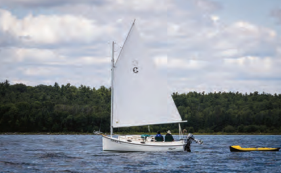
Marina-hopping cruises usually involve staying in a slip at a marina at the end of each cruising day. In most cases, food, fuel, heads, and supplies are readily available at the marina or nearby. Marina hopping can be done on coastal and inland waters. If the weather looks bad, it’s easy to stay in port. This mode of cruising places the fewest demands on a boat and its features.
On short cruises of two to five days, it’s nice to be able to stay out for the entire cruise without needing to use shore facilities. I’ll consider that time period as the baseline for a short cruise. This mode of cruising places more demands on boat features than marina hopping, but not as much as you would need for more extended cruising.
For cruises of more than a week, the time between shore stops can be considerably longer, increasing the importance of several boat features.
If you are now saying to yourself, “But I want to take all those kinds of cruises,” consider how often you will do each. Focus on the type of cruising you will do most frequently and decide if the tradeoffs for the other types of cruising are critical for you.
Marina hopping
Boats suitable for marina hopping do not need the storage space and tank capacity required by boats that will be taking longer cruises. You will still want a portable potty for use away from the marina but you can easily carry enough water, fuel, food, and ice for daily use.
You will want a small outboard engine for maneuvering in marinas and getting somewhere when the wind dies. You will want sails that can be reefed if the wind pipes up and you will want an anchor for lunch stops. A light-air sail is convenient, but not really necessary for marina hopping. You don’t need a tender for marina hopping unless you plan to anchor off a beach along the way.
The number of people who need to sleep aboard is the main determinant of adequate boat size for this type of cruising. Two adults can easily marina hop in small boats such as the West Wight Potter (15 or 17 feet), Sage 17, or Com-Pac Horizon Cat (20 feet).
Two adults and two children can find sleeping space in slightly larger 21- to 22-foot boats that offer, in addition to a V-berth, two settees or a settee and a quarter berth for sleeping. Boats in this size range are or have been made by Precision, Catalina, O’Day, San Juan, Com-Pac, Venture, and others.
Four adults will find boats in this size range a bit snug, although the ability to get off the boat while at the marina may help. Boats in this size range are readily available on the used market for well under $20,000 and many can be found for less than $10,000, often including trailers.
Two-to five-day cruises
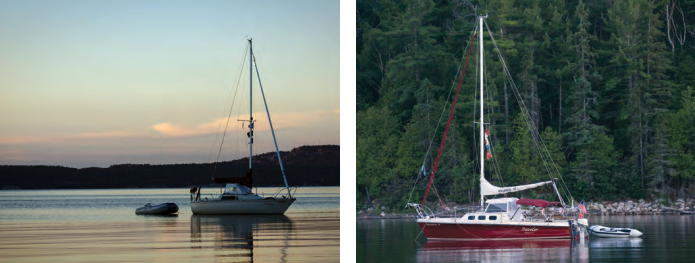
Cruising for two to five days puts more demand on storage space and tank capacity than marina-hopping does. A couple of 5-gallon water jugs will last two people for this time period. Most chest coolers can keep block ice for a few days or you can plan to travel without ice. If you are using a portable potty, its capacity may be the limiting factor in how long you can stay out. The largest portable potty on the market has a holding tank of only 5 gallons. Two adults could go three to four days with a tank that size.
Since you will be anchoring out overnight, you will want good ground tackle. You will want sails that can be reefed in heavier air. A light-air sail might be handy if you want to conserve fuel or if you just want to be able to sail rather than motor when winds go light.
A small tender is handy even on short cruises. It can be used for going ashore, rowing out a second anchor if needed, visiting other boats, and also for exercise. If the cruising sailboat is not beachable, a tender is just about a necessity.
Once again, the number of people who will sleep aboard is a determining factor in boat size for cruises of this duration. Most boats of 22 feet or smaller do not have an enclosed head compartment and the head is often located under the V-berth. Moving the portable potty into the cabin will make nighttime access easier. You have to decide whether modesty is an issue for you.
Also, boats under 22 feet in length can seem very small if you are confined below in bad weather. Two people would have room to stretch out in a boat of this size, but four adults would feel cramped. Boats under 20 feet do not usually have a lot of storage space, and can feel cramped by the time you add water jugs, ice chests, extra sails, food, clothing, and other gear.
For use by two adults and one or two children, I’d recommend considering at least a 21- to 22-foot boat, such as those listed above.
For four adults or two adults and older children, the added volume of 22- to 24-foot boats will be welcome. Several boats are available in this size range, such as the Precision 23, Com-Pac 23, Rhodes 22, Canadian Sailcraft 22, Montgomery 23, or the San Juan 24. Many of these boats can be found on the used market for less than $20,000. Any of them can also be used for marina-hopping cruises.
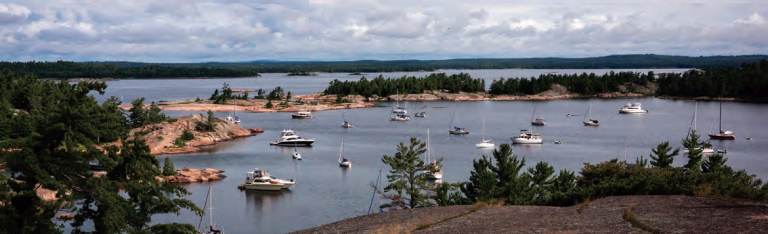
Note that if you can arrange to stop at a marina every couple of days for pump-outs and provisioning, you can easily extend your cruise without needing a larger boat. For example, the Trailer/Sailors Association leads a two-week cruise to the North Channel of Lake Huron every summer. Members cruise in boats ranging in length from 17 to 30 feet. However, these are relatively protected waters and it is fairly easy to arrange marina visits every three or four days.
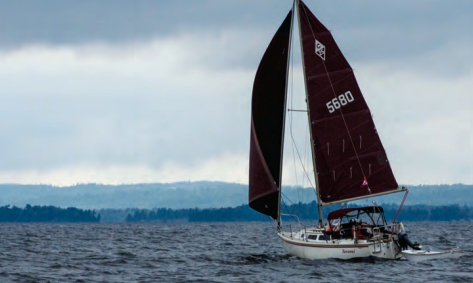
Cruises of a week or longer
When you plan to cruise for a week or longer with no shore stops, you need larger storage and greater tank capacity than you would for shorter cruises. You may need to carry extra jerrycans of fuel. You will want an engine with an alternator so you can charge batteries and a holding tank of at least 10 gallons capacity. Remember that overboard waste discharge is illegal in inland and coastal waters.
You will need to be able to carry adequate drinking water. It is almost impossible to get block ice to last a week, so you’ll need to consider adding refrigeration or learn how to cruise without ice. You will need enough storage space for food, libations of choice, anchors, extra sails, charts, clothing, recreational materials, foul weather gear, and so forth.
You can use a sunshower for bathing in the cockpit. Two people can easily shower on a gallon of warm water if the water is used carefully and only while rinsing. A small tender (a dinghy or a kayak) is necessary for going ashore, rowing out a second anchor if needed, visiting other boats, exploring anchorages, and exercise.
Aside from storage needs, the number of people the boat must sleep continues to be the primary determinant of recommended boat size for extended cruising. Two adults can usually handle extended cruising in boats 23 feet or larger. For four adults, or two adults and children, a 25-foot boat will be considerably more comfortable.
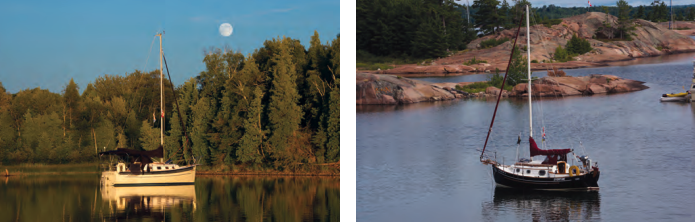
Most boats in this size range can be fitted with auxiliary tanks for waste and for fresh water and often have enclosed head compartments and separation between the V-berth and the main cabin. Many have standing headroom. Popular choices include the Catalina 25, MacGregor 26, Seaward 25, Bayfield 25, Com-Pac 25, and the Cape Dory 25. If the capacity of your tow vehicle is limited, consider lighter, water-ballasted boats such as the MacGregor. These boats can be found on the used market for around $20,000 or less, depending on age and condition. Any of them can also be used for marina-hopping or on shorter cruises.
Some larger boats on the market can also be trailered with a sufficiently powerful tow vehicle. Among these are the O’Day 26 and 27, the 20-foot Pacific Seacraft Flicka, or the 24-foot Pacific Seacraft Dana. A few 30-foot boats are also legally trailerable, such as the C&C Mega 30 or the Alberg 30. The legal width limit for towing trailerable boats is 8 1⁄2 feet. Set up and launching of larger boats is more challenging. A mast-raising system is necessary, and a trailer tongue extension is almost always needed.
Your choice
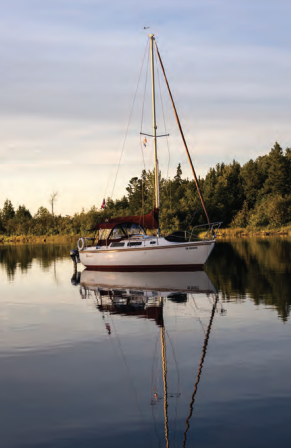
As you look at different boats, think about how you will be able to use them. Check the storage space. Visualize where you will put clothing, food, and other supplies. Gather all the people you plan to take with you below and try to imagine how comfortable you would be if stuck below for a day or more in bad weather. Visualize changing clothing or using the head and see if it meets your modesty needs.
See if the cockpit seating is comfortable enough for several hours of use. Decide whether there’s enough room to prepare meals below. Walk around the deck and imagine deploying an anchor or changing sails. See if the seller will show you how to set the boat up for launching. Then step back and look at the boat and see if you like the way it looks. Look at the condition of the hull, the sails, and the engine. Check the trailer for rust and look at the tires. Consider having the boat surveyed, especially if you’re going to spend a lot to buy it. Take the boat for a test sail if possible. Read reviews in Good Old Boat or on the Internet to see if there are any other pluses or minuses that might sway your decision.
Moral support
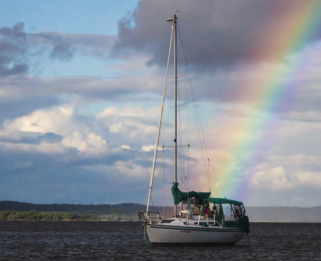
Trailer sailors are a friendly and helpful bunch. Many congregate and offer advice and answer questions on online forums. In addition, owner-run forums for many specific brands of boats are available. A number of membership-based sites with modest dues also exist, and most current builders of trailerable sailboats also maintain websites. Internet searches will yield many, many other resources.
Mike Nelson is a retired engineering psychologist. He and his wife, Diana, sail a Pacific Seacraft Flicka, a good old boat that, happily, meets all the requirements above for longer cruises. Mike is also the past president of the Trailer/Sailors Association.
Thank you to Sailrite Enterprises, Inc., for providing free access to back issues of Good Old Boat through intellectual property rights. Sailrite.com