Tame reefing lines with neatly hitched coils
Issue 91 : Jul/Aug 2013
Mainsail reefing systems vary in detail but have one problem in common: what to do with the excess lines from the reef-clew outhauls.
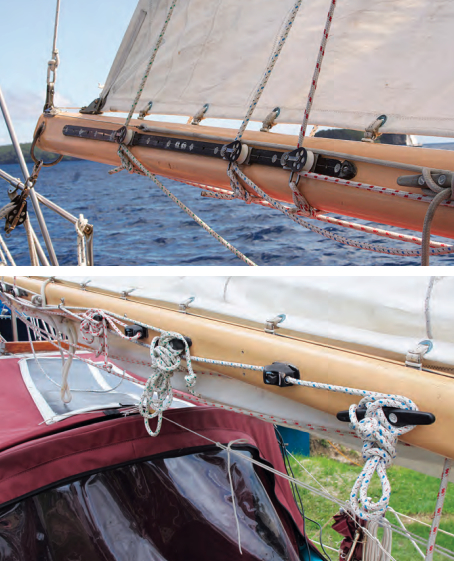
We have three sets of reef points on Entr’acte. The clew outhaul lines are quite long: 12 feet for the first reef, 18 for the second, and 24 for the deep reef. Under full sail, these lines are not a problem but, as the first reef goes in and the clew is hauled out and cleated, three long tails must be coiled and stowed. Not only must that first reef outhaul be adjusted, but the slack must be taken out of the other two outhauls and their excess line stowed as well. That’s a lot of spaghetti!
Over the years, I’ve seen and tried various coiling methods but found them all wanting. While the lines were out of the way, they were either not secure, too secure, not neat and shipshape, or a chore to readjust. What’s worse, they always seemed to tangle when I needed to readjust them or shake out a reef.
After much trial and error, I happened upon what I consider to be a nifty way of dealing with this problem. I don’t lay claim to inventing this system. It evolved over time and I’m certain a thorough search will discover it in some lexicon somewhere. I believe I managed to somehow reinvent a wheel.
My criteria for a good line stowage technique are that it must be simple, fast, secure, neat and, most important, easy to undo without creating tangles.
The keys to making this work smoothly are to have reefing cleats large enough to handle the loop and extra wraps and to practice until you are able to correctly judge how large to make each coil and the amount of tail you need.
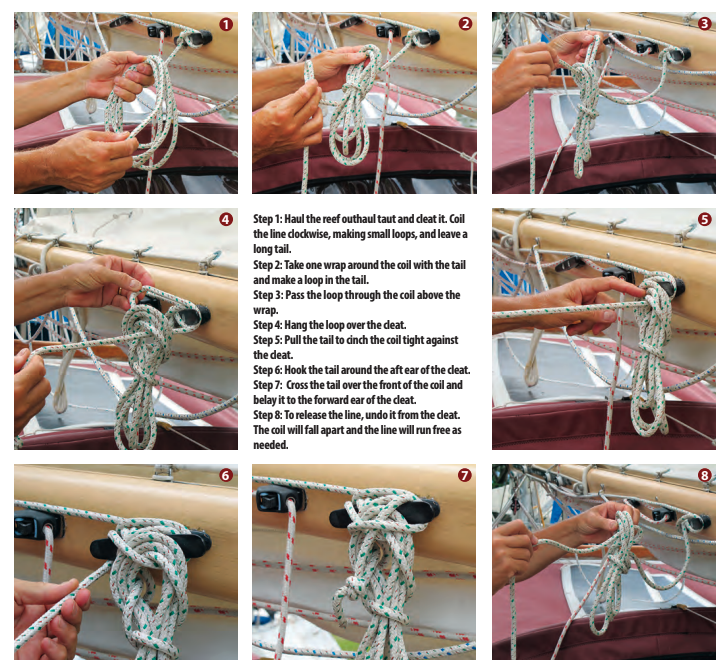
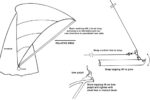
Step 2: Take one wrap around the coil with the tail and make a loop in the tail.
Step 3: Pass the loop through the coil above the wrap.
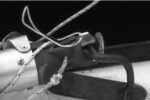
Step 4: Hang the loop over the cleat.
Step 5: Pull the tail to cinch the coil tight against the cleat.
Step 6: Hook the tail around the aft ear of the cleat.
Step 7: Cross the tail over the front of the coil and belay it to the forward ear of the cleat.
Step 8: To release the line, undo it from the cleat. The coil will fall apart and the line will run free as needed.
The coils certainly look shipshape, but the beauty is in the undoing. Remember the old adage about “one hand for the ship, one hand for yourself.” While making and belaying the coils, I steady myself by holding the line close to the cleat. Releasing the coil is a one-handed operation, regardless of conditions or light — I don’t even need to look at it anymore. Holding onto the boom with one hand, in one motion of my other thumb I release the belaying loop and unwrap the loop from the cleat. The coil just falls apart and drops onto the deck.
Voilà! My reefing lines are ready to be adjusted and re-coiled.
Ed Zacko the drummer met violinist Ellen while playing in the orchestra of a Broadway musical. They built their Nor’Sea 27, Entr’acte, from a bare hull and since 1980 have sailed thousands of miles on both sides of the Atlantic and in the Pacific. Follow their voyage at www.enezacko.com.
Thank you to Sailrite Enterprises, Inc., for providing free access to back issues of Good Old Boat through intellectual property rights. Sailrite.com