Fatigue, false steps, and a child adrift
Issue 107 : Mar/Apr 2016
After four days of the most uncomfortable seas in our entire world circumnavigation, we arrived at the island of Great Inagua, Bahamas, in half a gale of renewed trade wind. It was May 1986. Once we’d anchored in company with our American buddy boat in the open roadstead of Matthew Town, both exhausted crews were obliged to clear customs before catching up on days of lost sleep.
While we were launching our aluminum dinghy and securing it off the stern, our neighbor zoomed over in his big outboard-powered inflatable to suggest we all go ashore with him. His motive was sound. The idea was that more people in one tender would make it easier to quickly carry it ashore after passing through the surf line. Formalities over, my wife, Patricia, our 8-year-old son, Ben, and I returned aboard lightheaded with exhaustion and hit the sack, all of us falling asleep instantly . . . or so we thought.
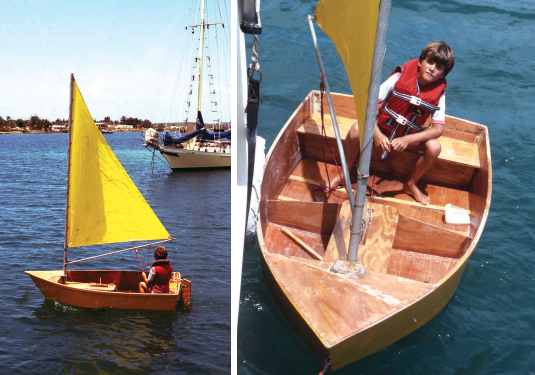
In our weary haze, we hadn’t properly considered the energy of children, nor the urgency with which they need to socialize after periods of isolation. Ben, a normally obedient lad, was tired, but couldn’t resist an invitation to play with his newfound mates on the buddy boat. While Patricia and I slept, he left his bunk, jumped into the empty dinghy, and cast off, forgetting that it was without oars, oarlocks, bailer, or any accoutrements whatsoever. He was suddenly alone in an empty shell scudding away with the trade wind.
On waking hours later, the sun by then drowning in a lumpy, gust-torn horizon, we were horrified to find Ben and the dinghy missing. Blind panic gripped us as we immediately started winching in the anchor cable to chase after him while trying not to think of how lonely and abandoned he must feel. Knowing Cuba was only 60 miles downwind offered no comfort to us at all.
With our sails rattling in anticipation of the anchor breaking out, Patricia heard a distant call and — for the first time in our panicked state — we looked across to our buddy boat where four lads were madly waving. The oldest of the Dinghy drama three boys there had seen Ben’s predicament and went after him in the inflatable. We were weak with relief and gratitude, but managed to mask our concern with a simple thanks and a mild rebuke to Ben for casting off in an empty dinghy. It was a reminder that parents only think their advice and warnings about life are seriously considered, forgetting that kids have their own priorities until they begin to absorb and appreciate the wisdom of their elders.
Passage weary
The core problem, of course, was me. I should have equipped the dinghy immediately after launching it or, considering the strong trade wind, hoisted it back aboard before joining our neighbors to clear customs. Exhaustion and an addled mind masked common sense to produce a situation that no parent ever wants to consider.
On our passage from Puerto Rico to Great Inagua, pyramiding waves had thrown Tientos, our 16-ton 47-foot ferrocement cutter, every which way for days on end. There was rarely enough wind to hoist any stabilizing sail and the engine had rebelled by shearing off two of its mounting bolts, thus restricting itself to idle speed. Into this mix were added periodic severe thunderstorms that further messed up an already unruly sea. I suspected we might have been on the outer fringes of a major storm system, and even wondered if this was normal when close to the fabled Bermuda Triangle.
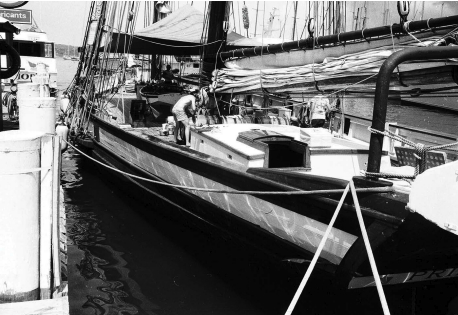
Tragically, part of my suspicion proved painfully correct. We later heard that the beautiful American replica, Pride of Baltimore, had foundered with the loss of four lives a little more than 200 miles northeast of our route. We had socialized with her crew in Gibraltar the previous October, so the news hit us hard. We found it doubly difficult to believe that such a large well-run sailing ship was really gone forever.
Because the edge of the same storm caused us nothing more than discomfort, we considered ourselves very lucky to have dodged the bullet, and to this day the fate of Pride of Baltimore still looms large as a stark reminder of how close we came to losing our son.
Alan Lucas, an Australian from New South Wales, has been cruising for more than 50 years, primarily south of the equator. In addition to many magazine articles, he has written 17 do-it-yourself books and six cruising guides.
Thank you to Sailrite Enterprises, Inc., for providing free access to back issues of Good Old Boat through intellectual property rights. Sailrite.com