Another candidate for the ‘perfect tender’ title
Issue 57 : Nov/Dec 2007
In the May 2003 issue of this magazine there was an interesting and informative article by Don Launer: “The Gentle Art of Rowing.” A sidebar mentioned Don’s British-built folding dinghy, which had served him well through two decades of use. The article provoked a great deal of reader interest, so this past summer I drove to Somerset, England, to visit the people who still make that boat.
Dinghies have to be a compromise between capacity and seaworthiness, weight and dimensions for stowage. Folders have their particular advantages and disadvantages contrasted, as they usually are, with infl atables. Folding dinghies tend to handle better but are ultimately less seaworthy. They’re faster to deploy but may be not as compact. They’re less buoyant but also less vulnerable to puncture.
Steve Rea, owner of the yard that makes the Seahopper folder, is an engineer who loves sailing. One day he sailed into a harbor where he saw the crew of a small sailboat assemble a folding dinghy on deck and row ashore. He was impressed by the idea with its engineering challenges but believed he could do better. Many of his clients since the 1970s, when he began to build and sell his own folders, would say he was right. I wanted to see for myself.
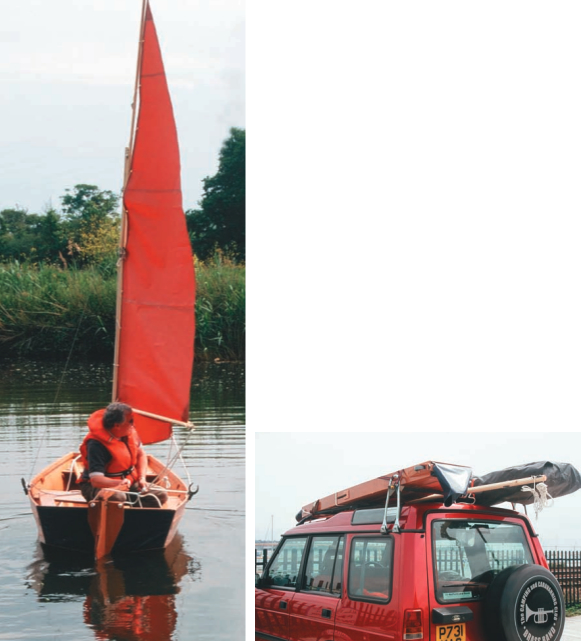
When I met Steve, he and a friend, Geoff, arrived in a four-by-four with an object on the roof that looked like an oversized gun case. This was the latest incarnation of Don Launer’s dinghy, reputed to row, motor, or sail. We went to the Exeter Canal, a rather charming stretch of waterway with barely a breath of wind, to test the boat’s sailing capability.
Taking shape
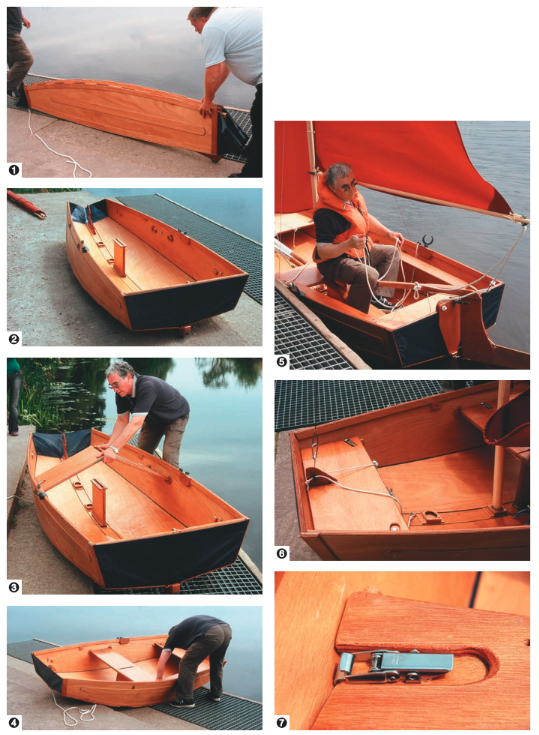
The gun case came off the roof and I reached for my camera. By the time I had fitted a lens, the little boat was taking shape so quickly that I had to ask them to fold it up again so I could see and photograph the initial stages.
A group of bystanders had formed, so impressive was the rapidity with which the little craft took shape. The two started again. This time I was ready. The “case” was set down as you might stand a briefcase hinge-down on the ground. Then the briefcase opened its two parts down flat like a butterfly’s wings, leaving a knee at the bow, a fixed daggerboard case, and a sternpost standing upright from a central keelson. Two inner boards hinged by fabric on their outer edges were then lifted to the vertical from the centerline — the body of the butterfly — declaring themselves as the side panels of a chined hull. The same stout fabric now closed off what would be the bow and stern transoms. The actual stern transom, two plywood panels hinged to the central wood sternpost, now folded outward and clipped to the side panels, while a loose panel was slid in place at the bow, each lending solidity to the ends ofthe boat.
In a matter of seconds, a fl at pack was becoming a pram dinghy. Seats at bow and stern, plus a rowing seat amidships, formed the sides to a curve. Side seats completed the job. These were held in by wing nuts; all other parts had been secured by over-center latches.
A set of mast and spars, contained within the length of the folded boat, were quickly and simply rigged with tanbark sails. The rudder was shipped and a daggerboard made ready. The little boat was wheeled along the pontoon by means of a small slip-wheel set into the stern-skeg, then lowered into the water. That wheel can also be used to wheel the folded boat along a hard surface, but would not function well on soft sand. A larger sand-wheel mounted to a board that fi ts into the daggerboard case is an option.
Easy to carry
Two people could easily carry this boat and — without the sailing rig — many would find it entirely possible to carry the boat singlehanded, especially when it’s folded. Of course, the boat can be carried to the water’s edge in its constituent parts to spread the load. As an exercise in ingenuity, it was impressive.
The time for assembly without haste was maybe 15 or 20 minutes, including delays while I took pictures or asked questions. I would estimate that, with practice, the boat could be unfolded and launched for rowing in less than five minutes.
An outboard bracket that permits a small outboard motor to be shipped, even under sail, is available, as are an optional tiller extension and a large spray hood mounted over a ridge and providing shelter to the forward sections of the craft.
These boats are available as a 6-foot 8-inch tender and a 10-foot pure sailing dinghy. The 10-footer is somewhat similar to the popular Mirror class dinghy and can, if required, be supplied with its own rig or ready to accept the Mirror mast, spars, and sailing rig, which may be an interesting proposition for those who own old Mirror dinghies now succumbing to the entropy of age but that still have a sound sailing rig. The dinghy featured in this article is the middle-size 7-foot 10-inch model, just like Don’s.
The timber in the boat is British Standard Specifi cation marine ply. The hull is 6-mm 5-ply, with 9-mm, 12-mm, and 15-mm 6-ply boards making up the transoms and seats that lend rigidity to the boat. The ply is gaboon, although other kinds can be supplied, if required, with appropriate cost adjustment. A half-round solid timber section can be fitted at the gunwale. One well-heeled client had a boat built entirely of teak with, it is rumored, gold oarlocks to match the general tenor of his classic yacht.
Down the hole
Steve is commendably taciturn with regard to celebrity customers, but lists the London City Council Sewer Department among his cherished clients. The folded boats can be passed down manholes swiftly enough to dodge the traffic and are dependable in an environment where you really would not want less than total leakproof reliability.
The standard of construction of the test boat is good, and all parts fit well. All fastenings are marine-grade with, I noticed, some very neat boat-nail clenching in the bottom boards. Standard fittings are to marine grade and made by Holt. The boards of the hull are precisely castellated along their mating edges for rigidity, while water ingress is prevented by the PVC membrane. This membrane, reinforced by an integral weave, is said to resist oil and solar degradation, a claim that would seem to be borne out by the longevity of these boats. It is also claimed that the material has memory, implying a degree of self-healing property such that a puncture hole may effectively shrink. The fabric is glued to the wood with a two-part adhesive.
The boats are normally finished in marine varnish and boat names can be added if required. It is possible to purchase unfinished boats in various stages; the purchaser may elect to do the paint or varnish finish or perhaps some of the construction work. This will usually be for reasons of particular finish, or enthusiasm, rather than to save costs, as the main hull is cut to critical tolerances and formed over molds, work that has to be done at the yard whether for finished boats or those completed at home.
Buoyancy is provided by means of internally anchored inflatable bags or an external gunwale-mounted inflatable fender. The sail rig, a basic gunter with foresail, is straightforward to rig and use. The test boat had two mast-step positions, one aft so the boat could be sailed with both sails, the other forward for mainsail only.
Very rigid
Aside from the rapidity of setting the boat up, two other features impressed me: the boat was a pretty craft and also very rigid. When we picked her up and lowered her into the water, she felt exactly like a non-folding dinghy, an impression enhanced by the fact that the PVC fabric was largely concealed by the ply. Steve explained that the robustness of these boats is a function of the high strength-to-weight ratio of marine plywood coupled with the natural spring and flexibility in the design. Common sense suggested to me that this would be so, yet I could detect no flex at all.
Geoff sailed her in virtually no breeze for the camera, then I had a try. I discovered that primary stability was reassuring and secondary stability, as the chine bit into the water, excellent. This would of course be even better with the inflated sponson fitted, generating even more stability. The boat is light and rides high in the water with transoms clear, her beamy design and easy deadrise lending stability.
I was luckier than Geoff and found my little voyage of discovery blessed with somewhat more of a zephyr, but not much more, so I heeled the boat to leeward anyway to set the sails to a curve to catch what there was and soon found steerageway. She answered her helm well and, in what were really quite challenging conditions for such a diminutive vessel, rewarded my efforts with the gift of an enjoyable sail.
She is a small boat, but by tender standards not too small. I would guess she could be rowed comfortably with two adults aboard, maybe even a third smaller person in sheltered conditions. At a push, two adults could sail her, depending on conditions, but one adult with a child or smaller adult would be more comfortable.
Freak wave
Several years ago, a mature couple were cruising the English channel when their vessel was inundated by a freak wave. They were attached by harness lines but had to release these as their boat was sinking rapidly. Then they spotted their little Seahopper floating by, still folded. They slid aboard and, without seats, used their bodies to brace the dinghy to a roughly unfolded shape. That buoyant little vessel kept them afloat in hard conditions for 15 hours until they were rescued. As courteous as they were courageous, they thanked Steve for saving their lives. Steve refitted the dinghy, which subsequently returned to service.
For serious sailing with two aboard, the 10-footer would be a better proposition, but the 7-foot 10-inch craft was surprisingly agile for a singlehander. Images of pleasant days spent in a light breeze exploring a sheltered anchorage or inlet came easily to mind.
This is exactly what I plan to do. When my current project boat nears completion I will follow in Don Launer’s wake and invest in a Seahopper. The folded boat will stow nicely alongside my companionway hatch exactly as it does in Don’s boat. In fact, I may just buy the boat a little sooner so I can keep my sailing hand in while working on the bigger ship. I hesitate for one reason only: that I would not be able to resist sailing that pretty little dinghy around the creek when I should be working on Gwendoline.
Geoffrey Toye, a writer and journalist, lives in a beach house in Wales and has been involved with small craft for more than 40 years. Good Old Boat has produced an audiobook version of his novel, Telegram from the Palace, a work of sailing fiction full of conspiracy and intrigue.
Thank you to Sailrite Enterprises, Inc., for providing free access to back issues of Good Old Boat through intellectual property rights. Sailrite.com