Searching for the Holy Grail of yacht tenders
Issue 57 : Nov/Dec 2007
It all started 11 years ago, three months before our wedding, when we bought our first home, a 1968 Islander 37. My husband, Frank, is French and suggested we name her Bille en Tête, which, very loosely translated from the French, means “hard-headed,” a trait we are a little guilty of. Our hard-headed woman provided us affordable housing in Los Angeles with built-in exotic vacations to boot.
And while she’s a good old boat, I have come to believe that the real pleasure of the sailing life depends mainly on the character of your tender. I suppose if we were cruising the Seven Seas, I’d be less concerned about our tender and obsessing more about things like watertight bulkheads, carbon-fiber masts, and an aft cabin, but Bille en Tête does nicely for one- to 12- week trips, leaving me to obsess about our tender.
The selection of a tender is a very personal thing with a plethora of features and factors to weigh. If we had stopped to consider life with our first dinghy, we may never have come to any agreement, but ignorance is bliss and love forgives much. Only one thing mattered to us both: we entered matrimony with a common hatred for the outboard. We are, after all, sailors (not motorers). L.A. has enough smog as it is; one less two-stroke smog hazard would be our contribution to environmental health. Frank had sworn off outboards after years of fighting, greasing, and coaxing them into submission. This started with the first outboard he found on a derelict dinghy far out at sea while sailing with his dad in the Mediterranean. It had been submerged and, like any 13-year-old, he relished tearing it apart piece by piece and putting it back together. I can picture the joy and amazement on a young Frank’s face when it first started up.
Summer project
Youth quickly forgets the fact that the outboard ran only intermittently. To him it seemed no more cantankerous than his dad, and it provided a fascinating summer project to learn all there was to know about how engines function (and stall). After 17 years of fixing outboards, the thrill of discovery was gone. Frank would no longer tolerate anything more cantankerous than himself on board. Fixing outboards no longer felt like a pleasurable way to spend a shortened summer vacation.
To add injury to insult, over the years he’s seen the chaos and maiming an outboard can cause: a dinghy zipping away, leaving a captain in its wake; a skipper with missing fingers; a kid with a mangled foot; and other heinous crimes. He hates having gasoline on board. He hates wrestling outboards over the rail. And I hate the thought of them giving up after you’ve motored farther away than you can paddle back. John Steinbeck regretted not “ridding the world of a mechanical cancer,” his “Seacow . . . who loved no one, trusted no one, and had no friends.” Frank would argue that it’s a genetic disease that afflicts all outboards.
Our distaste for outboards does present the interesting challenge of what to do for suitable ship-to-shore transportation. Without an outboard, an inflatable dinghy is too easily swept away with the wind; rowing even a hard-bottomed inflatable is a fair-weather sport. And a true rowing dory would never stow well on a 37-foot sloop. A 60-foot schooner to go with the dory was not in our budget.
Generous contributions
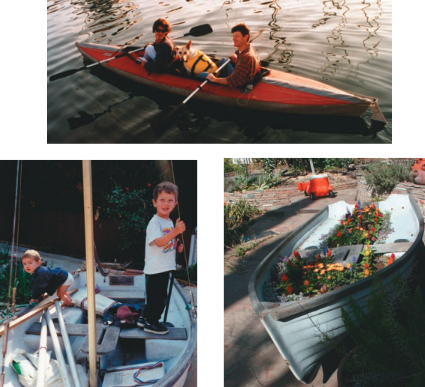
As newlyweds, we met this challenge with verve and quickly agreed that a two-person sea kayak would do nicely. With the generous wedding contributions of relatives we purchased our first tender, a Folbot folding tandem kayak (65 pounds). We named her Le Paradis. This was the ultimate tender for a newlywed couple: easy to stow, 20 minutes to build, a solid, swift, red Cadillac of a kayak with a thick rubber gray interior. With two 30-year-young paddling engines, we often passed by smaller outboards with a smug smile and a nod.
We could circumnavigate Santa Barbara Island in two hours (could, that is, except for the spectacular elephant seal and sea lion rookeries that often held us captivated for hours, making the trip a full-day adventure). We’d jet from the anchorage around the point to the nearest rookery, then sit with binoculars staring at the drama on the beach for hours, until the sun moved to a less comfortable position. Then we’d zip around to the shade of the next point, surfing a few large swells, stretching our arms a bit along the way, and settling in the nearest kelp bed to anchor us for a few more hours of seal watching.
There we witnessed large males battling in tooth-to-tooth combat, mothers nursing pups, preteens playing ding-dong-ditch-’em with our kayak. There was ample room for a couple jugs of water, fishing gear, a loaf of bread, some Wasabi (hard bread), and a bottle of wine. Survival at sea was never better.
Our Folbot was wide and steady, inspiring confidence in me to continue to clamber in and out all the way up to my eighth month of pregnancy. We tested her with a 65-pound Labrador mix and decided there’d be ample room for growing human kids. When that first precious little package came along, he was amazingly light (8 pounds 9 ounces) and easy to lower down into the kayak by the handy life-jacket handle behind his head. Tightly zipped up, snoozing for hours. Inches from his food source, he was content (no Wasabi for him).
Mangrove swamps
The Folbot charmed our socks off during a three-month trip we took down the outer coast of Baja into the Sea of Cortez. We discovered hundreds of mangrove swamps on our first stop along the outer coast in Bahia Magdalena. These snaking, lush green, shady labyrinths are wide at the entrance and grow narrower with every switch-back and turn. Sometimes we’d push on until even our slim craft could go no farther. We’d sit quietly waiting for the dryads and water nymphs to bring us a magical shrinking potion, but only sand dabs appeared, so we’d leave the discovery of the end to smaller creatures. Other times the mangroves would grow sparse, giving longer and longer glimpses of a desert landscape beyond, past the lush green bushes on to a finale of blazing white sand dunes. No other vessel is so well suited to the task of exploring tidal mangrove thickets.
Our kayak served equally well in the Sea of Cortez. We found her quite accommodating to the task of provisioning the boat with food, supplies, and visitors. We discovered that in a pinch (literally), we could squeeze four adults into the two seats, provided they had been well lubricated with margaritas.
Paradise was lost December 24, 1997. We’d sailed to Catalina Island, my father following in our wake in his Noble 45. Both boats were filled with food, friends, family, and presents. All were unloaded in Avalon and carted up the street to a rented house (with a large oven) that could accommodate our extended crew. We had a rollicking round of Pirates’ Christmas. Frank had prepared a magnificent Christmas Eve feast. Before serving it up, my dad stepped outside, took a deep breath of warm, dry, evening air and, like any seasoned Southern California sailor, he panicked. Hot and dry in December is not a thing to be reveled in when moored or anchored on the east side of the island. It meant one thing to us. The wrong Santa had arrived: Santa Ana!
Pregnant again
He grabbed his wife, my brother, Frank, and a good friend to go save the two boats. I was pregnant once again (seven months) and stayed in the comfy condo with the now 2-year-old, so I can’t tell the remainder of the story firsthand. Apparently, when they arrived at the dinghy dock, it had already departed. At the first sign of Santa Ana winds, the pontoon is normally towed in the lee of the jetty at the mouth of the harbor, dinghies and all. The harbormaster personally escorted the fleeing (hungry) pirates to their boats, through waves that were now breaking at the second row of mooring cans. They spent a long sleepless night fighting their way around to the rugged backside of the island. They hove to at sea, waiting for daybreak to pull in to Cat Harbor and set the hook. At the time, we were all Luddites, with no cell phones in our possession. I’m told they ate a hearty pancake breakfast and slept the day away in the warm sunshine. I don’t think they dreamed of the treasures they’d left behind.
Meanwhile back in Avalon, the winds had died down but the sea had not. Huge breakers were crashing against the pier where the dinghy dock had been. I worried, as only a pregnant mother can, about my husband, brother, and father all lost at sea . . . and me a sorry widow (they had more than 90 years of sea time between them and had all battled far worse conditions, but there’s no reasoning with those powerful hormones). A walk around the harbor did little to allay my fears; there we found the tattered remains of our kayak. She was crushed, squished like a banana, only recognizable by a single bent and broken aluminum support, with a bit of red canvas flapping in the Christmas wind, reaching desperately out of the water between the battered rails of two hard dinghies. Luckily, she was the only one lost at sea that night.
Reserve tender
After this loss, we tried a short stint with a fiberglass sailing/rowing dinghy. At 9 feet, she fit on the cabintop. She had a checkered past, once the tender Cloud to the sailboat Silver Lining, she had a pretty face and a wicked temper. We called her Dark Cloud. She loved to sink in the surf and to flatten fingers, and she had a nasty tendency to capsize, even in light winds. In her defense, she was never really intended as a family boat. We gave in to her love for the bottom and filled her with water, then later sand, in our backyard. She was a much kinder grandmother to the kids as kiddy pool and sandbox. This year she made a pretty little raised flowerbed.
Next came the Mother of all Tenders or the Tender for all Mothers. Frank immediately took action. Realizing that I was reluctant to go to sea with two babies, he knew the answer to continued happy sea days was a secure and worry-free mother. He immediately set to work on a tender replacement project. With some software from Plyboats, he passed the rainy days of February conceiving the ultimate tender. Length gives you speed, width gives you stability. The challenge: how to stow it. He’d often looked wistfully at all that wasted space on the foredeck of our Islander; he now had a plan to fill the 12 feet between the mast and the windlass. He decided on a removable transom so the dinghy would fit up over the top of our cabinhouse. He designed her so a mother carrying two babies could stand on the rail without tipping her over. Without the transom she could also serve as a diving platform.
Big garage
Meanwhile I was scouring the classified ads for houses within a 20-minute drive of my job in West L.A. . . . one with a big garage for boat construction projects. Kid Number Two arrived March 1, 1998 (9 pounds 5 ounces . . . looking at the trend there, we decided to stop while we were ahead).
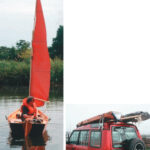
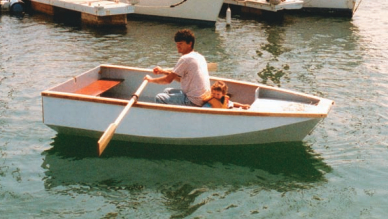
The tender, built on deck, was complete two weeks later (at 200 pounds, a bit heavier than the Folbot). She was 12 by 5 feet, not too fast, very stable . . . what more could a mother ask? The Barge was born (see photo on Page 82). I could stand on the rail with both kids (with one in a front pack to free a hand for stability). She could be slowly rowed or sailed, but with lots of patience. As new parents, we were gaining a new respect for the quality of patience and, for a while, we were satisfied.
With all that room, the kids could run from side to side counting garibaldi damselfish; we could all lean over one side for an especially interesting sighting, like a flatfish skittering on the bottom. But our adventuresome days of circumnavigating islands and exploring the long channels of mangrove swamps were over. Just rounding the first point at Santa Barbara Island to watch the sea lions took a lot of back muscles and time. Yet the Barge seemed the perfect playpen for toddlers. They did not have the attention span to appreciate a grand circumnavigation anyway. The darting fish below and the curious preteen sea lions following kept them entertained.
The Barge was a brave boat. It was on the occasion of another surprise attack of the dreaded Santa Ana winds that, in her transomless configuration, she saved our stern anchor from the breakers. Frank used the anchor line to pull the Barge through the breakers, lifted the stern anchor off the bottom, and rowed like hell back to our boat. Too windy to hoist back on deck, she followed like a dream all the way back to Long Beach, dancing the tops of the waves like a skittering coot, shaking any water off her back when whitecaps washed her prow.
Rolled under dinghy
We had proved her unsinkable, but unfortunately the kids were not. This we learned a couple summers back on Santa Rosa Island when Kid Number Two, eager to feel the sand between his toes, jumped a little early and a 3-foot wave rolled him under the dinghy. Luckily, he came up laughing. But Frank and I gave each other the big round-eyed look as we tugged the Barge up the beach. Suddenly she seemed even heavier than ever. As the boys grew older and their attention span longer, running from side to side was not enough fun. They wanted the boat to go faster. The nice, stable, solid, leisurely playpen faded into a too heavy, too boring, sea slug.
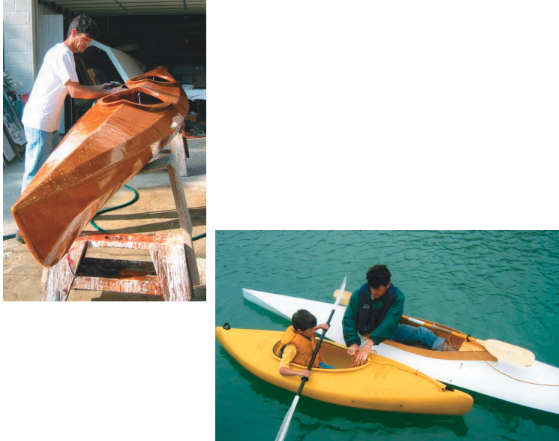
In memory of the happy days zipping about in the Folbot, Frank designed a sleek, thin, one-person kayak in the origami style, using a very thin fiber-glass sheathing filled with foam. The Gull is big enough (or rather Frank’s French posterior is skinny enough) to carry him with one well-placed 5- to 8-year-old in his lap. For a while, this worked quite well. The need for speed and adventure (and escape) could be assuaged for one or two of us at a time. It provided quality time . . . one-on-one with dad, a chance to hold cabin fever at bay . . . and it kept brotherly love between the two boys alive for a few extra hours each day. The old Barge was always available as a solid swimstep, landing craft, and salvaging platform.
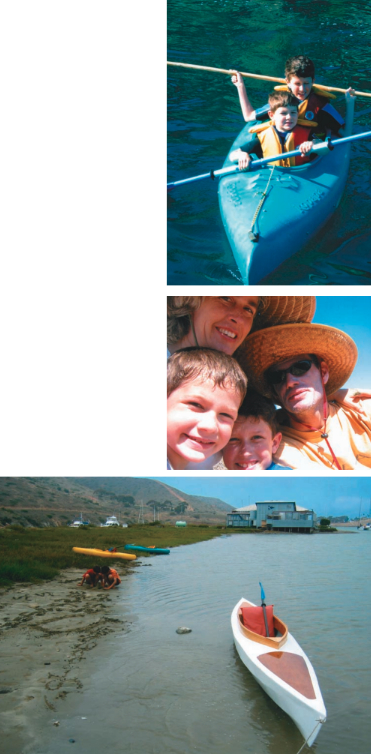
Last Christmas we added two used short-and-broad Tupperware kayaks to our collection (Ducky and Froggy in honor of their colors and behavior on the water). We thought they’d be fun for the kids to mess about in. The boys actually did pretty well at paddling in perfectly calm weather the short distance to the shallow well-protected muddy beach in Cat Harbor. The kayaks qualify only as toy tenders, but practice will make perfect.
New dilemma
As I write this, the 8-year-old will soon be nine. And while he does have his father’s build, and while the Gull’s width still accommodates their spiny arses, she will not house the rapidly expanding length of leg. Perhaps one triple kayak would suffice for the next two to three years, with the two kids in each other’s laps in the middle. How long would the 6- and 8-year-old last in the same hole? How many years or how many hours . . . another dead end. Dinnertime conversation turned toward two tandem kayaks. Frank already has them named Endeavor and Discovery. I think it might be unlucky to name them prematurely.
As a practice run, Frank made a two-person plywood Pygmy Boat kit kayak as a wedding present for some good friends. We tried her out for a couple of trips to Catalina and Santa Barbara Island. She is beautiful and we’re jealous of the newlyweds. Since we fabricated our own envy, we’ll just have to fabricate a way out of it. But before we expend all that sweat and money, I have to stop and ask, will that solution really meet our needs? She’s almost too pretty to mess about in. And how long would this solution last? One of my joys of going in tandem is the freedom to stop paddling now and then, knowing that my mate will pick up the slack for a little while and we’ll still be making progress. The boys have turned this into an art form. One mother paddling a two-person kayak is quite a slog. My only hope is that as my arms give out, the boys will grow into strapping paddlers to take up the slack.
Tentative step
The newlyweds took delivery of their gift, forcing Frank to take a tentative step toward our own tandem solution. He designed a 1.5-person kayak dubbed Pelican, expanding our flotilla to four kayaks. Pelican is more stable and roomy than Gull, which results in compromised speed. But she’s easier than a tandem with a sightseer in the front seat.
By now you may be wondering how many dinghies a boat can hold . . . more than I thought, that’s for sure. Bille en Tête is quite a picture sailing into an anchorage with the four kayaks on deck. The main victim is our requisite and delightful spinnaker run home. With all those tenders on deck, we’re loath to fly it since the pole is stowed at the bottom of the pile. Realistically, our current state will last only another year or two. Time to commit to a new solution and reduce our fleet to two tandems. By the time they’re built, the boys will be more active participants in the paddling task.
So what are the downsides of having two kayaks? Our backyard looks like a boatyard, I expect the zoning department to knock any day. Frank does not really need a new project of this size (we also own a home now that has its own thirsty projects). Kayaks don’t make very good dive boats and the kelp forests around here are spectacular. Soon the boys will want more independence and speed. They’ll be old enough to build their own kayaks or find their own outboard floating in the ocean. Ah, the pursuit of tender bliss keeps our minds sharp and our muscles tuned.
The only constant is change and plus ça change, plus c’est la même chose. A new tender every year and the same old question every year: “What’s next?”
Margo Reveil is a building architect working in Los Angeles to fill the cruising kitty. She’s been sailing since the age of three. She, her husband, and two boys (now 9 and 12) collectively have 100 years of sailing experience. They lived aboard for four years, then moved ashore when the younger son was born.
Thank you to Sailrite Enterprises, Inc., for providing free access to back issues of Good Old Boat through intellectual property rights. Sailrite.com