Issue 34: Jan/Feb 2004
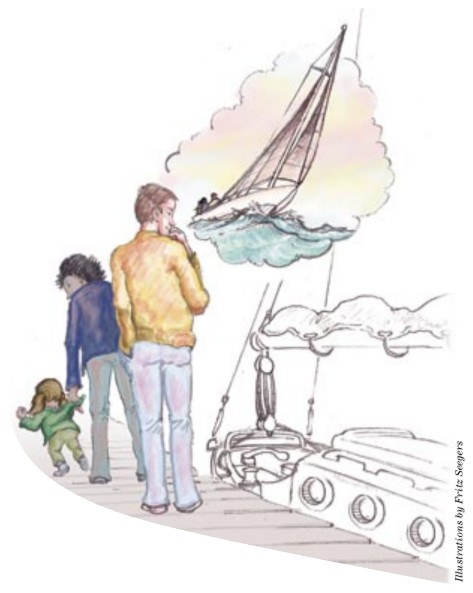
I REMEMBER EXACTLY WHEN IT ALL started. I was standing on a dock in Coeur d’Alene, Idaho, looking at a lonely sailboat. A light breeze tapped the halyards against the mast and gently rocked her in her slip. My 2-year-old daughter toddled precariously over the water while my wife held the hood of her sweatshirt like a lifeline.
It was a cool May morning. Low clouds hung over the lake waiting for the sun. It was a strange place to find a sailboat, landlocked at the foot of the Bitterroot Mountains on this beautiful, calm lake. But why not? I looked at the long, graceful lines of the boat. I imagined the sound of the sails filling with air, the winches grinding, the boat beginning to heel, the waves slapping the bow. The dream began quietly.
One and a half years later, we were in Port Ludlow, Washington, chasing dreams. We were aboard a dirty, neglected little sloop with drooping lifelines and tired sails. Mussel shells littered the deck. The docklines were nearly chafed through. The mainsheet was sun-bleached and brittle. A winch was missing from the cabintop with only a broken chunk of plastic remaining. Barnacles hung from the rudder. The brightwork was awash in peeling varnish. I didn’t even know where to begin. This boat hadn’t left the dock in years.
“It looked a lot cleaner in the pictures,” my wife said, inspecting the thick green slime clogging the cockpit drains.
I had my clipboard, my flashlight, and my screwdriver. I had Don Casey’s book, Inspecting the Aging Sailboat. I had my checklist. I had no idea what I was doing. It was like trying to inspect the Titanic after it had already gone down.
Forgotten dream
This boat was too much like the others — another forgotten dream, left to rot at the dock. We were disappointed. I was beginning to wonder if this was a good idea, buying a boat. So far it looked more like a project than a pastime.
But the seed that was planted at that dock in Coeur d’Alene was nourished by sailing magazines and trips to the lake. The idea was still vague, though. It was like trying to make out a distant object in the fog. Then I picked up a copy of Cruising in Seraffyn, by Lin and Larry Pardey, and read it in one day. I told my wife, “If you don’t want to buy a sailboat after you read this book, I’ll never mention it again.”
But she was hooked too, and the idea began to take shape. We set goals. We made a plan: in 10 years we’d gain enough experience and save enough money to sail for a year. Pipe dream? Maybe. But it changed the way we thought. We restructured our lives around the Plan. It became the measure for all other decisions. A bigger house? A new car? Cable TV? Every decision was measured against the Plan.
The first step was getting some experience. We live about an hour from Montana’s Flathead Lake, the largest natural freshwater lake west of the Mississippi. There are an active sailing community and ample racing and cruising opportunities. It was the perfect way to get our feet wet. We haunted the marinas and wandered the docks. We rented, crewed, chatted, and hitched rides. We took notes, made lists, and compared opinions. We read books, studied magazines, and surfed the Internet.
Learning on someone else’s boat is valuable experience. But eventually the need to call for that critical sail change, make that key tack, choose to lay anchor, or just decide to go home overpowers the need to learn under the steady hand of an experienced sailor. Eventually, you need your own boat.
Intimidating task
Buying a boat is wildly intimidating — there are hundreds of used fiberglass sailboats to choose from. We wanted the perfect boat: something well built and seaworthy, comfortable but still respectable around the buoys, safe for a small child, manageable on a trailer, something we could afford. Throw in a thousand different opinions, brokers, delamination, dry rot, blisters, bottom paint, cored hulls, engines, and trailers, and the task becomes a considerable challenge.
First of all, there is no perfect boat. It’s more like the perfect compromise. My wife swooned over spacious cabins while I pointed out dumpy lines. I drooled over swept-back racing rigs while my wife pointed out the lack of a head. Slowly, as we refined our expectations — compromising speed for amenity, age for affordability — one boat emerged as the right boat for us.
And she happened to be for sale! She had a nice roomy cockpit, good lines, a workable sail plan, a comfortable cabin, a head, a small galley, and a trailer. But there were problems, too. She had an older inboard gas saildrive — which ran fine, as long as you cleaned the soot off the spark plugs, according to the owner — but there was no alternator to charge the battery.
The price seemed high, but it was August, and the owner was making payments on a new, larger boat. If she was still for sale come Labor Day, he’d be motivated, and we’d be ready to make an offer.
Too late
A week before Labor Day he sold the boat. I kicked myself for not pulling the trigger. I felt like we’d missed a good opportunity. But my wife reminded me that I’d be glad I didn’t have that old two-stroke stinking up my cabin.
We expanded our search, and on a cool October morning, we set off for Seattle, nearly 600 miles from home. The boats we saw resembled the dream in form, but failed to deliver in person. The brokers were excited to sell us a sailboat, but not about the idea of sailing. One told us he didn’t even own a boat anymore — he was going into telecommunications just as soon as he could clear out his inventory. Another asked us confidently, “How much would you like to offer?” after she wouldn’t let us raise the sails or start the motor on the rough-looking boat at her dock.
(A word to brokers: buying a sailboat is about passion. No one needs a sailboat. I’m not buying a car. Humor me. Feed the dream. I want to see myself cutting across the bay on a setting sun. If the dream is gone for you, I don’t want to know about it.)
The last boat on our list was in Port Townsend, on the tip of the Olympic Peninsula. We crossed the Tacoma Narrows bridge and headed north through a light rain. The freeway dwindled to a two-lane road, and we passed through farm fields with signs for pumpkins and “u-pick-em” corn.
Try back later
An hour outside Port Townsend, I called ahead to the broker’s office.
“Did Ray know you were coming?” the guy in the office asked.
“Yes, I talked to him a few days ago. He said he’d be around.”
“He’s off launching a boat,” he said. “Should be back soon. Why don’t you try back in an hour.”
“Who’s this?”
“Tim.”
“We drove all the way from Montana to see this boat, Tim.”
“Right. That’s a long way.”
“Maybe you could show us the boat?” I asked.
“Ray usually handles the boats.”
An hour later, there was still no sign of the broker. We found Tim outside the office feeding a sandwich to the gulls. I asked him again to show us the boat. We had to head home the next day. It seemed a shame to come all this way and not to see the boat. Tim finally ad- mitted that he didn’t actually know where the boat was, but he did offer to call the owner.
After another hour, all he’d managed was a slip number: C58.
“Which marina?” I asked.
“Don’t know, just said Port Ludlow.”
Called again
It was getting late, so we found a place to stay and would try the broker in the morning. We opted for a nice meal and $10 campsite over an $85 hotel room. In the morning, I called the office again. It was Sunday, and now nobody was answering the phone. I left a message for Ray. I told him I had a pocketful of money and was hot to buy a boat, but if I didn’t hear from him by the time I finished breakfast, I was going back to Montana forever.
We finished breakfast and headed for Kingston to get the ferry. I was angry at being stood up by the broker, and I was angry that none of the boats we’d seen warranted an offer. It would be a long drive home.
“There’s Port Ludlow,” my wife stated matter-of-factly as we passed a road sign pointing left.
“Should we try it?” I asked. “Maybe we can find the boat.”
I turned around and drove back to the turnoff. Port Ludlow is a tidy little resort community tucked into the trees. A sign proclaims: “The Village in the Woods by the Bay.” The only commercial activity, aside from a gas station, is a large new marina.
We found our way on to the dock and walked out to C58. The boat was there, with a blue Bluewater Marine sign and a fresh coating of bird droppings on the deck.
We went through the motions, filling out my checklist, inspecting every part of the boat, hoping that if the price were low enough, this could somehow be a good deal. But it was not. I could feel it right in the bottom of my stomach: that nebulous void that take the things you love and makes you hate them. I could see the black hole near the bilge that would swallow years of my life and piles of my money.
End of a dream
This boat was where dreams end, where the money ran out, the marriage broke up, or the tumor became malignant. It made me sad, because somewhere, sometime, this boat was loved. It represented the same hopes and dreams we were having … the same dreams that seem so fresh and alive. Dreams of a simpler, less ordinary kind of life, measured in quality instead of quantity.
I wondered if this boat had any of the dream left in it.
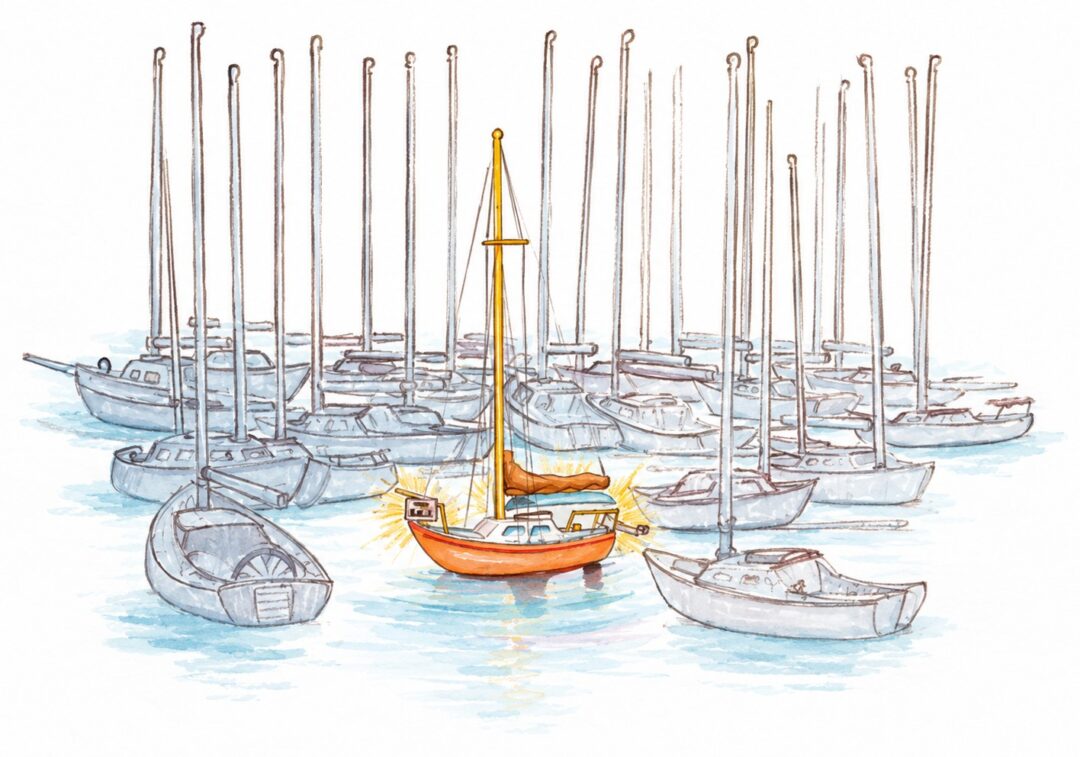
We started back to the car. My eyes scanned the rows of boats — other people’s dreams — lined up in their slips. My eyes rested on a tidy sloop with beige topsides and a maroon stripe. It was the same kind of boat we were looking for.
I stopped.
There she was.
It was like walking into a wall. Her deck was clean. She had crisp, tan sailcovers and tidy new docklines. A four-stroke outboard hung neatly from her stern. Her hull was sleek. The rigging was fresh. The lifelines were stout. Bright new halyards ran down the mast, and a little red “For Sale” sign was wired to the bow pulpit.
“Should I call?” my wife said.
“Yes, call,” I replied and realized my throat was dry.
Five minutes later we were aboard was the owner. We sat in the cockpit and talked like friends. For the next hours, he patiently answered our questions and shared his stories of 12 good years with the boat. She warmed as he talked, the teak glowed, the lines were supple and clean.
All the gear
She had new sails, an autopilot, a Bimini, cockpit cushions, a cockpit table, a wind chute for the forward hatch, an extension to make the double bed a little wider, and a custom icebox built for the Sea of Cortez.
“You had her on the Sea of Cortez?”
“Three times.”
A friend had told me, “You’ll know when you find the right boat.”
This was the one.
The only thing we hadn’t discussed was price. I was afraid to ask. She would be out of our range — she had to be. She was too clean, too well maintained. The sails were too new. There were too many extras. There was no way we could afford her.
I asked, braced for disappointment, “What are you asking for her?”
He answered without hesitation. The other shoe never dropped. His price was fair.
I met my wife’s eyes. We tried not to smile, but inside we were jumping up and down. He sensed it, I think, because he asked, “Do you have time for a sail?”
There is always time for a sail.
Thank you to Sailrite Enterprises, Inc., for providing free access to back issues of Good Old Boat through intellectual property rights. Sailrite.com