An inexpensive and economical cruiser/racer
Issue 63 : Nov/Dec 2008
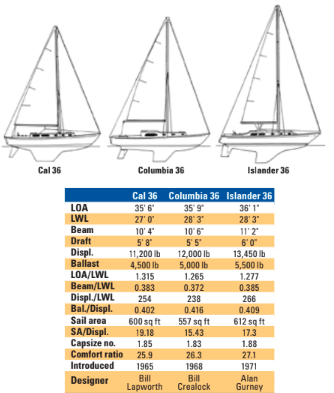
After the success of the revolutionary fin-hull/spade-rudder Cal 40 in 1963, it was inevitable that Bill Lapworth would create similar designs in other sizes to meet the demands of Jensen Marine, the Cal 40’s builder, as well as those of the sailors who wanted to win races. It was equally inevitable that other builders would produce fin-keel production yachts in competition for the growing market. The three designs compared here are all California-built, as the yachtsmen of that state were the first to widely accept the fin for distance racing. The Eastern establishment was harder to wean away from the full-keel and keel/centerboard hull, but it slowly came around as the Cal 40 and other fin-keel yachts proved their worth in race after race.
The Cal and Columbia 36s were both designed by Californians, but the Islander was from the board of Alan Gurney, a young Scottish designer who also created the magnificent 73-foot ketch, Windward Passage, which set many records in her day. In any case, the three boats are quite different from each other, although all were developed as cruiser/racers at three-year intervals during the same general period.
Off the wind, the Cal 36, having the highest sail area/displacement ratio, should come into her own. The Cal 36 has a very clean underbody profile, but her fin is fairly long and the lateral plane area is generous by today’s standards. The Islander’s fin is shorter, slightly deeper, more shark-like, and of smaller area. She is the only boat of the three with a skeg-hung rudder, although the Columbia’s spade rudder is fitted below a shallow skeg. I came across another drawing of the Columbia that showed an unusual scimitar-shaped fin some 400 pounds lighter than the squared-off fin in the sketch. It seems the scimitar fin may have been a patented type by another designer, over Bill Crealock’s objections, and the return to a more conventional fin was done to improve performance.
All three of these boats will perform admirably, but I would have to give the Islander an edge in windward ability. Her taller rig with its much higher-aspect-ratio mainsail will go a long way to make up for her sail area/displacement ratio. In addition, her extra beam and displacement will increase her stability and, with her efficient fin, will add to her weatherly qualities. The Columbia 36 appears to be quite under-canvassed in comparison with the others. That is a result of her small mainsail, some 52 square feet smaller than the Cal 36’s main, although both rigs have about the same mast height. This may be the result of the influence of the Cruising Club of America rule of that era and will not affect the yacht’s usefulness as a cruiser. However, it could well reduce her chances in club racing, particularly in lighter air.
Off the wind, the Cal 36’s big 304-square-foot mainsail will help make up for the Islander’s larger foretriangle. Also, the Cal’s clean underbody, without skeg or bustle, will let her get up and surf when the breeze is favorable. An around-the-buoys race between these two yachts would be very interesting indeed and, in my opinion, would be decided by the skill of the rival skippers and crews, the breeze that day, and the usual luck of the game. None of these three yachts will prove a serious contender against modern ocean racers, but both the Cal and Islander could provide a great deal of fun and competition for local club and area events.
Any one of the three yachts will give her lucky owners a great deal of pleasure as a relatively inexpensive and economical cruiser within the limitations of their accommodations. The Columbia 36’s arrangement, with the chart table up forward across from the head, may be a bit unhandy at times but the other two boats have fairly straightforward, late-1960s layouts. As well, all three yachts come up with a reasonable comfort ratio for their size and a reassuring capsize number. Given a thorough going-over by a competent marine surveyor, and a refit as required, any of the yachts will prove to be capable of comfortable coastal cruising — and even adventurous bluewater voyages — in the hands of a competent skipper.
Ted Brewer is a contributing editor with Good Old Boat and one of North America’s best-known yacht designers, having worked on America’s Cup boats, as well as boats that won the Olympics, the Gold Cup, and dozens of celebrated ocean races. He also is the man who designed scores of good old boats . . . the ones still sailing after all these years.
Thank you to Sailrite Enterprises, Inc., for providing free access to back issues of Good Old Boat through intellectual property rights. Sailrite.com