One man’s workboat has become a gem
Issue 63 : Nov/Dec 2008
Jim Mumper found two of the most significant things in his life in a bar: his wife, Linda, and his career. While we can’t recommend this practice for everyone, visiting a bar on occasion certainly worked well for Jim. Their children are significant, of course, but the stork brought them.
And then there are boats. Sailboats play a significant role in Jim’s life and played a defining role almost as soon as he discovered wind power. From his teens and onward, Jim has been messing about in boats.
A southeastern Pennsylvania boy, Jim always had a love for the water and was building and captaining log rafts at an early age. During his high school years, a friend —another Jim — from Annapolis invited him to visit. “Come on down, my dad has a boat” may very well have been the sentence that changed Jim’s life.
“That was it,” Jim recalls. “Sailing bit somehow. I liked the rigging, the boats, the wind, and the water.” College and time in the service intervened, but once Jim was free of these obligations, his life compass pointed toward Annapolis, where he and his family continue to live.
When he moved to Annapolis as a young man, he bought a 24-foot Rainbow and became an instructor in the early days of Jerry Wood’s Annapolis Sailing School. After founding the sailing school, Jerry Wood and his wife, Cathy, also founded the United States Sailboat Show, more commonly known as the Annapolis Sailboat Show.
Jobs with sailing focus
Working for Jerry Wood and his sailing school in the mid-1970s was an opportunity like none other for a young person, in terms of growth and experience. Jim recalls: “Jerry and Cathy were good mentors. Jerry was also building the Rainbows, which had been commissioned from Sparkman & Stephens. He put young people in charge of the school and the yard. He gave them leadership responsibilities at an early age.”
Jim’s uncle was a product rep, and Jim decided he’d like to represent marine equipment lines. With that goal in mind, he next went to work at Fawcett’s Boat Supplies in downtown Annapolis. He was working there, but not sure retail was for him, when he met a friend in a bar who told him that the U.S. Naval Academy in Annapolis was looking for a civilian to manage its sail-training craft. He got that tip 26 years ago and has been on the job with the Academy ever since.
“I’m working with the Academy’s sailing fleet — 20 McCurdy & Rhodes 44s, Colgate 26s, IRC raceboats, 420s, Lasers — plus the Academy’s powerboat fleet,” Jim says. It’s a dream job if you like messing about in boats.” This position has enabled Jim to make deliveries and ocean crossings and to participate in several Annapolis-to-Bermuda races. After Dodge Morgan donated American Promise (in which Dodge circumnavigated) to the Naval Academy, Jim was among a group of 12 who sailed her to Dartmouth, England, as a training voyage for midshipmen. Another group of midshipmen and experienced sailors brought the boat home to Annapolis. Each crossing took about 20 days.
In the mid-1970s, Jim met Linda (in a bar, remember) and they sailed the Rainbow on the Chesapeake Bay. “This first boat, Diamond in the Rough, was our dating boat,” Jim says. They were married in 1979 and the Rainbow was sold soon afterward. Another defining moment that any sailor would remember fondly was the time when Jim was struggling — in the small cabin of the Rainbow with no standing headroom — to zip up the back of Linda’s dress so they could attend the Oxford Regatta dance. He tells the story often and with great relish, “It’s a big day when your wife turns to you and says, ‘Honey, we need a bigger boat.’”
Time for a bigger boat
The following year they found a Cal 29 to their liking. This boat was Diamond in the Rough II. This Cal was actively raced and cheerfully cruised for 15 years as their children — Sally and Jimmy — grew up. During this time another larger Cal caught their eye. “We saw a Cal 36 in the southern end of the bay,” Jim says. “I left a note on the boat telling the owner of our interest if he ever wanted to sell it . . .”
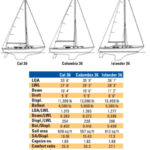
Fast-forward a couple more years. Jim finds a 1968 Cal 36 — a real fixer-upper boat — and buys it in 1994. He spends a year fixing it up and launches it the following July. During that time Jim is seldom home, as the project boat steals his time after work. Once he’s fully committed to this particular fixer-upper, the fellow with the boat that turned their heads to begin with gets in touch to tell them he’s now ready to sell the boat. Worse, he is asking less than the fixer-upper cost! But it’s too late. Jim is too far down the road with the project boat to turn back.
“I put another 10- to 12-grands’ worth of materials into this boat,” Jim recalls. He added a new roller furler, three new sails, and new cushions. It had a structurally sound hull and there was no delamination, but it was cosmetically and mechanically bad. “Everything was mildewed. Paint was flaking. The systems were worn out: engine, plumbing, wiring . . . basically, I bought the hull and mast.”
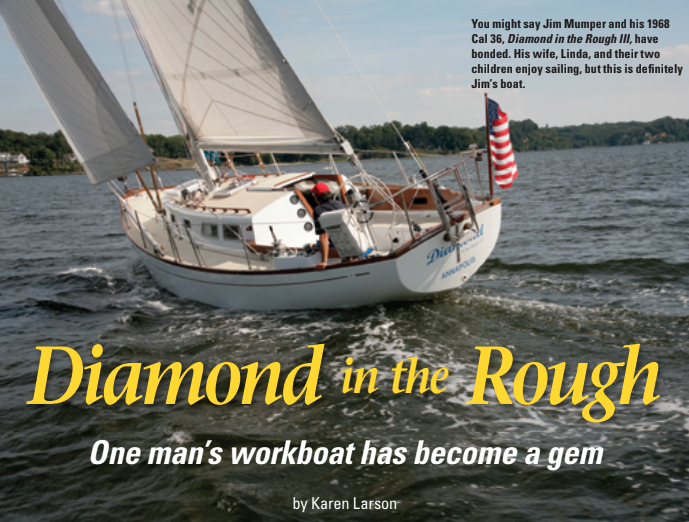
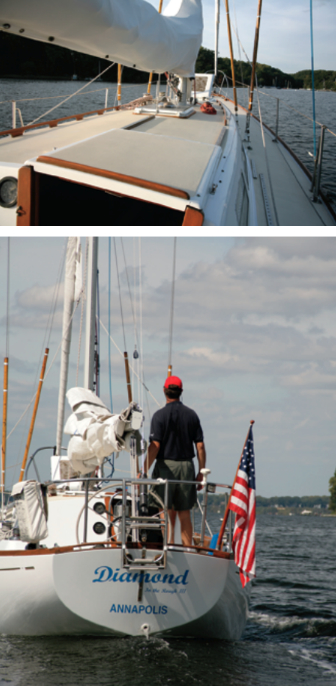
Jim says, “That boat should have been named Driven, because that’s what I was. I worked on it every day except for Linda’s birthday, Mother’s Day, some of Father’s Day, and Christmas.” Instead of Driven, the Cal 36 was named Diamond. But after Jim raced her for a season and was disappointed by the less-than-stellar race results, superstition stepped in. “Notice how he added the rest of the name as an afterthought,” Linda notes while observing the boat’s stern. “That’s why.” These days Jim is sailing Diamond in the Rough III, and her race record is much improved.
Good old workboats
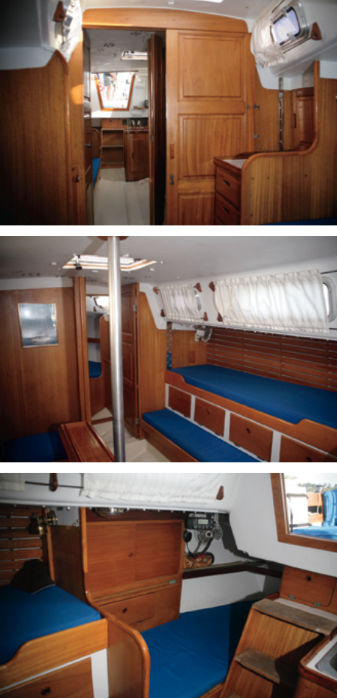
“Workboats,” Jim says. “They should be called workboats. Because from the day you buy ’em to the day you sell ’em, that’s what they are.” The first year with Diamond in the Rough III, Jim rewired, replumbed, got the old Atomic 4 running soundly, and painted the interior. “That first year I had her up and running and looking good again,” Jim says. “After that, the work was less intense. The projects were more fun.”
The next year involved replacing the halyards, replacing the original wooden spreaders with aluminum ones, sanding and varnishing, adding a barrier coat, and doing cosmetic work on the interior wood. Another year, Jim overhauled the mast, basically renewing the whole system including new wiring, new chainplates, internal halyards, and a paint job.
There was the dining table project, which required taking what Jim describes as a “huge” dining table and cutting it down to a more reasonable size by cutting off 11 inches and adding a drop leaf.

There’s a diesel engine in the long-range plan. But the 25-year-old Atomic 4 is still working, so why not wait another year or two? “And I will want radar sometime,” Jim says. After a moment he adds, “. . . and a dodger . . . a chart plotter . . . a new rigid inflatable boat (RIB) . . .” A workboat indeed.
Why trouble yourself continually improving a boat that is already bringing home silver in the local racing fleet? Jim is quick to reply: “When I retire we’d like to sail Diamond to Maine and to the Bahamas. If we can do that, I’ll be happy . . . or should I say, more happy and proud of Diamond in the Rough III.”
Karen Larson didn’t become passionate about sailing until she met Jerry Powlas. They bought a C&C 30 soon after they were married and (within the limits of a sailboat and short vacations) have been sailing farther and farther afield ever since. They hope to increase their potential range with a trailerable C&C Mega 30, the infamous “project boat.”
Thank you to Sailrite Enterprises, Inc., for providing free access to back issues of Good Old Boat through intellectual property rights. Sailrite.com