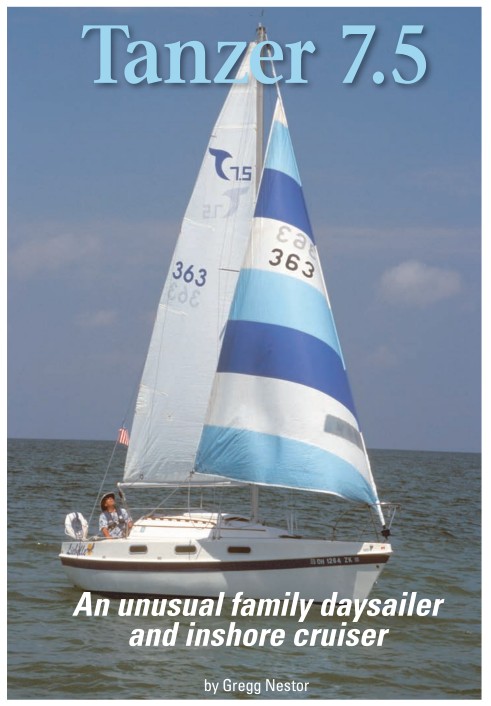
An unusual family daysailer and inshore cruiser
Issue 52: Jan/Feb 2007
JOHANN “HANS” TANZER WAS AN Austrian, who designed, built, and raced small sailboats in Switzerland. In 1956 he emigrated to Canada with $5 in his pocket, a tool chest, and a “head full of designs.” He settled in Dorion, Québec, where he went into business under the name Tanzercraft. It was here that Hans built Flying Scots, Lightnings, International 14s, and Y-Flyers.
Recognizing the need for a boat that was more “family friendly” than his current offerings, around 1963 he designed and built the Constellation. The boat was well received and sales were strong. In 1968, Hans expanded and changed the name of his company to Tanzer Industries Ltd., and the name Constellation to Tanzer 16. Production of the Tanzer 16 continued until 1985, with a total of nearly 1,900 units having been built.
In 1970, Hans launched his most successful model, the Tanzer 22. Like its predecessor, the Tanzer 22 continued in production until 1985 and accounted for 2,270 units. Buoyed by these numbers, in 1975 Hans introduced the Tanzer 26 and in 1977 our review boat, the Tanzer 7.5 (24 feet 6 inches). These boats were similar in design and targeted sailors who wanted to move up in size from Tanzer’s smaller models. About 790 Tanzer 7.5s were built during its production run, which also lasted until 1985.
Tanzer Industries Ltd. continued its strong presence in the Canadian sailboat industry with a steady supply of orders and several new models. To meet demands, the company further expanded to include production facilities on both U.S. coasts as well as in Canada.
In 1986, however, there was a general slump in the sailboat industry. In May of that year, just one month after C&C Yachts went into receivership, Tanzer Industries Ltd. declared bankruptcy. The company’s assets were sold to an auction firm, and Tanzer Industries was no more.
Design and construction
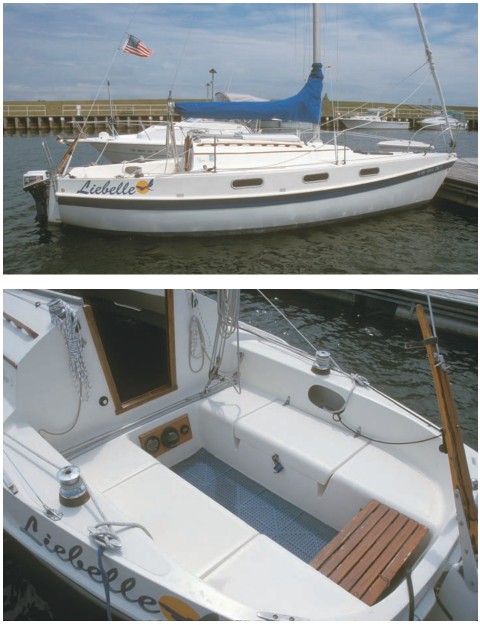
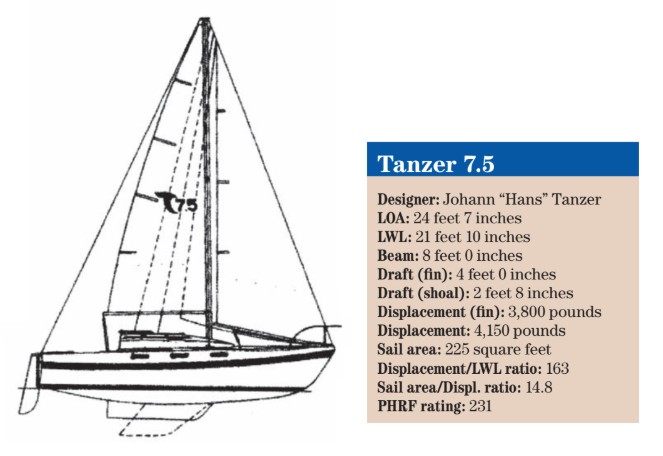
The Tanzer 7.5 has neither a traditional profile nor a contemporary go-fast appearance. While many sailors find the look of the Tanzer 7.5 not to their liking, others firmly believe that its lines were about 10 years ahead of their time in terms of shape and performance. Whatever the case, one can only surmise that Johann Tanzer drew the lines to a shape he felt was practical. Like the Tanzer 22, the deck of the 7.5 is raised, with its sides forming additional freeboard above the hull-to-deck joint. It has a small cabin, bold waterline and sheer stripes, an outboard spade rudder, and a swept fin keel.
You’ll find nothing out of the ordinary when it comes to the basic construction of the Tanzer 7.5. The hull is a solid, hand-laid laminate of fiberglass and polyester resin. The deck is also a hand-laid laminate, cored with balsa. This reduces weight, while providing structural stiffness. The hull-to-deck joint is a matching pair of outward-turning flanges that are bonded with adhesive, riveted together, and covered with a “clip-on” extruded PVC rubrail. Because of the boat’s raised-deck design, the finished hull-to-deck joint is a foot below the actual deck surface.
As is quite common in boats of this size, the Tanzer 7.5’s interior incorporates a molded fiberglass pan and headliner. When properly bonded in place, these two components enhance the structural integrity of boat; make up interior features, such as berth foundations; and impart a finished look. The flip side is the tendency to cause condensation and the inhibition of customization. Early models had their bulkheads veneered with a wood-grained laminate, while later versions were covered with real teak veneer. Both are over marine-grade plywood.
Underwater, the Tanzer 7.5 is fitted with either a 4-foot fin or a 2-foot 8-inch shoal-draft keel. Both are cast iron and externally fastened. While the fin keel weighs in at 1,600 pounds, the shoal-draft keel weighs 1,950 pounds. This difference in ballast is designed to impart the same degree of stability, no matter which keel configuration is chosen.
The deck hardware is of average quality. However, some of the through-bolted fittings lack proper backing plates. This was the case with the review boat’s bow pulpit.
Deck features
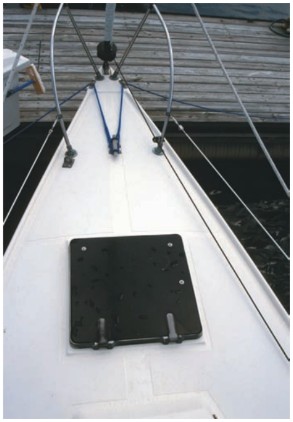
The design of the boat makes for a very narrow and pointy foredeck that is taken up almost entirely by the large forward hatch. Situated in the center of the remaining foredeck space is a single mooring cleat. The small cabin structure is cambered and narrow, leaving little room for walking on its top. Fortunately, there are 14-inch-wide sidedecks on which to move fore and aft. These are reasonably wide for a boat of less than 25 feet. To aid in moving about the deck, there’s a pair of cabintop teak handrails and molded-in non-skid.
The boat features six non-opening portlights, three per side. Rather than being situated in the cabin trunk, these elongated oval ports are mounted in the raised portion of the deck just above the hull-to-deck joint.
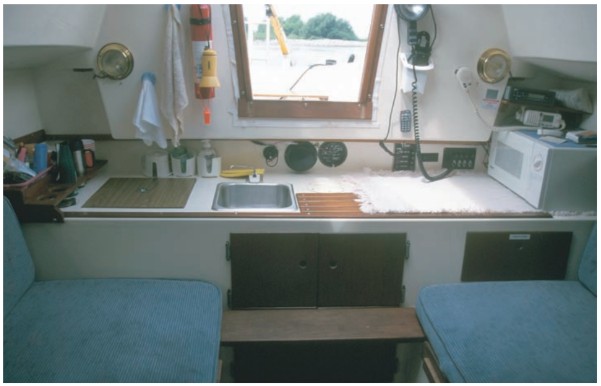
One of the boat’s best features is its 6-foot long cockpit surrounded by reasonably high coamings. Coupled with tiller steering, the cockpit is obstruction-free, spacious, and can comfortably accommodate six people. For stowage, there’s a pair of deep cockpit-seat lockers that connect with each other beneath the cabin sole. This creates a cavernous space in which to stow sails and other bulky items. Small items can be conveniently stowed within easy reach in a pair of port and starboard coaming cubbyholes. Surprisingly, with all the available space, there’s no dedicated fuel tank locker. When a remote tank is used, as is most commonly the case, it is stowed in the aft portion of the footwell, beneath a slatted teak seat.
At the threshold of the companionway is a token bridge deck — token in that it is only wide enough to provide a mounting place for the traveler.
Other deck features include a bow pulpit and single lifelines, a transom-mounted swim ladder to starboard, and an engine bracket to port.
Belowdecks
Below, it becomes immediately clear that the Tanzer 7.5 is laid out for a crew of two or possibly a couple with two small children. This arrangement is predictable and straightforward.
The forward cabin houses a kid-sized V-berth with filler and stowage beneath, a pair of outboard shelves, a hanging locker to starboard, and a portable toilet to port. A few boats were fitted with the optional marine head. Jim Bridgens, the owner of our review boat, has relocated the portable toilet to the floor space beneath the V-berth filler, and converted the area vacated by the portable toilet on the port side to shelving. The result of this is a very workable arrangement that considerably increases the amount of easy-access stowage.
The forward cabin is separated from the saloon by a bulkhead and a saloon-type door. When closed, the door offers privacy to each compartment. When open, it functions as the door to the hanging locker. Because the door neither reaches all the way to the sole nor extends to the overhead, it does not impede air circulation when closed.
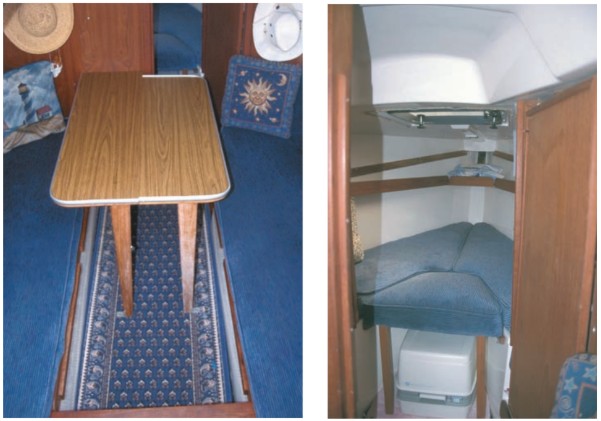
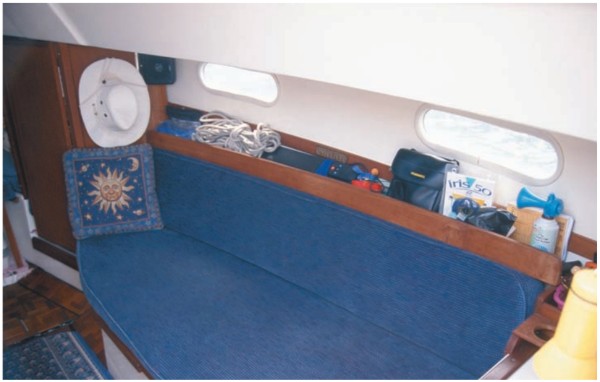
There are opposing settees in the saloon and a folding table that is mounted on the port bulkhead. When in use, the table reaches both settees and can comfortably accommodate four people. The settees are 6 feet long and can function either as single berths or, by inserting a plywood base and rearranging the cushion backs, can be converted into a large double berth or playpen. For stowage there’s a pair of outboard shelves and bins beneath the settees.
The galley is simple and functional, spanning the aft portion of the cabin. It features a single stainless-steel sink with pressurized cold water, a top-loading icebox that drains into its own holding tank underneath the starboard settee, and plenty of counter space, including an area for a countertop stove.
There’s stowage beneath for galleyware and cooking utensils. The 10-gallon freshwater tank is located in the forward portion of the port cockpit locker and is filled from the deck.
With the exception of the bulkheads and trim, all the boat’s interior surfaces are the same smooth gelcoat as the fiberglass pan and overhead liner. The raised deck contributes significantly to the boat’s 5-foot 8-inch headroom.
The rig
The Tanzer 7.5 is a masthead sloop. Its mast, which reaches a height of 32 feet above the water, is stepped on deck in a hinged tabernacle. This is supported belowdecks by a teak compression post. The mast features a single pair of spreaders and is held in place by a pair of cap shrouds, dual lower shrouds, a headstay, and a single backstay that’s significantly offset to starboard.
The mainsail came standard with a single set of reef points and jiffy reefing. The original halyards were external wire/rope and are good candidates for an upgrade to today’s low-stretch ropes. A pair of single-speed Barlow #15 halyard winches is situated on the aft edge of the cabintop.
Tracks and cars for the headsail are on the sidedecks and lead to a pair of single-speed Barlow #16 primary winches mounted on the port and starboard cockpit coamings. The mainsail has end-boom sheeting led to a traveler on the bridge deck.
Under way
While the Tanzer 7.5 is a trailerable pocket cruiser and not a racer, it is a steady performer. On a broad reach, the boat is fast, balances easily, and exhibits little pressure on the helm. Approaching 45 degrees apparent wind, the boat’s speed drops off. Backing off about 5 degrees will increase boat speed.
The Tanzer 7.5 handles the wind quite well, especially the fi n-keel model. At about 18 knots of windspeed, however, it would be prudent to shorten sail. This will allow the boat to straighten up, sail on its feet, and reduce any developing weather helm.
The boat is a coastal cruiser, however it has made a few notable passages. One owner sailed his Tanzer 7.5 single-handed from Canada to France and back.
When considering the addition of an outboard motor, a 9.9-hp is sufficient and will easily move the boat along at hull speed at two-thirds throttle. It also will have enough power to enable the boat to punch through head seas.
Things to check out
As is the case with any boat that has a deck cored with balsa, sound it carefully to determine if water has penetrated the core and caused any skin delamination.
The outward-facing hull-to-deck joint is prone to damage and has been known to leak. If the rubrail covering the joint is damaged, wavy, or has been replaced, slide it off and scrutinize the joint below. Also, water stains in the cabin are a dead giveaway.
Some through-bolted deck fittings were installed without backing plates. In some cases this will be obvious and easily remedied. In others, the overhead liner may pose a problem.
There have been several reports of leaks at the seam joining together the two halves of the fiberglass rudder. Since the rudder is transom-mounted, it’s a simple matter to remove it for inspection and to check its weight.
Conclusion
The Tanzer 7.5 is neither trendy nor flashy. Its overall construction is sound, and there are no major flaws or problem areas common to this model. It makes an acceptable first sailboat and represents a good value. Expect to spend between $6,000 and $9,000 for a reasonably cared for and outfitted Tanzer 7.5.
Thank you to Sailrite Enterprises, Inc., for providing free access to back issues of Good Old Boat through intellectual property rights. Sailrite.com