Eradication attempts wither to a ritual cleansing
Issue 110 : Sept/Oct 2016
I have morning rituals when cruising. Though I try to sleep late, I usually rise with the sun, but with deliberate care so as not to wake my spouse. After a little yoga in the pilothouse, I can delay the inevitable no longer. I make my way down the stairs into the saloon, up the back stairs, and out onto the rear deck. By the time I get there, I have run the gauntlet of several interior spiderwebs.
I’ve tried to disrupt these denizens of every inside crevice since 2004 — our first season on Carrie Rose, our 32-foot Nordic Tug — with limited success. Like Darwin’s finches isolated on the Galapagos Islands, my spiders must by now be their own genus and species. I reach the rear deck with these thoughts in mind. This is a lot of mental baggage to carry around just to go look out back.
Carrie Rose has been on the move for the last four summers, so every day brings a new vista. If we’re anchored, I do a position check. If we’re in a marina or tied to a wall, I look at the fenders and lines. Either way, I find I am looking through a fine mesh of spiderwebs.
I feel like Gulliver tied down by the Lilliputians. These determined little beggars spend dusk to dawn encasing the boat in a silken cage. By this time in the morning, they have descended into their lairs. Rarely do I see a spider, just their handiwork.
Morning is the time to rid the boat of the fibrous remnants of a night spent gorging on the insect prey du jour. I open the rear deck box and grab my tools.
In search of a tool
Each season, my quest for the proper way to clear the boat of spiders began anew, the way our humanoid ancestors must have first developed tools. I started by using my hands, moved on to boathooks and sail battens, and from there to brooms, brushes, and mops.
Then came the chemical warfare stage. From well-known but ineffectual shelf brands, the products I used quickly progressed in their lethality. This approach ended with a spray bottle that had a name like a Kung Fu movie sequel. I could spray it at any random spot on the boat and several spiders would instantly drop dead onto the deck. This substance was eventually banned by our local marine store due to its devastating effect on gelcoat. But if you looked like you could be trusted not to squeal, the store manager would quietly sell you a bottle from his stash. It worked, but I had to make sure I was standing upwind of the spray. Eventually its toxicity (never mind the gelcoat damage) made me cease and desist. The search for the proper tool for eradicating arachnids has taken up much of my boating career, but I finally discovered an efficient and non-toxic solution.
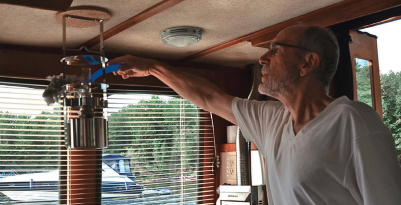
I was back to square one when I noticed my wife’s new cleaning device. If memory serves, Charlotte bought it to address another futile task: cleaning window blinds. It has a translucent baby-blue handle with a central hinge that sounds as if it might break each time it’s unfolded. The working end is a fuzzy variegated fibrous sheath about 8 inches long. It looks electrostatic and seems like it should be sticky to the touch but is not. The contraption weighs about an ounce and is surprisingly durable. It is a Swiffer Duster.
I no longer search for webs to eradicate. I simply use this duster to outline the borders and crevices of the entire boat. I start in the stern, move up to the deckhouse roof, and work my way forward. The fibers grab every gossamer thread. Along the way, I do not hesitate to squash any errant spider I dislodge from its hiding place. My other tool is an artificial chamois I use to clean the deck of spider remnants and poop.
I complete this ritual daily. I have learned not to let the spiders get the better of me. Given half a chance, they multiply in droves while growing to intimidating sizes. The de-webbing takes about 15 minutes with the added benefit that I get to inspect the entire boat. I can’t think of a more satisfying way to watch the sunrise.
Dean Raffaelli started sailing on Lake Michigan at age 11. He previously owned a Halberg-Rassy Monsun 31, and had thoughts of doing the Great Loop. He now owns a 1990 32-foot Nordic Tug. Carrie Rose wintered at Kent Island, Maryland, prior to a summer cruise on Chesapeake Bay.
Thank you to Sailrite Enterprises, Inc., for providing free access to back issues of Good Old Boat through intellectual property rights. Sailrite.com