Don’t forget — the advantage always goes to the buyer
Issue 52: Jan/Feb 2007
IT WAS IN 1995 THAT I STARTED looking for my first big sailboat. I had previously owned a 14-foot Flying Junior and a 20-foot O’Day pocket cruiser, but this would be my first real “bay boat.”
As I was somewhat naive about the boat-buying process, I jumped at the chance when a friend, familiar with the art of buying and selling boats, volunteered to help. My first lesson under his tutelage was one that has served me well ever since.
One of the first boats we looked at was a 1980 Hunter 30. The boat had been well used and had received little in the way of maintenance or care. In a word, it was “trashed.” While it appeared structurally sound, it needed a lot of cosmetic work that I was willing to do if the price was right. The asking price of $20,000 was average for the market at that time.
We asked the broker for a private moment while we discussed the possible purchase of the boat. Though this was one of the first boats we had seen, I had boat-buying fever and was chomping at the bit to make the purchase. “Slow down, slow down,” my friend counseled. “There are a million boats out there, and we’ve just started to look.” My friend was a little amused by my over-anxious attitude and said, “Let me handle this. Don’t say anything. Just listen. We’ll have some fun with this.”
Low-ball offer
When the broker returned, my friend looked him straight in the eye and said, “We’ve estimated what it will take to get this boat back in shape. We figure it will cost around $13,000. We’d like to offer $7,000 for the boat. The offer is good for 24 hours. After that, we’ll be moving on to bigger and better things and will no longer be interested.”
I thought to myself, “$7,000? Is this guy nuts? And why give him a 24-hour deadline?” The broker said he would take the offer to the owner but wasn’t optimistic. I handed over a good-faith check for $500, and we left.
I was pretty disappointed. I wanted the boat and figured there was no way I would get it, considering the way my friend had handled the deal. However, bright and early the next morning, I received a call from the broker. The owner had accepted the offer. The 24-hour time constraint had intimidated him out of even coming back with a counter-offer.
In spite of this, I didn’t buy the Hunter. My friend wisely insisted I keep looking until I’d had a chance to see more boats. I told the broker I had changed my mind, and he destroyed my check for $500. A good faith deposit is generally required with any offer, but one should always get a confirmation from the broker that the check will be returned or destroyed if the offer falls through.
No reputable broker would keep a good faith deposit, regardless of the reason for not consummating an offer by buying the boat. There is no legal obligation to buy a boat once an offer has been made and accepted. There are simply too many contingencies in the contract one signs when an offer is made, the most outstanding being the results of the survey.
I eventually bought a 1990 Ericson 32 and was grateful that my friend had reined me in. The Ericson was a great boat, was more seaworthy than the Hunter, and needed little work. The icing on the cake was that three years later I sold the Ericson for $10,000 more than I had originally paid.
Lessons learned
Making a profit on a used boat is not the norm. However, I had purchased my boat at a good price and in the process had learned a couple of very valuable lessons from my friend.
First, I learned to take my time and look at many boats before making a purchase. In this way, I was able to learn what was available, what the market was like, what I liked, and what truly suited my needs, rather than letting the excitement of fulfilling my dream cause me to act hastily.
Second, I began to realize that there were a whole lot more boats out there for sale than there were buyers; and that in the world of used-boat buying, the advantage always goes to the buyer.
Buyer’s market
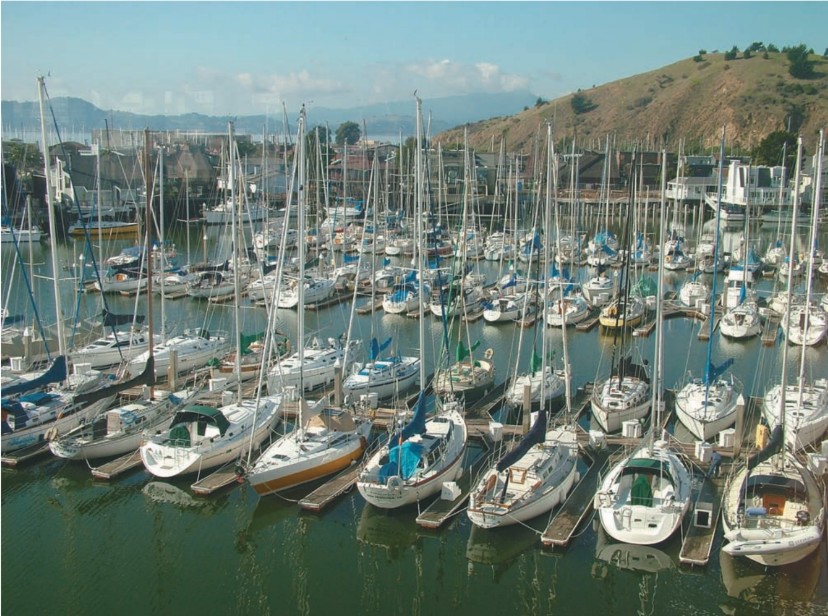
We often hear the terms “buyer’s market” and “seller’s market.” It’s a seller’s market when there are fewer boats available on the market for sale than there are buyers, requiring buyers to compete. It’s a buyer’s market when there are more boats available for sale than there are buyers, in which case buyers can expect the advantage.
It’s always a buyer’s market in the used-boat world, regardless of what the broker may tell you.
Used vs. new
If you think a new boat is the way to go, consider this: a new boat loses 30 percent of its value in the first year of ownership. Sales tax and annual property taxes can be double (and even triple) the costs compared with buying an older used boat, and new boats require wheelbarrows full of money to outfit them with required electronics and safety gear.
Used boats cost less to buy, have higher resale value (the resale value for a 20-year-old boat is pretty much constant from year to year), have all the seaworthiness of a new boat, and generally come with loads of equipment, like extra sails, electronics, tools, tenders and life rafts, life jackets, and so on.
Of course, a used boat may require some work. A familiar bit of wisdom recited in the boating industry says, “There is nothing that time and money cannot fi x.” This is true. If an owner is willing to do most of this work, however, his time will require no capital outlay. Most of the skills required to do what needs to be done on a used boat are well within the ability of most boatowners. The rest can be learned by actually performing the work.
What a boat should cost
The average sale price for a boat manufactured 20 or more years ago has pretty much stabilized. A boat’s fair market value is available to boat buyers from several sources. One source is the BUC book, which is like a boat bluebook. The pricing information found in the BUC book is provided by boat brokers nationwide and reflects retail, or broker-listed, prices. In this sense, the brokers somewhat artificially set the prices found in the BUC book. Several Internet sources are available that can help determine used boat pricing. Some of these include Yacht World, NADA Appraisal Guides, and the BoatU.S. Boat Value Check.
The offer
Before an offer is made, review one or more of these sources to determine the current fair market value for the boat under consideration. On a first offer, prior to completion of a survey by a professional surveyor, the general rule of thumb is to offer two-thirds of the boat’s fair market value. Of course, this will depend on the condition of the boat and what you, as the buyer, are willing to pay.
But don’t hesitate to make what might be considered a “ridiculous offer.” An offer of this type is never ridiculous to the buyer who gets the boat at his price. It’s all a matter of perspective.
A buyer should never feel intimidated (particularly by the broker whose job is to talk a buyer into paying more) for making an offer that is “too low.” No offer is too low.
Don’t let the broker (or owner/seller) see that you have any doubts about your offer. If you don’t believe your offer, no one else will. Be firm and confident. You can always change your number after hearing the counter-offer. There is no loss-of-face in raising your offer after the counter-offer is made (and there’s also no disrespect associated with sticking to your guns — remember, there are a million boats out there for sale).
Surveys, loans, insurance
If you plan to borrow money to purchase a boat, your lending bank will require a survey by a licensed surveyor before lending money. An insurance provider will also require a survey to establish a baseline for the boat’s worth and condition and to verify that it is a seaworthy craft.
When a bank grants you a mortgage loan on a boat, the bank will require that you purchase insurance for the boat in order to protect the bank’s investment from loss. If you do not obtain insurance when the purchase is made, the bank will buy insurance through its own provider and bill you. It is for this reason and, more importantly, to protect you, as the buyer, from the possibility of loss, that insurance should be lined up and ready at the time of purchase.
Even if you pay cash for a boat, liability is still an issue. Most marinas require proof of liability insurance coverage (a minimum of $300,000), with the marina named as “additional insured” before allowing your boat to stay in a slip there. A better idea is to protect your investment by purchasing comprehensive coverage for your boat, unless you can afford to bear the financial burden of a total loss.
After the survey has been completed, it’s time to revise your offer . . . down. No surveyor worth his fee has ever performed a survey on a used boat without finding something that needed repair or replacement.
This occurs for three reasons: first, the surveyor wants to maintain his professional credibility (and job security). Second, the surveyor is likely to be an honest, competent individual who wants to give customers the best possible service (the surveyor’s next job may depend on it). Third, finding a used boat that does not require at least some small amount of repair is highly unlikely.
The net result is that your final offer is generally less than the first offer due to the cost of needed repairs discovered by the surveyor. This happens in 99 percent of used boat purchases. The broker presents the buyer’s final offer to the seller. The seller either accepts this offer, or negotiations continue until an agreement is reached.
Upgrades, improvements
If a seller has added lots of expensive gadgets and “go-fast rigging,” these upgrades do not necessarily increase the value of the boat. (From an owner’s perspective, the general rule of thumb is that total investment should not exceed fair market value). This does not mean that you should not consider investing your own labor into the repair and renovation of a used boat. This work is, after all, a labor of love.
The bottom line is that you can purchase an older boat, enjoy it for many years, treat the work that goes into maintaining and improving your boat as an avocation or hobby, and resell it without taking a beating. However, expecting to make a profit from your labor is not realistic in the world of used boats.
Consider my most recent project as an example. I have more than 2,000 hours of my own labor invested into the restoration of my 1977 Hans Christian 38T. Boatyards charge $50 to $70 an hour for labor. Therefore, the labor I have performed on my boat would cost at least $100,000 if done by a boatyard. At the time of this writing, the fair market value for a 1977 HC38T in excellent condition was around $100,000. If I had paid fair market value for my boat and had then hired a boatyard to make the repairs and upgrades, my total cost would have been $200,000. This is double what I can realize from the sale of my boat.
However, I didn’t pay fair market value for my boat. I purchased my boat at two-thirds its fair market value, or $65,000. This allowed me to plow another $35,000 hard cash into this project without losing money. Performing my own labor allowed me to use the money saved for the purchase of hardware and equipment. How else could an average guy like me get the equivalent of a brand-new boat (costing $200,000 to $300,000) finished and ready to sail anywhere in the world for $100,000?
The added benefit is that I have had the opportunity to get to know my boat and its systems inside and out. In the process, I’ve gained the confidence and knowledge needed to perform my own repairs. I have educated myself through firsthand experience gained by working on my boat.
Bottom line
Of course, it isn’t necessary to restore a used boat to Bristol condition to sail her and enjoy her. Boatowners are at liberty to put more or less effort into their projects, depending on their desire, expectation, and ability.
I required a sailboat that was structurally superior, safe, seaworthy, and capable of open-ocean passage-making. I chose a cost and labor effort that matched my resources and abilities. Someone else with different needs and abilities might choose to pay a great deal less for a good used boat, add a few hundred dollars in repairs and amenities, and have many years of boating pleasure.
Secrets for used boat buyers
- Know the fair market value of your purchase.
- Before making an offer, carefully analyze what repairs and improvements are required to make the boat meet your needs.
- Avoid exceeding fair market value with the combined cost of the boat and the needed repairs and improvements.
- Invest your labor freely and enjoy the sense of pride and accomplishment you experience as a consequence.
- Slow down, take your time. Remember not to rush, because there are a million boats out there and the advantage always goes to the buyer.
Thank you to Sailrite Enterprises, Inc., for providing free access to back issues of Good Old Boat through intellectual property rights. Sailrite.com